| En Français | Home/Contact | Billiards | Hydraulic ram | HNS | Relativity | Botany | Music | Ornitho | Meteo | Help |
Here is an introduction to strategy games.
This collection brings together single-player and multiplayer games for which a strategy is known : either a winning strategy for one of the two players, an optimal strategy, or simply a rational one.
Contents :
B2.1. Pawn games :
The following pawn games all have a winning strategy for one of the two players.
B2.1.1. 17 matches game :
17 matches game is a two-player strategy game with a winning strategy depending on the chosen variant.
Rules of the game :
Two players face a pile of 17 matches.
Players take turns, each removing 1, 2, or 3 matches.
Two variants then exist :
V1. The player who empties the pile wins the game.
V2. The player who empties the pile loses the game.
Winning strategy :
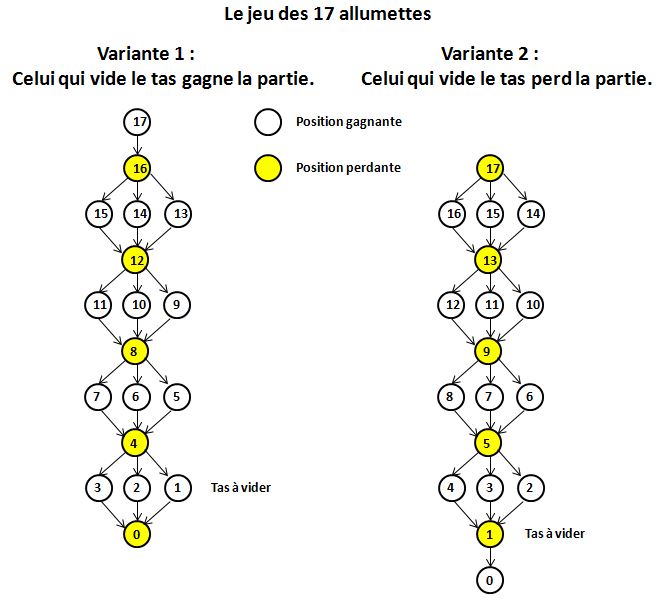
V1 : the first player wins by always returning the game to a multiple of 4 matches (i.e., 16, 12, 8, 4, 0).
V2 : the second player wins by always returning the game to a multiple of 4 + 1 matches (i.e., 13, 9, 5, 1).
Explanation :
The game can be represented by a directed graph (called options graph), where each vertex corresponds to a game position n (number of matches remaining) and each edge corresponds to a possible move (going from position n to n - 1, n - 2, or n - 3). See Figure above.
Two types of positions are distinguished :
- A winning position (G in white) when there exists at least one move leading to a losing position (P in yellow).
- A losing position (P) when all possible moves lead to winning positions (G).
Variant V1 :
Position 0 is losing for the player whose turn it is (they cannot move and have lost).
By working backwards through the graph, we observe that :
- 1, 2, and 3 are winning,
- 4 is losing,
- then, by induction, all multiples of 4 are losing positions.
These losing positions correspond exactly to those with Grundy number (denoted 'mex') equal to zero (since it is an impartial game), which explains why the player who can identify them can always force a win.
Variant V2 :
Position 0 is winning for the player whose turn it is (they win without moving since the opponent took the last match).
By working backwards through the graph, we observe that :
- 1 is losing,
- 2, 3, and 4 are winning,
- then, by induction, all positions of the form 4 k + 1 are losing (with k a non-negative integer).
Here too, these losing positions are exactly those with Grundy number zero, explaining the periodicity modulo 4.
Grundy number :
In an impartial game (like the 17 matches game), the Grundy number g(n) of any position n is defined as the mex (minimum excludant) of the Grundy numbers of its positions reachable in one move, where mex denotes the smallest natural integer absent from the set.
Any position with no possible moves also has a Grundy number equal to 0.
Applied to the 17 matches game, this leads to the following recurrence relation :
g(n) = mex{g(n - 1), g(n - 2), g(n - 3)} pour n ≥ 1
Variant V1 :
g(0) = 0 since no move is possible from position 0, hence the result : g(n) = n mod 4
Variant V2 :
g(1) = 0, hence the result : g(n) = (n - 1) mod 4
Interpretation : Positions with Grundy number zero are exactly the losing positions. The winning strategy therefore consists of always moving to return the opponent to a zero-Grundy position.
B2.1.2. Heap game :
Heap game, also known as Nim or Marienbad game, is a winning strategy game for two players based on simple and fascinating mathematical principles.
Rules of the game :
Two players are presented with several heaps of objects (stones, cards, matches, scallop shells). The number of heaps and the number of objects per heap are arbitrary.
Players take turns, and each player removes as many objects as they wish (but at least one) from a single heap.
The player who empties the last heap wins the game.
Winning Strategy :
The winning method relies on a specific addition operation called "Nim_addition". We calculate the XOR sum of the heap sizes written in binary notation (that is, bitwise "exclusive OR", where the result bit is 1 if and only if the bits are different).
If this Nim_addition is zero, the position is a losing one (called an "even" position). Otherwise, the position is a winning one ("odd" position), and there is always at least one action that can bring the Nim_addition back to zero.
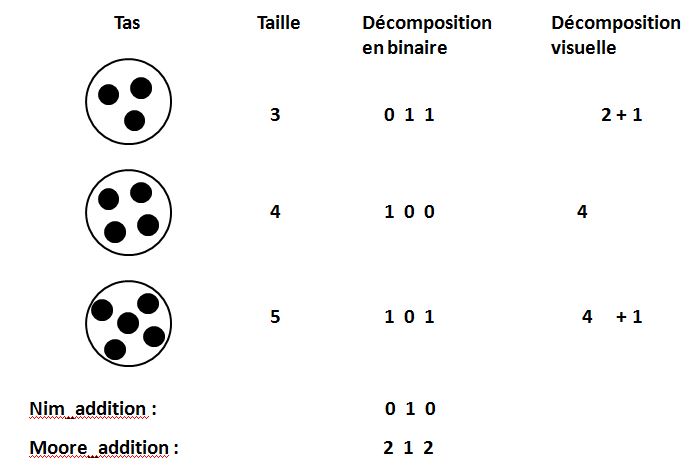
Example (see Figure above) : Consider three heaps of size 3 (011 in binary), 4 (100 in binary), and 5 (101 in binary). The Nim_addition (denoted "⊕") is : 3 ⊕ 4 ⊕ 5 = 2 (10 in binary), which is not zero. The first player can therefore win by adjusting the size of one of the heaps.
A more visual way to do this is as follows [DEL1]. We decompose each size into sub-heaps pi, each containing i objects, where i is a power of 2. This is equivalent to writing these sizes in binary notation.
For each power of 2, we count the total number of corresponding sub-heaps. A position is considered a losing position if this number is even for all powers of 2.
In the previous example, we have : 3 = p2 + p1 ; 4 = p4 ; 5 = p4 + p1. Here, the sub-heap p2 appears only once. To restore an even position, we must therefore remove this sub-heap, which reduces the heap of size 3 to 1.
Explanation :
Let n heaps be given, with ti being the size of heap i. The Nim_addition is : S = t1 ⊕ ... ⊕ ti ⊕ ... ⊕ tn
A legal move consists of choosing a heap m and modifying its size tm by a strictly smaller integer t'm, the other heaps remaining unchanged.
The initial Nim_addition S is then written : S = t1 ⊕ ... ⊕ tm ⊕ ... ⊕ tn
After the move, it becomes : S' = t1 ⊕ ... ⊕ t'm ⊕ ... ⊕ tn
Given the identity : tm ⊕ tm = 0, and the commutativity and associativity of the XOR operator, this can also be written :
(*) S' = S ⊕ (tm ⊕ t'm)
1. Case S = 0 : An even position always leads to an odd position.
Given relation (*), if S = 0, then we have : S' = tm ⊕ t'm
Since tm ≠ t'm, we necessarily have : tm ⊕ t'm ≠ 0, therefore S' ≠ 0.
.
The new position is thus odd.
2. Case S ≠ 0 : Starting from an odd position, there is at least one action leading to an even position.
If S ≠ 0, let r max be the rank of the most significant non-zero bit in S. In the previous example (S = 10 in binary), r max corresponds to the second rank from the right.
Therefore, there exists at least one heap m whose size tm has a bit equal to 1 at rank r max.
We then define a new size t'm = tm ⊕ S
At rank r max, there is a 1 in tm and a 1 in S, so the bit at rank r max becomes 0 in t'm. Furthermore, no higher-ranking bits are modified. We therefore have : t'm < tm, and this action allows us to play a legal move by reducing the size of the heap tm.
The relation (*) can then be written :
S' = S ⊕ (tm ⊕ (tm ⊕ S)) = (S ⊕ S) ⊕ (tm ⊕ tm) = 0
The new position is therefore even.
B2.1.3. Moore's Nim :
A generalization of the heap game, called Moore's Nim, is defined as follows [DEL1] :
Rules of the game :
On each turn, the player chooses between 1 and k distinct heaps (k fixed, example : k = 2) and removes at least one object from each of the chosen heaps.
Winning Strategy :
The method involves writing the size of each heap in binary (as in the heap game), then calculating a "Moore_addition" which is the vector obtained by adding the bits of each heap column by column modulo (k + 1).
The position is even (and losing) if all columns result in a remainder of zero, and odd (and winning) otherwise.
Example (see Figure above) : Suppose k is fixed at 2 and there are three heaps of size 3 (11 in binary), 4 (100 in binary), and 5 (101 in binary). The Moore_addition (denoted "⊕") is 3 ⊕ 4 ⊕ 5 = vector 212, which is not zero. The first player can therefore win by adjusting the size of one or two heaps, for example by removing 1 object from the heap of 4 and 2 objects from the heap of 5. The position then becomes : 3 ⊕ 3 ⊕ 3 = 0 which becomes even for the other player.
Explanation :
Let n heaps be defined, with ti = size of heap i, and k a fixed integer between 2 and n. The Moore_addition is : S = {c1, c2, ..., cr, ...} with cr = (number of heaps whose bit at rank r is 1) mod (k + 1)
1. Case S = 0 : An even position always leads to an odd position.
If S = 0, then for any rank r, the number cr of 1 bits is divisible by k + 1, which can be written as : cr = 0 mod (k + 1).
Let r max be the largest rank actually modified among the heaps chosen by the player. In this column, only the modified heaps can change bits. Since the player can modify at most k heaps, cr max varies by an integer with an absolute value at most equal to k.
Since no non-zero variation with an absolute value at most equal to k is divisible by (k + 1), divisibility by (k + 1) in this column is broken.
The new position is therefore odd.
2. Case S ≠ 0 : Starting from an odd position, there is at least one action leading to an even position.
If S ≠0, let r max be the rank of the most significant non-zero bit of S.
Let T be the set of heaps k whose size tk has a bit equal to 1 at rank r max.
Among these heaps, we can then choose a subset T' of 1 to k heaps such that, if we flip the bit at rank r max in each of the heaps of T' from 1 to 0 (by appropriately reducing these heaps), the new number of 1s in this column becomes a multiple of (k + 1).
We then proceed by descending induction on the ranks : for each rank r < r max, we adjust the same heaps (always by reducing them) so that the column r also becomes a multiple of (k + 1), without ever modifying the bits at strictly higher ranks that have already been fixed.
At each step, we act on at most k heaps, so this local correction is always possible, just as we "correct" the columns one by one in the heap set (k = 1) with the XOR operator.
At the end of this process, all columns have a number of bits set to 1 that is divisible by (k + 1).
The new position is therefore even.
Using the three heaps as the previous example (with k fixed at 2), the column-by-column correction process is as follows :
- The three heaps ti can be written in binary as follows :
t1 = 3 = 011
t2 = 4 = 100
t3 = 5 = 101
- Moore_addition gives S = 212, which is not zero (odd position).
- The maximum column r is 2 with T = {t2, t3}
- We can act on at most k = 2 heaps;. Here, these 2 heaps are sufficient with T' = T
- To make the second column a multiple of 3, we must remove the 1s from these two heaps.
One approach is to target the position {ti} = {3, 3, 3}, the only possible solution with k = 2.
We leave heap 1 unchanged, reduce heap 2 by 1 object, and heap 3 by 2 objects.
Note : For k = 3, there are several solutions leading to the positions {ti} = {3, 3, 3}, {2, 2, 2}, or {1, 1, 1}, respectively.
B2.1.4. Camel game :
The camel game, or "ten-franc coins" game, or "push-shell" game, is a variant of the heap game, defined as follows :
Rules of the game :
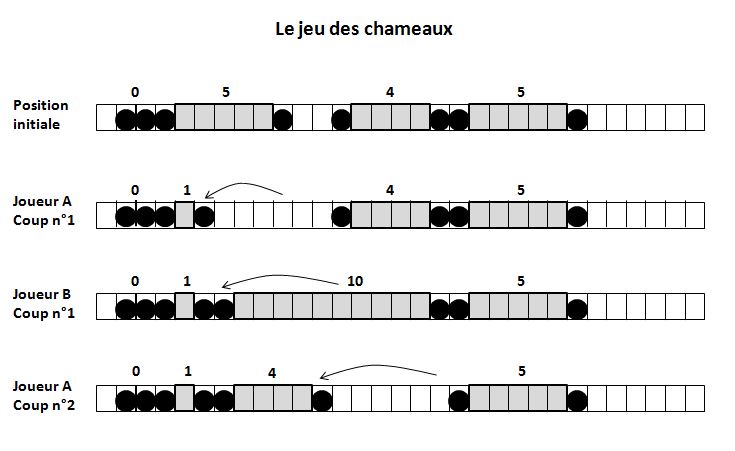
The game is played on a row of squares consisting of a starting square and several coins, one per square, initially placed at arbitrary distances between coins (see Figure above).
The number of coins must be even. In the odd case, a dummy coin must be added, placed just before the starting square.
Players take turns, each moving a single coin towards the starting square, one or more squares further, without jumping over the coin already in place.
This way of moving is analogous to a caravan of camels in single file across the desert, each animal following the other without being able to overtake it.
The game ends when all the coins are blocked.
The player who makes the last move wins the game.
Winning Strategy :
The winning strategy is to play like in the heap game, maintaining a position with zero Nim_addition, and, when a move modifies this reading by increasing a heap, to immediately make a restoration move to return to an Nim_equivalent position.
The methode is as follows [TRI1] :
1. The initial position is fixed. See the example in Figure above "Position initiale" = 0111000001001000011000001, with the starting square on the left, 0 representing a free square and 1 a square occupied by a coin.
2. Starting with the coin furthest from the starting square, form disjoint pairs of successive coins from the furthest square from the starting square, each coin belonging to only one pair, and then count the number of free squares within each pair.
This counting is equivalent to defining a set of heaps of objects. See Figure above "Position initiale" showing the configuration (0, 5, 4, 5) of these heaps.
3. Next, moving a coin along the row of squares is equivalent to removing as many objects as desired from one heap among several, the winner being the one who empties the last heap.
This rule of the game is exactly the same as that of heap game, and the goal is to reach a winning even position. See Figure above "Joueur A - Coup n 1" = 0111010000001000011000001, showing the move that leads to the winning configuration (0, 1, 4, 5) corresponding to the Nim_addition 0 + 1 + 4 + (4 + 1) = 0.
4. However, unlike the heap game, a move can increase the size of a heap.
See Figure above "Joueur B - Coup n 1" = 0111011000000000011000001, showing such a move resulting in the configuration (0, 1, 10, 5).
5. To return to an "equivalent Nim" position, it is necessary to cancel any move by the opponent that would increase the size of one of the heaps. To do this, the size of the heap must be reduced to its initial value.
See Figure above "Joueur A - Coup n 2" = 0111011000010000001000001, showing the move allowing a return to the previous winning configuration (0, 1, 4, 5).
B2.1.4. Dominoes :
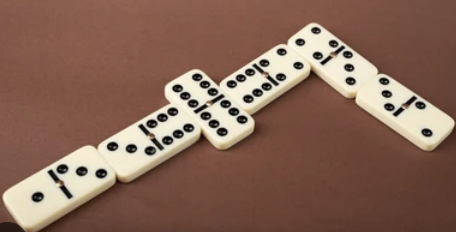
Dominoes are played with a number of players between 2 and 7.
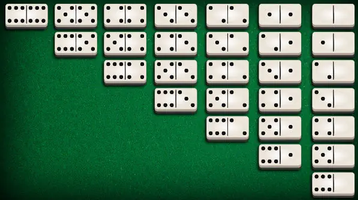
In the classic game, called "double-six" dominoes, the equipment consists of 28 flat rectangular tiles whose visible face is divided into two equal squares, each bearing a number of pips. Seven dominoes are doubles (0-0 or blank-blank, 1-1, ..., 6-6). The other twenty-one are mixed, with all combinations from 0-1 to 5-6, without repetition. See Figure 1 above.
The rules of the game are as follows [CLA][PER][CHA] :
Initial setup :
- All dominoes are spread face down on the table and then shuffled.
- Each player takes an equal number of dominoes : 7 for 2 or 3 players, 6 for 4 players, 5 for 5 players, 4 for 6 or 7 players, the remaining dominoes form the boneyard (or stock).
Starting player :
- Each player places their dominoes in front of them, visible only to themselves. The player holding the highest double plays it first, placing it face up on the table. This domino will be the first in a long chain. See example in Figure 2 above.
- If no player has a double, the player with the highest-value domino begins. In case of a tie in the sum of the two halves, the domino containing the highest single number takes priority (for example, 6-1 over 5-2).
Objective :
- Players take turns in order. The winner is the first player to place all of their dominoes on the table.
- If all players are blocked and the boneyard is empty, the player with the smallest total number of pips on their remaining dominos wins. If several players are tied for this lowest total, the round is declared a draw.
Game rules :
- Each player plays a single domino per turn, then passes the turn to the next player.
- Each player adds one domino to either end of the chain on the table, matching two faces with the same number. For example, if one chain end shows a 4, the player must play a domino containing a 4. Doubles are usually placed perpendicular to the chain (a visual convention).
- When a player cannot play a domino, they must draw a single domino from the boneyard and may play it immediately if it matches. Otherwise, they add it to their hand and pass their turn. If the boneyard is empty, a player who cannot play also passes their turn.
Winning strategy :
Dominoes is a game combining chance and strategy. Two levels of rules are proposed below [CLA][PER][CHA] : a simplified version, accessible to younger players, which consists, at each turn, in determining the best choice of domino and chain end, and an expert version which adds hand management over the course of the game.
|
Simplified version : At each turn, determine set E of the playable dominoes in your hand. Then apply : 1. Anticipate the next turn : Among set E, choose the domino and the chain end that leave open a number present on the greatest number of other dominoes in your hand, then play this domino. If no choice satisfies this condition, go to the next rule. If several choices satisfy it equally, go to the next rule while narrowing set E to the dominoes corresponding to those choices. Example : For the hand (0-1, 1-3, 1-4, 3-6, 2-5, 2-0, 6-4) and a chain with the numbers 3 and 5 at its ends, set E includes three playable dominoes: 1-3 (on the 3 side), 3-6 (on the 3 side), and 2-5 (on the 5 side). Playing 1-3 leaves the number 1 open, present on two other dominoes (0-1, 1-4). Playing 3-6 leaves the number 6 open, present on only one other domino (6-4). Playing 2-5 leaves the number 2 open, present on only one other domino (2-0). The best choice is therefore to play 1-3. 2. Play the doubles : Among set E, play the doubles. If no double is playable, go to the next rule. If multiple doubles are playable, go to the next rule while narrowing set E to these doubles. 3. Reduce the weight of your hand : Among set E, play the heaviest domino. If several dominoes of the same maximum value are equivalent, choose any one of them. Example : For the hand (3-5, 6-4, 0-1, 0-2, 1-2, 0-0, 1-1) and a chain with the numbers 3 and 6 at its ends, set E includes two playable dominoes: 3-5 and 6-4. Neither leaves open a number present on other dominoes in the hand (rule 1 not applicable), and neither is a double (rule 2 not applicable). The domino 6-4, the heaviest (10 points total), is therefore played. |
|
Expert version : At each turn, determine set E of the playable dominoes in your hand. Then apply : A. Dominoes to keep : - Scan the numbers from 0 to 6 appearing on the dominoes in your hand, and keep the isolated dominoes (that is, those containing at least one number that appears only once among all the dominoes in the hand) by setting them apart from the other dominoes. This rule preserves the diversity of numbers available in your hand for as long as possible. - The shared dominoes (that is, those containing no isolated number) are to be played first. - Note : A double cannot be an isolated domino, because its number already appears twice on the domino itself. Example with a hand of 7 dominoes (0-1, 1-3, 1-4, 2-6, 3-5, 2-0, 6-4) and a chain with the numbers 3 and 5 at its ends : - The only isolated number is 5, so the only isolated domino is 3-5. - By difference, all the other dominoes are shared (0-1, 1-3, 1-4, 2-6, 2-0, 6-4). Among them, only 1-3 is playable (on the 3 side). B. Dominoes to play : Examine the two numbers at the chain ends and determine which of the shared dominoes can be played (set E). Then apply the following rules to set E or, if it is empty, to the new set E of playable isolated dominoes : 1. Anticipate the next turn : Among set E, choose the domino and the chain end that leave open a number present on the greatest number of other dominoes in your hand (making it easier to place your other dominoes on the next turn), then play this domino. If no choice satisfies this condition, go to the next rule. If several choices satisfy it equally, go to the next rule while narrowing set E to the dominoes corresponding to those choices. Example : For the hand (0-1, 1-3, 1-4, 3-6, 2-5, 2-0, 6-4), with a chain having the numbers 3 and 5 at its ends, only one domino is isolated : 2-5. Two shared dominoes are playable : 1-3 and 3-6. Playing 1-3 leaves the number 1 open, present on two other dominoes (0-1, 1-4). Playing 3-6 leaves the number 6 open, present on only an other domino (6-4). The best choice is therefore to play 1-3. 2. Play the doubles : Among set E, play the doubles (a double can only connect on a single number, making it harder to place as the game progresses). If no double is playable, go to the next rule. If multiple doubles are playable, go to the next rule while narrowing set E to these doubles. 3. Reduce the weight of your hand : Among set E, play the heaviest domino (the one with the highest value, to limit your score in the event of a block). If several dominoes of the same maximum value are equivalent, choose any one of them. Example : For the hand (3-5, 6-4, 0-1, 0-2, 1-2, 0-0, 1-1) and a chain with the numbers 3 and 6 at its ends, there are two playable dominoes, both isolated : 3-5 and 6-4 (so rule B.1 does not apply). Neither is a double (rule B.2 not applicable). The domino 6-4, the heaviest (10 points total), is therefore played. C. Ongoing reassessment : At each turn, the "isolated" and "shared" categories must be reassessed as follows : 1. After each domino is played : Reapply rule A to the two numbers of the played domino, one or more shared dominoes possibly then becoming isolated. Example : - Playing a shared domino : Using the example from rule B.1, the domino 1-3 is played. Rule A is immediately reapplied to the numbers 1 and 3 : the number 1 remains shared (0-1, 1-4), but the number 3 now only appears on domino 3-6, which becomes isolated. - Playing an isolated domino : For the hand (6-4, 3-5, 0-1, 1-4, 0-2, 1-2, 0-0) and a chain with the number 6 at both ends, two dominoes are isolated : 6-4 and 3-5. No shared domino is playable and 6-4 is played (the only playable domino, rule B.3). Rule A is immediately reapplied to the numbers 6 and 4 : the number 6 no longer appears on any domino. The number 4 now only appears on 1-4, which becomes isolated. 2. After each unsuccessful draw : Reapply rule A to the whole hand, in order to determine the status (isolated or shared) of the drawn domino, and also to detect whether an isolated domino now shares a number with it. Example : For the hand (0-1, 2-0, 6-4) and a chain with the numbers 3 and 5 at its ends, if 2-4 is drawn (not playable), rule A is immediately reapplied to the whole hand : the number 2 is no longer isolated (shared with 2-0), and neither is the number 4 (shared with 6-4). The domino 2-4 becomes shared, as does the domino 2-0 (which loses its only isolated number, 2). However, 6-4 remains isolated thanks to its number 6, which has not changed. |
B2.2. Checkerboard games :
The following games are played on a standard 8 8 chessboard or on a 10 10 International Draughts.
B2.2.1. Northcott's game :
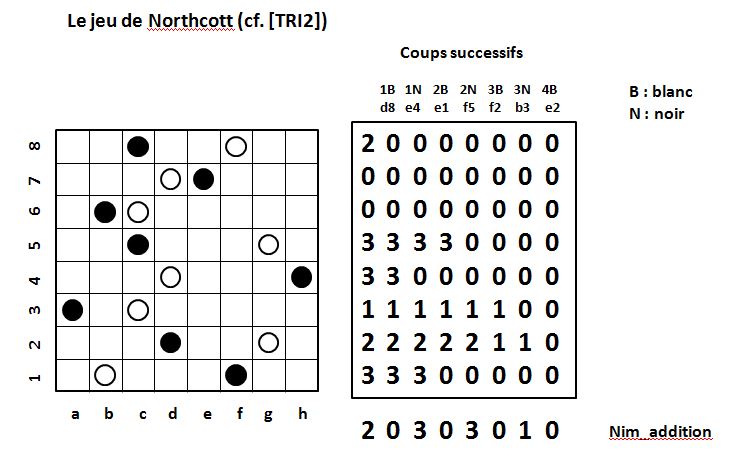
Northcott's game, invented by the American mathematician D.G. Northcott, is a variant of the heap game and camel game, defined as follows :
The rules of the game are as follows :
Initial setup :
The game is played on a standard 8x8 chessboard, with each player having 8 pawns, white for one player and black for the other (see Figure above).
The players place their pawns on the squares of the chessboard, one of each color per rank, without them occupying the same square. Thus, on each of the 8 ranks, there is one black pawn and one white pawn.
Objective :
The players take turns.
Each player chooses one of their pawns and moves it horizontally along their rank, any number of squares to the right or left, without jumping over the opponent's pawn.
The player who makes the last move wins the game.
In the original version, the game ends as soon as all the pawns are adjacent (even in the center of the ranks).
The edge-blocked variant extends the game until all the pawns are completely blocked at the edges of the chessboard. This rule makes the game more symmetrical and visually appealing.
Winning Strategy :
The method is exactly the same as in the heap game. Each rank corresponds to a heap whose size is the number of free squares between the two pawns (white and black) in that rank.
The optimal strategy is therefore to calculate the Nim_addition of these 8 values.
However, as in the camel game, the player can increase the size of a heap (by moving their pawn back), which does not change the strategy, as the situation can be restored on the next turn.
Example (see Figure above, cf [TRI2]) :
1. The initial configuration of the heaps is given by the first column of the table in the Figure. It is (2, 0, 0, 3, 3, 1, 2, 3) whose Nim_addition is 1 ⊕ 3 = 2 ≠ 0.
2. Assume that the white pawns belong to the winning player. To give their opponent an even position, this player must subtract 2 from one of the ranks, for example by moving their white pawn to position d8, leaving a configuration (0, 0, 0, 3, 3, 1, 2, 3) whose Nim_addition is 0 (see Figure above).
3. The subsequent moves for both players are given in the table of the Figure.
4. If the white and black pawns are all facing each other, but not all blocked against the edges of the chessboard, the player forced to move (Black) can only move one of the pawns back, increasing the number of free squares between the pawns, which the other player (White) immediately reduces to 0.
5. The game therefore ends in favor of the initially winning player (White), whether in the original version of the game or the edge-blocked variant.
B2.2.2. Wolf and Sheep :
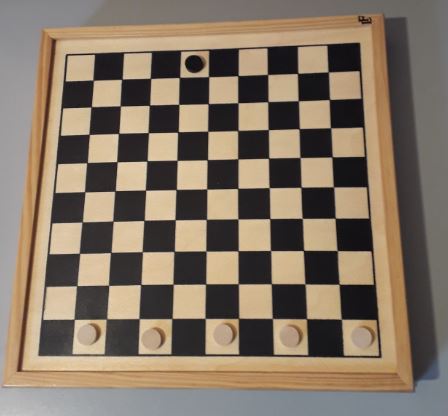
Wolf and Sheep is a winning strategy game for two players.
The rules of the game are as follows :
Initial setup :
The game of Wolf and Sheep is played on a 10 x 10 International Checkers board, oriented with a white square in the bottom right corner, and using only the white squares.
At the start of the game, the wolf (black pawn) is placed on one of the white squares on one edge of the board, chosen by the player controlling it.
The 5 sheeps (white pawns) are placed in a line on the 5 white squares on the opposite edge.
Objective :
Players take turns.
The wolf starts the game. Its objective is to cross the line formed by the sheeps and reach the opposite edge of the board, which is initially occupied by the sheeps.
The sheeps win if they manage to completely block the wolf.
Movement rules :
The wolf moves one square diagonally, either forward or backward.
The sheeps also move one square diagonally, but only forward.
Capture rules :
There is no capturing or jumping.
Winning Strategy :
The strategy is successful for the sheeps in about 25 moves if they flawlessly follow these rules [PER][CHA] :
1. Advance without pursuing : The sheeps must never try to encircle the wolf or advance toward its position. The goal is to gradually reduce the wolf's room for maneuver, never to attack.
2. Advance in a compact line : The sheeps must remain aligned in a single rank or two adjacent ranks, without making isolated advances, so as never to create an exploitable gap.
3. Block the wolf's two possible moves : The sheeps must first occupy the two squares diagonally directly in front of the wolf.
4. Only play useful moves : The sheeps must only make moves that directly contribute to respecting the three previous rules.
5. Final blockade : When the wolf is trapped against an edge or in a corner of the board, the sheeps can break the compact line to occupy all accessible adjacent diagonal squares.
B2.2.3. International Draughts :
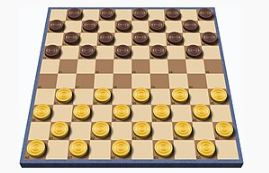
The rules of the game are as follows [PER][CHA] :
Initial setup :
International Draughts is played on a 10 x 10 board, oriented with a white square in the bottom right corner, and using only the black squares.
At the start of the game, 20 white and 20 black men are placed on the first four ranks on each side of the players.
Objective :
Players take turns.
White always moves first.
A player wins if the opponent has no more pieces or cannot move.
The game is declared a draw if :
- No player can advance towards a capture (for example, when the game only involves movable Kings, with no possibility of capture),
- The same position is repeated three times with the same player moving and the same movement options,
- 25 consecutive moves are played without a capture or King promotion.
Movement rules :
- Men move one square diagonally forward if the square is empty.
- A King can move diagonally any number of squares, forward or backward, as long as the square is empty.
Capture rules :
- A piece (man or King) can jump forward or backward over one or more opponent's pieces in a single turn, but cannot jump over the same piece more than once.
- Each opponent's piece that is jumped over is captured and removed from the board at the end of the complete sequence of captures.
- If a piece can capture, it must do so. If multiple capture sequences are possible (multiple jump), the player must choose the one that captures the most pieces.
Special rules :
- A man is promoted to a King when it reaches the last opponent's rank, symbolized by the stacking of a second man.
- Touch-play : A touched piece must be played, unless announcing "adjust" (adjusting its position) before touching the piece.
Winning Strategy :
There is no known winning strategy in International Draughts.
The optimal strategy is to minimize gross errors by following these rules [PER][CHA] :
1. Advance as a unit : Men in tandem or groups of 2 or 3 protect each other and make it harder for the opponent to capture.
2. Protect with a pyramid formation : When advancing a piece, ensure that two other pieces diagonally behind it protect it.
3. Play in the center first : The wings are difficult to defend and easy to block.
4. Simplify the game : Force simple exchanges (1 for 1) as soon as possible, provided you maintain a compact position. Fewer pieces mean fewer potential traps.
5. Detect open diagonals : When long open diagonals exist, check that the opponent cannot exploit them to place a King or launch a multiple jump, while simultaneously exploiting them offensively yourself.
6. Anticipate multiple jumps : Check before playing that the move doesn't involve an opponent's multiple jump.
7. Secure any King promotion : Before attempting a promotion, check that the destination square doesn't allow for an immediate capture.
8. Crown early : Aim to promote one or two men quickly to Kings to gain control of the game.
B2.2.4. Chess :
Rules of the game :
The rules of the game are as follows [PER][CHA] :
Initial setup :
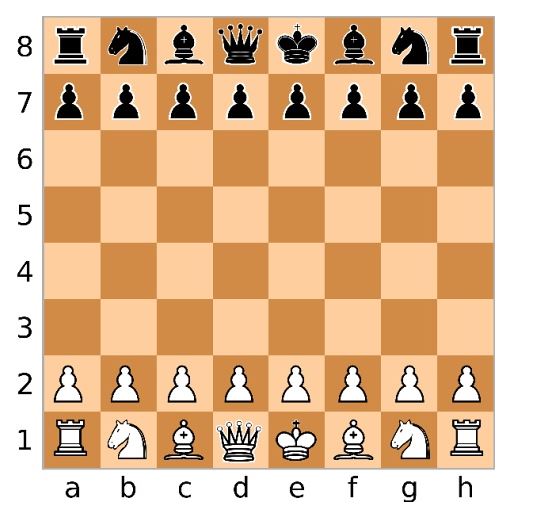
Chess is played on an 8x8 checkered board, oriented with a white square in the bottom right corner.
At the start of the game, 16 white pieces and 16 black pieces are placed as follows :
- On the first rank : starting from each end, a rook, a knight, a bishop. The two central squares are occupied by the king and the queen, with the queen placed on the square of her color.
- On the second rank : the 8 pawns.
Objective :
Players take turns.
White always moves first.
A player wins the game if they checkmate the opponent's king, or if the opponent exceeds the time limit while the player has sufficient material to checkmate them.
Movement rules :
- King : One square in any direction (horizontal, vertical, diagonal). It cannot move to a square that would put it in check.
- Queen : Any distance in any direction, provided the path is clear.
- Bishop : Any distance diagonally, provided the path is clear.
- Knight : L-shaped move (2 squares in one direction and 1 perpendicular). It is the only piece that can jump over others.
- Rook : Any distance horizontally or vertically, provided the path is clear.
- Pawn : Advances one square forward in its file (or 2 squares from its initial position, if the path is clear). It never retreats.
Capture rules :
- All pieces except the pawn capture according to their normal movement by occupying the opponent's square.
- The pawn captures only one square diagonally forward (right or left), never straight ahead.
- En passant capture : A pawn advancing two squares from its initial position and landing adjacent to an enemy pawn may be captured by that pawn on the immediately following move, as if it had only advanced one square. The capture is made diagonally onto the square the captured pawn would have occupied after a single-square move.
- The capturing piece takes the place of the captured piece, which is removed from the board.
Special rules :
- Promotion : A pawn reaching the last rank transforms into a queen, rook, bishop, or knight (choice made immediately).
- Castling : The king moves two squares in his original rank towards the adjacent rook, which then jumps over the king to its side. Two castlings are possible but only one per player per game : queenside (long) castling and kingside (short) castling. Castling conditions are :
1. Neither the king nor the relevant rook has moved previously.
2. The path between them is clear (no intervening pieces).
3. The king is not in check at the time of castling.
4. The king does not cross a checked square.
5. The king's and rook's final squares are not attacked.
- Touch-move rule : A touched piece must be played (moved if friendly, captured if enemy), unless announcing "j'adoube" (adjusting its position) before touching it.
Endgame rules :
- Check to the king : The king is under attack. Three possible defenses (PIF acronym): Capture the attacker, Interpose a piece between king and attacker, Escape the threat.
- Checkmate : The king is in check with no possible defense.
- Draw : Possible cases are :
1. Stalemate : No legal move possible, with king not in check.
2. Draw by agreement : Both players agree to end the game.
3. Triple repetition : the exact same position is repeated three times during the game, with the same player moving.
4. 50-move rule : 50 consecutive moves played by each player without capture or pawn movement.
5. Checkmate impossible due to insufficient material : Checkmate is impossible from any possible position (examples : king alone against king ; king and knight against king ; king and bishop against king ; etc.).
6. Dead position (fortress) : Checkmate is impossible from the current position (example : white king in a corner with three white pawns blocking access to the king, against black queen).
7. Time expired without possible checkmate (Article 6.9 of the FIDE for the general principle and 6.12.1 for the exception of nullity) : The game is a draw if one player exceeds the time limit and the other player has insufficient material to checkmate their opponent.
Winning strategy :
There is no known winning strategy in Chess to date. The optimal strategy is to minimize gross errors by following these rules [PER][CHA] :
1. Fundamental principle : Most games are won by the opponent's mistakes rather than perfect moves.
2. Develop pieces quickly :
- Bring out knights and bishops early in the opening to active squares.
- Avoid moving the same piece multiple times without necessity.
3. Ensure king safety :
- Castle early, unless there's a tactical reason not to.
- Avoid exposing the king in the center during the opening.
4. Occupy or control the center :
- Exert influence over the central squares (d4, d5, e4, e5) with pawns and pieces, either through direct occupation or remote control.
- Attack on the wings only after stabilizing the center.
- Avoid bringing out the queen too early.
5. Secure the pieces :
- Place pieces on squares where they have numerous action possibilities.
- Coordinate pieces so they support each other.
6. Structure the pawns :
- Each pawn move permanently alters the position and must be justified by a plan.
- Avoid doubled pawns (on the same file), isolated pawns (without allied pawns on adjacent files), or backward pawns (lagging on their file).
7. Exchange tactically :
- Favor piece exchanges when they improve your position.
- Simplify the position when you have a material or positional advantage.
8. Hunt threats :
- Check for threats with every move.
- Do not leave pieces hanging.
9. Exploit opponent's weaknesses :
- Doubled, isolated, or backward pawns.
- Weak squares (those no longer controlled by opponent's pawns): occupy with a knight (best choice).
- Blocked or poorly placed pieces: force unfavorable exchanges for the opponent.
- Bad bishop (bishop on squares of the same color as its pawns): never exchange it for one of your active pieces, except in rare exceptions.
10. Anticipate the endgame :
- Activate your king: it becomes an offensive piece once safe.
- Pawn structure gains increased importance.
11. Manage your time :
- Avoid consuming too much time in the opening.
Algebraic notation in chess :
Pieces : K=King, Q=Queen, R=Rook, B=Bishop, N=Knight, (none)=Pawn
Squares : notation is always given from White's point of view : files from a to h, left to right, and ranks from 1 to 8, bottom to top.
Structure of a move : [Piece][optional disambiguation][x if capture][destination square][optional promotion][check or checkmate][Annotations]
Basic examples :
e4 : the pawn advances to e4
Nf3 : the knight goes to f3
Bxe5 : the bishop captures on e5
Moves and captures :
Piece + destination square : move (e.g. Nf3)
x : simple capture (e.g. exd5, Bxe5), en passant capture (e.g. exd6, sometimes followed by e.p.)
disambiguation : when at least two identical pieces can move to the same square, the starting file is specified if that is sufficient (e.g. Nbd7); otherwise, the starting rank is specified (e.g. N1d2), and, if necessary, both the starting file and rank are specified (e.g. Qh4e1).
=Piece: promotion when a pawn reaches the last rank (e.g. e8=Q, axb8=N)
Special moves :
O-O : kingside castling
O-O-O : queenside castling
+ : check (e.g. Qh5+)
# (or ++, in older notation) : checkmate (e.g. Qh5#)
Annotations to comment on the quality of a move : ! good, !! excellent, ? mistake, ?? blunder, !? interesting, ?! dubious
Result : 1-0 (White wins), 0-1 (Black wins), 1/2-1/2 (draw)
How chess engines work :
The best modern chess engines vastly outperform the best humans. They never anticipate every possible future position, and rely on two complementary approaches :
- Tree search calculation : The engine explores possible moves several dozen plies (half-moves) ahead, pruning branches judged less promising, then evaluates each position reached.
- Neural evaluation (NNUE) : Rather than hand-written rules, a neural network trained on millions of positions from self-play games "recognizes" the quality of a position, somewhat like intuition. Stockfish today combines both: fast search + neural network evaluation.
In the opening, most engines use an opening book, built from millions of games played by grandmasters and/or engines, to play the first moves instantly without calculating. Once out of book, they switch back to standard calculation.
In the endgame, for positions with 7 pieces or fewer (Kings included), regardless of piece type, Syzygy tablebases provide an exact and exhaustive solution : the engine no longer calculates - it directly looks up the perfect result (win, draw, loss) and the optimal path to it. Beyond 7 pieces, it falls back on standard calculation (search + evaluation), since complete tables don't yet exist.
Note : The only endgame configurations that are always winning without pawns and against a lone king (known as "basic checkmates"), regardless of the initial position of the pieces and whoever is to move, are the following :
King + Queen vs. lone King (forced mate in at most 10 moves)
King + Rook vs. lone King (maximum 16 moves)
King + two Bishops (of opposite colors) vs. lone King (maximum 19 moves)
King + Bishop + Knight vs. lone King (maximum 33 moves)
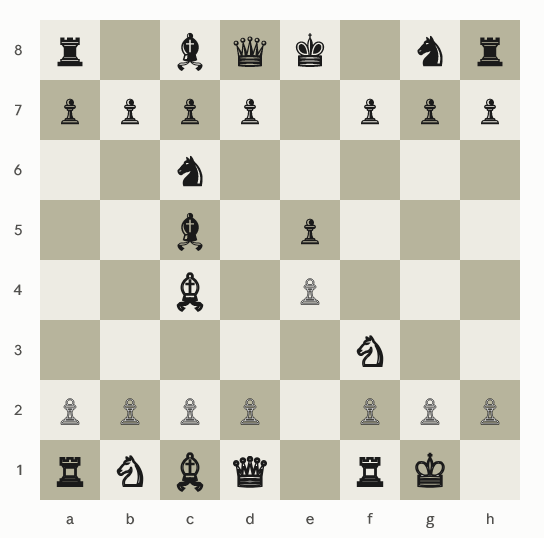
The Italian Game (Giuoco Piano) is one of the oldest and most widely taught chess openings, known since the 16th century. It relies on rapid and natural piece development, with direct pressure on the f7 square, the weak point in Black's camp before castling.
Here is the classic sequence (with the final position shown in the Figure above) :
1. e4 e5 - controlling the center
2. Nf3 Nc6 - White attacks the e5 pawn, defended by Black
3. Bc4 Bc5 - developing the bishop to c4, aiming at the weak f7 square (and preparing castling)
4. O-O - king safety (kingside castling), provided the f-g-h pawn shield is preserved
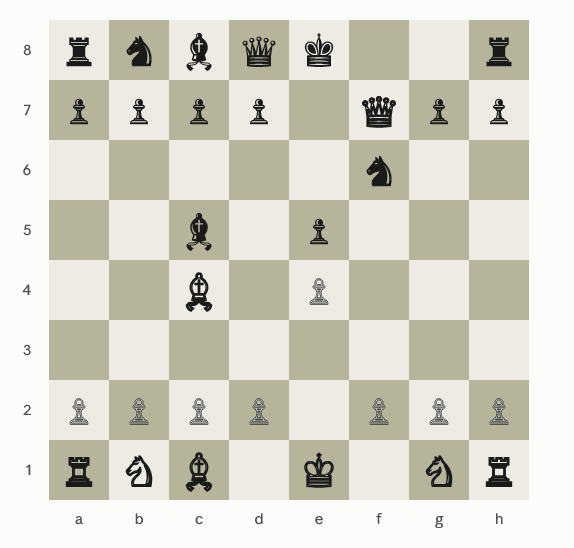
"Scholar's Mate" is the classic beginner's checkmate : it describes both the player who delivers it and the one who gets mated.
It is a quick four-move mate that only works if the opponent doesn't spot the threat. The mate is delivered on square f7, attacked by both the Bishop (from c4) and the Queen (from h5 or f3), and defended only by the King.
Here is the classic sequence (with the final position shown in the Figure above) :
1. e4 e5
2. Bc4 Bc5 (or Nc6, it doesn't matter for Black at this stage)
3. Qf3 (or Qh5) - the Queen already targets f7, a weak square defended only by the black King
3...Nf6?? (a mistake by Black, who overlooks the threat)
4. Qxf7#
Note : A well-prepared opponent easily blocks the threat, for example with 3...g6 or 3...Qf6 to protect f7 and chase away the Queen. After that, White has even lost time by bringing the Queen out too early, ending up in a slightly inferior position.
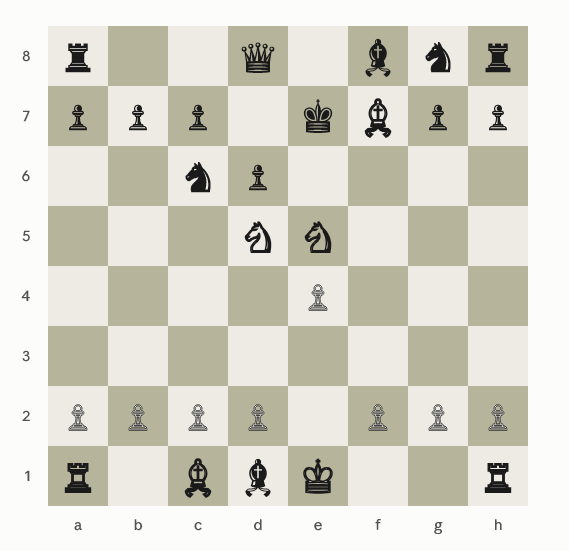
"Légal's Mate" is a classic trap based on a deceptive pin : the black Bishop pins the white Knight against the Queen, but this pin is only apparent, and White can then safely sacrifice their Queen to launch a lightning mating attack, exploiting the weakness of square f7 (via the Bishop) and square d5 (via the Knight).
This historic mate took place in Paris, around 1750, between François-Antoine de Kermur, Sire de Légal, playing White, and the Chevalier de Saint-Brie, playing Black. Légal was playing with a handicap (without his a1 Rook).
Here is the classic sequence (with the final position shown in the Figure above), reversing the historical order of White's moves 2 and 3, which was 2. Nf3 d6 then 3. Bc4 Bg4, to obtain here : 2. Bc4 d6 then 3. Nf3 Bg4
1. e4 e5
2. Bc4 d6 - White develops the Bishop
3. Nf3 Bg4 - the black Bishop pins the Knight against the white Queen
4. Nc3 Nc6 - a neutral move by Black
5. Nxe5!? - an apparent sacrifice : the Knight seems protected by the pin, but this pin is deceptive
5...Bxd1?? - Black takes the Queen, thinking they've won material
6. Bxf7+ Ke7
7. Nd5#
Note : This trap only works if Black takes the queen on move 5. Furthermore, for 5. Nxe5 to be attempted without the risk of a material disadvantage for White, it is necessary that :
- The d5-square be free, so that White can continue with 6. Bxf7+ Ke7 7. Nd5# if Black plays 5...Bxd1
- There be no Black knight on c6 able to play 5...Nxe5, because this knight on e5 would prevent White from recovering the bishop on g4 with Qxg4
In the historical sequence, Légal therefore took a real risk by playing 5. Nxe5!? : if Black had seen the trap and replied 5...Nxe5!!, White would have lost the knight.
B2.3. Card games :
The following card games illustrate different ways of playing with chance, where reflection, patience, and sometimes cunning influence the outcome.
B2.3.1. Prisoner Solitaire :
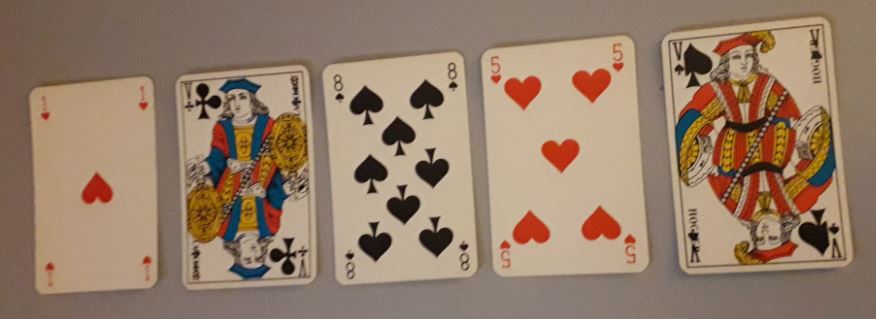
Prisoner Solitaire, or Accordion game, is played alone and requires a deck of 32 or 52 cards.
Rules of the game :
History tells us that it was used to pass the time for prisoners in their cells.
The rules of the game are as follows [PER][CHA] (see also the video [JEU]) :
The player holds the deck of cards face down and draws them one by one, laying them out in a single line face up on the floor or a table.
As soon as a card is framed by two adjacent cards of the same rank (any face cards or numbers, such as two 7s or two Queens) or of the exact same suit (spades, hearts, diamonds or clubs), the player places it on top of the previous card and closes the gap.
Each move back can create a new local framing and potentially a second one just before it. The player then takes absolute priority over the furthest framing that has not yet been dealt with, recursively, until no framing remains in the entire line of cards laid out.
This hierarchical rule ensures optimal handling of the framings, preventing omissions and accelerating convergence towards two final piles.
Example (see Figure above) : The cards drawn successively are as follows :
Ace of Hearts, Jack of Clubs, 8 of Spades, 5 of Hearts, Jack of Spades.
The operations are then as follows :
Ace of Hearts, Jack of Clubs, 8 of Spades, 5 of Hearts, Jack of Spades, 5 of Hearts on 8 of Spades, Jack of Clubs on Ace of Hearts, 5 of Hearts on Jack of Clubs.
The game ends here at the first layout with two single piles (5 of Hearts, Jack of Spades).
When all the cards in the deck have been drawn and all ongoing framings have been processed, the player collects the cards by stacking them from bottom to top, turns the deck face down, and begins a new layout.
The goal of the game is to reduce the layout to two single piles, which is generally achievable but very time-consuming.
However, there is a non-zero probability of failure (less than 5 % according to empirical studies). For example, during a layout, if none of the cards are framed, then subsequent layouts will reproduce the initial configuration exactly or its inverse, depending on the card-picking method.
B2.3.2. War :
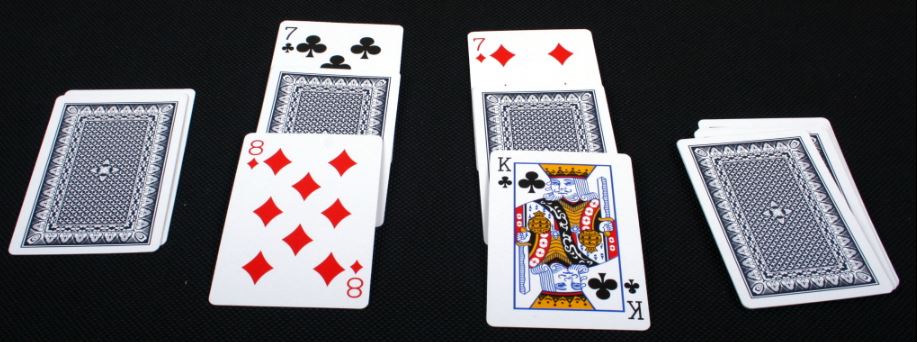
War is a simple game for two players that requires a standard deck of 32 or 52 cards.
The modern rules are as follows [WIK1] :
Objective :
Cards are dealt one by one to all players, who gather them face down into a single pile.
Each player draws the top card from their pile and places it face up on the table.
The Ace is the highest card, followed by King, Queen, Jack, 10, and then descending values.
The player with the highest card wins the trick. He collects all played cards and places them under his pile.
In case of a tie - called a "war" - each player draws a new card and places it face down on top of the previous card, then a second card face up on top of those. This final card decides the winner. If another tie occurs, the process repeats as needed.
The winner is the player who collects all cards from their opponent's pile.
The game ends in a draw - even if one player clearly dominates - if a player's last card is face down or matches their opponent's value. In these cases, war cannot occur.
Variant :
There is a variant where each player receives a full deck of 32 cards at the start, shuffled independently.
The game then proceeds exactly according to the classic rules.
This variant eliminates the initial unfairness caused by splitting cards from a single deck.
However, the game length is roughly doubled.
Winning Strategy :
War is a game of pure chance with no winning strategy.
A game lasts about 30 minutes median (350 tricks) with 52 cards, or 20 minutes (250 tricks) with 32 cards - ideal for quick family play.
B2.3.3. Crapette :
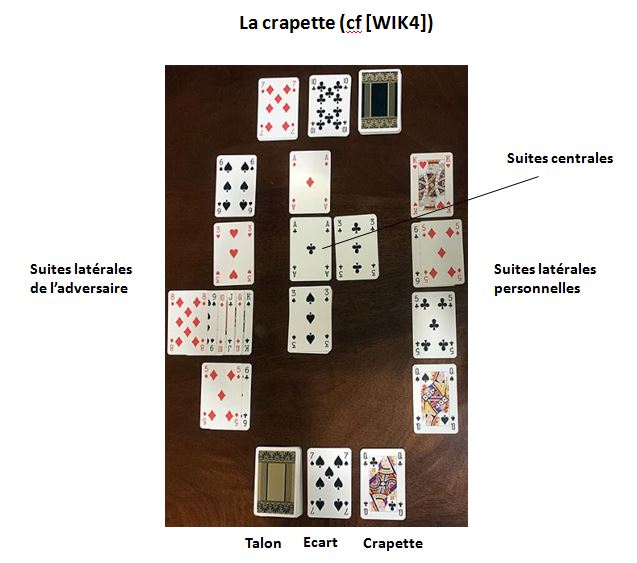
Crapette is a two-player card game belonging to the patience (solitaire) family. It requires two standard 52-card decks (without jokers).
The word "crapette" could mean "small bulging toad", by analogy with the pile of 13 hidden cards, bulging like a crouching toad, with its eye as the last visible card.
The rules below describe the flexible version of the game (often referred to as the family version) [PER][CHA].
Initial setup :
Each player uses their own deck, which they shuffle and then lay out on the table as follows (see figure above) :
- Crapette pile : Each player draws 13 cards and places them face down in a pile in front of them, to their right.
- Side sequences (or working piles) : Each player draws 4 additional cards and places them face up, to their right, forming a personal vertical column.
These cards form the beginning of the 8 side piles in play (4 personal piles and 4 belonging to the opponent).
- Central sequences : 8 central spaces, shared by both players, are left empty. They will later receive 8 card piles face up, arranged in 2 vertical columns, one for each of the 4 suits.
- Stock (talon) : The remaining 35 cards are placed face down in a pile to the left of the player's crapette pile.
- Waste pile (écart or discard) : This pile, initially empty, is located between the stock and the crapette pile. It receives, face up, cards drawn from the stock that cannot be played.
Initial tie-break :
- Each player then turns face up the top card of their crapette pile.
The player with the higher-ranked card (using the descending order : Ace, King, Queen, ..., 2) takes the first turn.
- In case of a tie, the players compare the 4 cards of their personal side sequences, position by position, from top to bottom.
Objective :
Each player must get rid of all their cards by playing them face up, according to the following possibilities :
- Central sequences :
Cards may be placed onto the central sequences, which consist of 8 ascending piles, built from Ace up to King, by exact suit (Spades, Hearts, Diamonds, Clubs).
This placement is final : once a card has been placed in a central sequence, it may not be removed.
- Side sequences :
Cards may be placed onto the side sequences, which consist of 8 descending piles, built from King down to Ace, alternating opposite colors (red/black).
This placement is temporary, as cards placed in the side sequences are intended to be transferred later to the central sequences.
- Opponent's piles :
Cards may also be placed onto the opponent's piles (crapette pile or waste pile), provided that the card played is of the same suit and of immediately higher or lower rank than the visible card of that pile (for example, a 10 of Spades on a 9 or Jack of Spades).
Players take turns. During their turn, a player may make as many plays as possible.
The winner is the first player who manages to play all of their cards onto the table.
In the event of a complete blockage of play, the player with the fewest cards remaining in total (crapette pile + waste pile + stock) is declared the winner.
Sources of draw :
A player may never draw cards from the opponent, whether from their piles or their personal side sequences.
The personal sources of draw are the following, in strict order :
- Strict order : 1. Personal crapette pile, 2. Personal stock (talon), 3. Personal waste pile
- Additional source available at any time :
The player's personal side sequences (4 piles).
Whenever a card is drawn from the crapette pile or from the stock, the next card of that pile must immediately be turned face up.
When the stock is exhausted, the player plays all possible cards from their waste pile and their crapette, then turns over the waste pile without shuffling to form a new stock.
When drawing from the side sequences, only the top card of a pile may be moved.
Placement destinations :
- Absolute priority :
The central sequences (8 piles).
- Secondary destinations :
The side sequences (8 piles, personal or belonging to the opponent) and the opponent's piles (crapette pile or waste pile).
Cards are always played or moved one at a time.
All cards in the side sequences must be visible, with the card played not completely covering the previous one.
The side sequences may only be reorganized through successive moves of cards taken from the tops of the piles. An empty space in a side sequence may receive any card.
Fouls :
A foul occurs whenever a player violates any of the rules stated above, in particular :
- Failing to place, as a priority, a card from one of their piles (crapette, stock, waste) onto the central sequences.
- Drawing a card from the stock while a card from the crapette pile could be played.
- Drawing a card from the waste pile while a card from the stock or from the crapette pile could be played.
Whenever a foul is committed, the opponent calls "Crapette !".
The player at fault leaves the rest of the layout unchanged, then places the incorrectly played card onto their waste pile, then immediately ends their turn, which passes to the opponent.
Common variants :
1. No drawing order variant :
The drawing order (crapette pile, stock, waste pile) is removed. The player may freely draw from any of these piles. This variant favors fluidity and optimization of sequences over the traditional priority constraint, turning crapette into a freer and more tactical game.
2. Variant with shared side sequences : The side piles are shared and not assigned to individual players, therefore without the personal/opponent distinction. The side piles can be manipulated by both players. This variant greatly increases the tactical depth and the potential for rearranging the piles.
Winning Strategy :
There is no winning strategy for Crapette. However, there exists a set of guiding principles to implement according to the following hierarchical order [PER][CHA] :
1. Play on the central piles to avoid a fault and advance the central game.
2. Create a maximum of empty spaces in the side sequences by two possible means : restructure the side sequences (often to merge several short ones into a single long one), and load the opponent's two piles. Note : 1 empty space (or 2 or 3) allows you to move a block of 2 cards (or 4 or 7, respectively) from one sequence to another.
3. Free the crapette pile by accompanying, when possible, the crapette card with the one from the stock or the waste pile, unless this freeing gives the opponent a favorable restructuring.
Each game takes about 20 minutes.
B2.3.4. Poker :
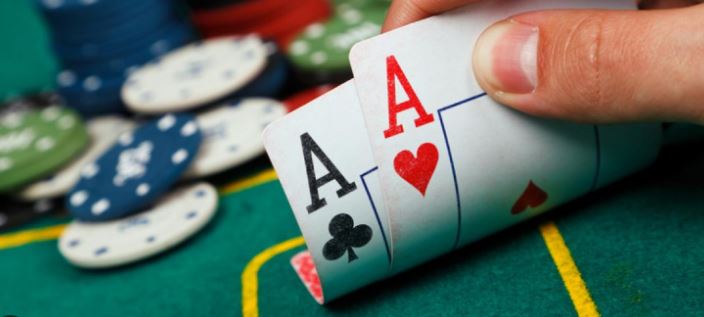
Poker is a strategic card game played by 2 to 10 players, using a standard 52-card deck.
Its main goal is to win the bets (the "pot"), either by forming the best five-card combination or by forcing opponents to fold through bluffing.
The four most played poker variants worldwide are Texas Hold'em, Omaha, 7-Card Stud, and 5-Card Draw.
A game refers to the set of hands played at a table, while a hand corresponds to one complete deal, from the initial bet to the pot award.
Warning : in English, the word "hand" can refer either to a hand of cards (combination) or to a round of play (deal).
Types and Values of Cards :
Two types of cards are possible :
- private cards, unique to each player, which can be hidden, called "closed" (visible only to that player) or visible, called "open" (revealed to the other players),
- community cards, visible and usable by all players.
According to the variant, the dealt cards are distributed as follows :
- Texas Hold'em : 2 hidden private cards and 5 community cards.
- Omaha : 4 hidden private cards and 5 community cards.
- 7-Card Stud : 3 hidden private cards and 4 visible private cards.
- 5-Card Draw : 5 hidden private cards, revealed only at showdown.
The card values are as follows, ranked in increasing order of strength :
2, 3, 4, ..., 10, Jack (J), Queen (Q), King (K), Ace (A), with the Ace also able to count as 1 in allowed straights (e.g., A-2-3-4-5).
In 4- or 5-player games, it is common to remove the 2, 3, and 4, reducing the deck to 40 cards.
Hand Hierarchy [WIK9] :
The hierarchy of hand strengths is as follows, with their probability of occurrence for a 52-card deck in two cases :
- List 1 : random 5-card draw, typical of the 5-Card Draw variant.
- List 2 : best hand from 7 cards, for Texas Hold'em, Omaha, and 7-Card Stud variants.
This hierarchy remains the same across all poker variants. Only their probabilities of occurrence vary, depending on the number of cards dealt and those that can be combined to form the best hand.
Each hand is defined by its minimal criterion, with the hand hierarchy automatically resolving overlapping cases.
| Hand | Definition | Example | Tiebreaker | Probability List 1 | Probability List 2 |
|---|---|---|---|---|---|
| Royal Flush | Straight flush with Ace-high | 10 J Q K A | impossible | 0.00015 % | 0.0032 % |
| Straight Flush | 5 consecutive values, same suit (Ace low allowed) | 8 9 10 J Q | highest card | 0.0014 % | 0.028 % |
| 4-of-a-Kind | 4 cards of same value | Q Q Q Q | value of 4-of-a-Kind, then kicker | 0.024 % | 0.17 % |
| Full House | 3-of-a-kind + pair | 10 10 10 K K | three value, then pair | 0.14 % | 2.60 % |
| Flush | 5 cards same suit | 8 9 10 J K | cards descending | 0.20 % | 3.03 % |
| Straight | 5 consecutive values (Ace low allowed) | 8 9 10 J Q | highest card | 0.39 % | 4.6 % |
| 3-of-a-Kind | 3 cards same value | 10 10 10 | value of 3-of-a-Kind, then kickers descending | 2.11 % | 4.83 % |
| Two Pair | Two pairs | K K 8 8 | highest pair, second pair, kicker | 4.75 % | 23.50 % |
| One Pair | 2 cards same value | K K | pair value, then kickers descending | 42.26 % | 43.82 % |
| High Card | None of above | A J 9 6 2 | cards descending | 50.12 % | 17.41 % |
| Total | 100,00 % | 100,00 % |
Note in this table :
- Suit color does not affect a hand's intrinsic strength in the hierarchy relative to other hands, except to form a Flush, Straight Flush, or Royal Flush. Among themselves, suits are equivalent and neutral, except to break ties in some non-standard variants.
- Probabilities do not always increase strictly with hand weakness, but the hierarchical order remains correct for determining the winner.
Entry fee (bankroll) :
The bankroll is the amount each player stakes to participate in the game.
- At the start of the game, the player buys chips corresponding to their bankroll.
- During the game, all bets and raises are made solely with chips.
- At the end, the player exchanges their chips for money according to their value.
Bet before card dealing (initial bet) :
Before any card dealing, a mandatory bet is required to form the starting pot.
It takes the form of antes (all players bet) or blinds (forced bets by certain players), made without knowledge of the cards.
Ante :
The ante is an identical mandatory bet placed by each player before the cards are dealt to create an initial pot.
It is mandatory in the 7-Card Stud variant and optional in 5-Card Draw.
Blind :
The blinds are forced bets placed before the cards are dealt to create an initial pot.
They are mandatory in Texas Hold'em and Omaha variants, and may be combined with antes depending on the game's specifics.
Two types of blinds exist :
- Small Blind (SB) : small bet, placed by the player immediately to the left of the dealer button.
- Big Blind (BB) : full bet (typically double the SB), placed by the player to the left of the Small Blind.
The other players, excluding SB and BB, do not bet initially.
The straddle (or sur-blind) is an optional additional bet (typically double the BB), placed by the player to the left of the Big Blind.
It provides a strategic advantage by allowing the straddler to act late on the first betting round, increasing the initial pot and putting pressure on opponents.
Card dealing (the deal) :
Cards are dealt one by one, clockwise, starting from the player to the dealer's left, according to the variant played.
The dealer's role rotates each hand.
Game flow :
After the deal, players bet through successive betting rounds, according to the variant's stages.
Action consists of making a decision : fold, call, or raise.
It starts with the player to the left of the blinds during betting rounds and proceeds clockwise.
Without blinds, action starts with the player to the left of the dealer (5-Card Draw) or the player with the lowest visible card (7-Card Stud).
The basic principle of betting is that a player must "call" by matching the highest bet to stay in the hand. If they don't, they "fold" and lose their bets already committed. They can also"raise", i.e. increase the bet, forcing other players to call, raise, or fold.
A betting round ends when all remaining players have either folded or matched the highest bet.
Betting rounds :
A hand consists of several betting rounds depending on the variant.
For each round, the number of cards indicated below is the number of cards dealt, revealed, added, or exchanged, made available to the player, whether they are private or community cards.
Texas Hold'em and Omaha : 4 rounds
- Preflop : 2 private cards for Texas Hold'em and 4 for Omaha
- Flop : 3 community cards
- Turn : fourth community card
- River : fifth and final community card
7-Card Stud : 5 rounds
- 3rd Street : 3 cards (2 hidden, 1 visible)
- 4th Street : 1 visible card
- 5th Street : 1 visible card
- 6th Street : 1 visible card
- 7th Street : 1 hidden card
5-Card Draw : 2 rounds
- After the deal : 5 cards
- After the draw : 0 to 5 cards
Card Exchange :
Depending on the variant, a player may or may not exchange cards, which are drawn from the deck by the dealer or by the professional dealer in a casino.
In Draw-type variants (especially 5-Card Draw), card exchange is allowed after the first betting round.
In other common variants (Texas Hold'em, Omaha, 7-Card Stud), no exchange is possible : cards are only dealt during the deal.
End of hand :
The hand ends either by all players but one folding (winner takes the pot), or by showdown after the final betting round.
Winning strategy :
There is no winning strategy in poker, but there exists an optimal beginner strategy that consists of following these principles [PER][CHA] :
1. Play for expectation : A decision is good if it is profitable in the long term, even if it sometimes leads to an immediate loss.
2. Adapt your strategy to your position : Play cautiously when acting early in the betting rounds, and aggressively by exploiting available information when acting late, ideally last.
3. Adapt your bets to the situation : Bet big when you have good cards or to protect the pot, and bet small or fold otherwise.
4. Bluff intelligently : Bluff just enough to make the opponent indifferent between calling and folding.
5. Play the opponents : Bluff more against cautious players and less against calling players.
6. Manage your stack : Never risk too much on a single hand and know when to leave the table.
7. Play tight : For a deliberately cautious strategy, participate in only about 20 % of the hands in a game, hence the ultra-simple rule depending on the variant :
- 5-Card Draw : Fold unless you have a high pair (JJ, QQ, KK, or AA), or better, from the deal.
- Texas Hold'em : Fold unless you have a pair, an Ace with a high card, or two consecutive cards of the same suit (suited connectors), preflop.
- Omaha : Fold unless you have two possible Flush hands with suited cards (double suited draw), or a strong pair (AA or KK), preflop.
- 7-Card Stud : Fold unless you have a hidden high pair or three cards that can form a Straight or Flush, after the third card.
B2.4. Dice games :
The following dice games are games that combine chance and strategy.
B2.4.1. Pig :
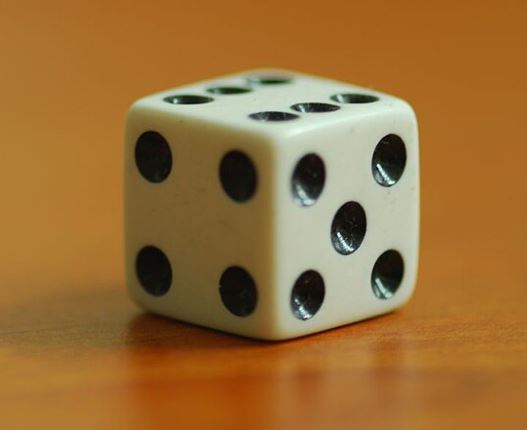
Pig, also known as 101 Game, is a simple dice game for two or more players that combines chance and strategy.
Be careful not to confuse it with "Le Cochon qui rit" (assembling a miniature or drawn pig) or "Pass the Pigs" (pig-shaped figurines used as dice).
The game relies on a balance between risk-taking and caution, with each player choosing the right moment to stop before rolling a 1 wipes out everything.
The game requires a standard six-sided die, a sheet of paper and a pencil to track scores.
The rules of the usual game are as follows [WIK6] :
Initial setup :
Each player's total score starts at 0.
Objective :
Players take turns.
On their turn, a player rolls the die as many times as they wish.
As long as the result is not 1, they add the value obtained to their turn points.
They can then choose to roll again to try to gain more or stop to secure the turn points and add them to their total score.
However, if they roll a 1, all turn points are lost (but not the total score points), and their turn ends immediately.
The winning player is the one who reaches or exceeds 101 points on their total score at the end of their turn.
Variant :
A harsher variant consists of resetting the player's total score to 0 when they roll a 1.
Winning Strategy :
There is no winning strategy for Pig because chance dominates. However, there exists an optimal strategy based on mathematical probability analysis, according to the following rules [PER][CHA] :
1. The optimal number of points to aim for per turn is around 20 points (optimal threshold to maximize expected gain).
2. This threshold should be decreased as the total score approaches 101 to reduce risk against the opponent : typically 15 points from a total score of 70 points, then 10 points from 91 points.
These thresholds come from mathematical analysis per isolated turn : Each additional roll has a positive expected gain, but also a 1/6 risk of losing all turn points. This expectation becomes unfavorable when accumulated turn points approach 20.
Demonstration :
The average value of a roll, conditional on not rolling 1, is : (2 + 3 + 4 + 5 + 6)/5 = 4
The probability of not rolling 1 is : 5/6
The raw expected value of an additional roll is therefore : (5/6) 4
But the risk of losing accumulated turn points must be considered. If the player already has T points in the turn, the net expected value E(T) of rolling again is : E(T) = (5/6) 4 - (1/6) T = 3.33 - T/6
Rolling again therefore remains favorable as long as : T < 20
B2.4.2. Yahtzee :
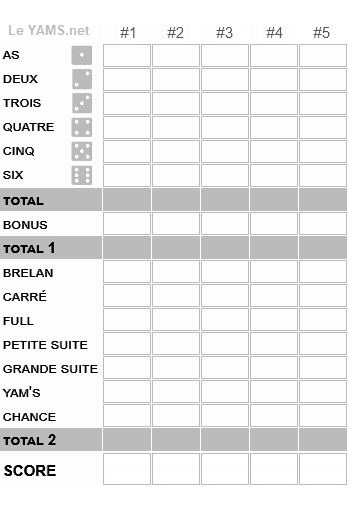
Yahtzee is a dice game for one or more players that combines chance and strategy.
Each player aims to form dice combinations to maximize their score on a dedicated scoresheet.
The game originated in Canada in the 1950s under the name "Yacht Game". It was created by a couple who introduced it to their guests during yacht cruises. The game was then popularized and marketed in 1956 as Yahtzee by Edwin S. Lowe.
The game requires 5 standard six-sided dice, a sheet of paper and a pensil for scoring.
The rules for the standard (family) game are as follows [PER][CHA] :
Initial setup :
The scoresheet has as many columns as players and as many rows as possible combinations (see Figure above).
Rows are divided into two sections :
- Upper Section : Each row corresponds to a dice value (Aces, Twos, ..., Sixes).
Aces : Sum of dice showing 1s. Score = this sum (example : 1-1-1-1-6 = 4 points).
Twos : Sum of dice showing 2s. Score = this sum.
Threes : Sum of dice showing 3s. Score = this sum.
Fours : Sum of dice showing 4s. Score = this sum.
Fives : Sum of dice showing 5s. Score = this sum.
Sixes : Sum of dice showing 6s. Score = this sum.
Total : Sum of the six scores above.
Bonus : +35 points if Total ≥ 63 points.
Total 1 : Total + Bonus
- Lower Section :
3-of-a-Kind : At least 3 identical dice. Score = sum of those dice (example : 2-2-2 = 6 points).
4-of-a-Kind : At least 4 identical dice. Score = sum of those dice (example : 3-3-3-3 = 12 points).
Full House : A triplet and a pair of identical dice (example: 3-3-3-6-6). Score = 25 points.
Small Straight : At least 4 consecutive dice (example: 2-3-4-5). Score = 30 points.
Large Straight : At least 5 consecutive dice (example: 2-3-4-5-6). Score = 40 points.
Yahtzee : 5 identical dice (example : 4-4-4-4-4). Score = 50 points.
Chance : Any combination. Score = total of all five dice. This saves a turn by avoiding crossing out a combination.
Total 2 : Sum of the seven scores above.
Final score : Total 1 + Total 2
Objective :
Players take turns.
On their turn, the player rolls the five dice, not exceeding three rolls total (initial roll plus two optional re-rolls).
After each roll, they may keep all or some dice as they wish to try to form the desired combination.
At the end of their turn, they must fill one empty box on the scoresheet.
If no combination is possible or worthwhile, they must cross out a combination of their choice.
The game ends after 13 turns corresponding to the 13 combinations, when all boxes on all players' sheets are filled.
The winner is the player with the highest score in the Final score row.
Variant - Upper Section line blocking :
When a player achieves the maximum possible score in an Upper Section row, that row becomes inaccessible to all other players for the rest of the game.
For example, a player rolls 3-3-3-3-3 in the Threes row. The Threes row is then crossed out for all other players.
Winning strategy :
There is no guaranteed winning strategy for Yahtzee because chance dominates. However, an optimal strategy exists based on these principles [PER][CHA] :
1. Upper Section : Aim for the 35-point Bonus and blocking Upper Section lines.
2. Variable scores (Upper Section, 3-of-a-Kind, 4-of-a-Kind) : Always re-roll up to the 3rd roll to maximize the score.
3. Fixed scores (Full House, Small Straight, Large Straight) : Stop immediately once the combination is obtained.
4. Chance : Reserve for high dice totals, or as a last resort to avoid crossing out a combination.
5. Overall strategy (timing) :
- Early game (turns 1-4) : Prioritize fixed scores (Full House, Small/Large Straight) which are relatively accessible and free up the Upper Section for later.
- Mid-game (turns 5-9) : Target variable scores (Upper Section, 3/4-of-a-Kind) to accumulate high points, including the Bonus.
- Late game (turns 10-13) : Aim for Yahtzee and Chance with high dice totals to maximize the Final score or save remaining empty boxes.
B2.5. Games on paper :
The following games, easy to set up with just a sheet of paper and a pencil, involve strategies based on controlling the game space.
B2.5.1. Battleship :
Battleship, also known as Touché-Coulé, is a two-player board game where opponents secretly place "ships" on a grid and try to "hit" each other's ships.
Standard French/Belgian rules are as follows [WIK2] :
Initial setup :
Each player uses two 10x10 numbered grids (French style : rows 1-10 top to bottom, columns A-J left to right).
Each player commands a fleet of 10 ships represented by rectangles 1-4 squares long :
- 1 large ship (4 squares)
- 2 medium ships (3 squares each)
- 3 medium ships (2 squares each)
- 4 small ships (1 square each)
L-shaped, T-shaped, square, zigzag or discontinuous shapes are forbidden.
The personal grid shows your own fleet. At game start, place all ships vertically or horizontally, drawing each as a bold rectangle.
Ships must be separated by at least one empty square (no corner touching). Empty squares represent water.
The firing grid tracks the opponent's territory, where you will hunt their ships.
Objective :
Players take turns calling out a grid square (e.g., "B6"). The opponent must respond with one of these announcements :
- "Miss" if the shot lands in water
- "Hit" if the shot strikes a ship but leaves intact squares
- "Sunk" if the shot hits the last intact square of a ship.
On their firing grid, the player marks :
- A dot (.) for a "miss"
- An X for a "hit"
- A circled X (⊕) for a "sunk". Immediately after this shot, the player must also mark with a dot (.) all unmarked squares surrounding the sunken ship in order to materialize the non-contact rule.
The winner is the first player to "sink" all of the opponent's ships.
Example :
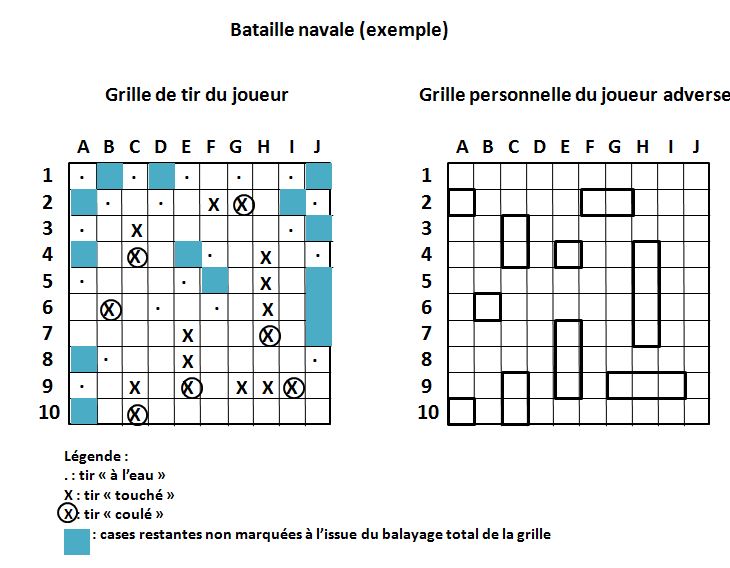
The Figure above shows an example of Battleship, with the opponent's personal grid (unknown to the player) and the player's firing grid.
The first shot is fired at square A1. Subsequent shots are fired row by row, from left to right and top to bottom, according to the optimal strategy (see below).
To avoid cluttering the Figure, the firing grid does not include the additional markings (.) placed on unmarked squares surrounding sunken ships immediately after a "sunk" shot.
After this firing grid has been completely scanned, all ships of size 2 squares or more are sunk. Only 3 small ships of size 1 square (A2, E4, and A10) remain to be found in a maximum of 14 shots (shaded squares in the Figure).
Variant :
Each player fires a volley of three shots in succession. This variant speeds up the game.
Winning Strategy :
No winning strategy is known for Battleship. However, an optimal strategy exists based on these rules [PER][CHA] :
1. Placement phase : Maximum dispersion.
- Distribute the ships across the entire grid to limit spatial correlations and make any local information less useful.
- Prioritize the center of the grid. Central squares allow for more possible placements, enabling ships to blend into the surrounding uncertainty (statistical camouflage).
- Avoid corners and clusters. In intuitive exploration, these areas are subject to psychological targeting ("suspicious zones"). In systematic exploration (checkerboard pattern), corners are hit by early shots, and clusters encourage concentrated shots that can trigger the abandonment of the systematic search in favor of a targeted search.
2. Search Phase : Minimum number of shots.
- Mentally color the opponent's grid according to a checkerboard pattern with alternating black and white squares (like on the checkers board of International Draughts).
- Choose a color and then systematically scan the squares of that color. Only fire at squares not already marked with (.), (X), or (⊕).
- As soon as a shot is called as "hit," abandon the search and proceed to the pursuit phase.
- This scan with a maximum of 50 shots will sink all ships of size 2 squares or more.
- After this scan, search for the remaining ships of size 1 square by randomly shooting at the n remaining unmarked squares (n = 15 on average). The average number of shots (E) to find the k remaining ships is then 12 shots if k = 3 (according to the formula E = k (n + 1)/(k + 1)).
3. Pursuit phase (after a "hit") : Tenacity.
- Immediately target orthogonal adjacent squares to locate and destroy the hit ship.
- Determine ship orientation (vertical or horizontal) after the second hit.
- Continue in the corresponding direction until complete destruction of the ship.
- Never return to global search until the ship is sunk.
B2.5.2. Racetrack :
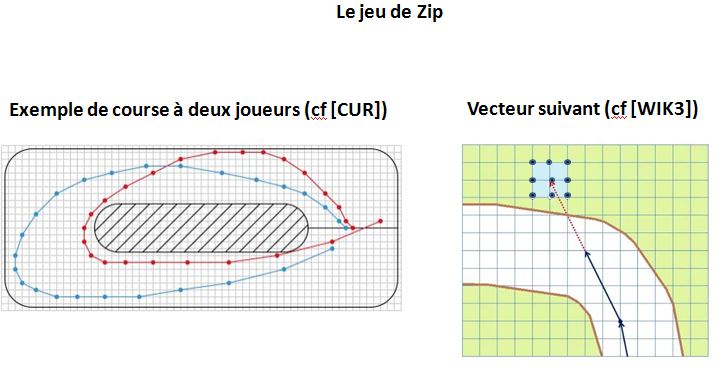
The Zip game, also known as Formula 1, Paper Race, or Racetrack - popularized by Martin Gardner in 1973 - is a fun game where one or more players compete in a speed race on a track drawn on graph paper, realistically incorporating acceleration and braking constraints.
The basic rules are as follows [WIK3] :
Initial setup :
The game requires graph paper (preferably large squares), an eraser, and one pencil per player (preferably in different colors).
The track is drawn on the paper with two more or less parallel winding boundaries, ending in a straight start line as wide as the number of players in squares, and a finish line.
Track boundaries can only be straight line segments to avoid disputes.
The track can also be a closed loop with the same start and finish line (see figure above).
Each player marks their car's starting position with a pencil on one of the grid points on the start line.
Objective :
Players then take turns.
The winner is the first player to touch or cross the finish line.
Movement rules :
1. Any move landing on a position already occupied by another player is forbidden.
2. The first move is one square forward along the track, represented by a vector from the starting point to one of its three neighboring points in the direction of the race.
3. On each turn, the player extends the previous move by plotting that vector from their current position. The resulting point is called the principal point. The player may also choose to move to one of the eight neighboring points of the principal point (see Figure above). These choices simulate the maximum acceleration or braking allowed given the car's inertia.
Fouls :
1. When a player leaves the track by crossing one of its boundaries, one of the following two types of penalties is applied on the next turn (to be agreed upon before the game starts) :
- Soft penalty (emergency braking) :
The player skips their turn. On the following turn, the vector corresponding to the off-track exit is reset to zero. The player restarts by moving to one of the eight neighboring points of their position (the principal point coincides with the current position).
This rule penalizes the mistake without eliminating the player from the race, giving them a second chance to win.
- Strict penalty (recovery race) :
The player must re-enter the track by crossing the boundary at a point located behind the point where they left the track. The higher the speed at the moment of exit, the greater the number of moves required to return to the track.
This rule significantly reduces the chances of winning after a mistake.
2. On some very twisty tracks, it may happen that a move off the track corresponds to a vector that crosses the track boundary twice, with both the starting point and the ending point lying inside the track. This kind of "risky shortcut" is allowed and does not count as going off the track.
Winning Strategy :
There is no winning strategy in the Zip game. However, an optimal strategy exists based on the following rules [PER][CHA] :
1. Anticipate turns by slowing down progressively to maximize average speed over the entire race.
2. Avoid sudden accelerations and sharp direction changes to reduce the risk of going off-track.
3. In turns, negotiate curves like a race car driver : approach the turn hugging the outer edge of the track. During the turn, maintain this trajectory as long as the turn's exit is not visible. Then, progressively cut the corner to rejoin the straight line. This trajectory minimizes the distance traveled within the curve and helps preserve a high exit speed.
B2.5.3. Gomoku-style game on 10 10 grid :
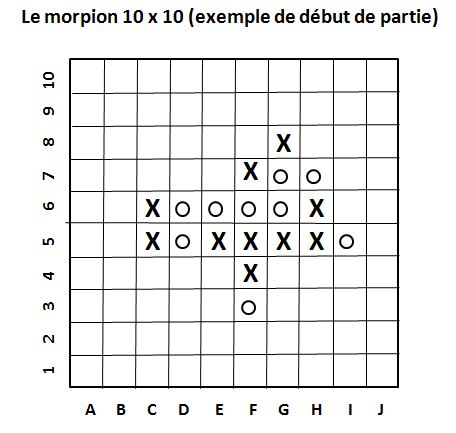
Gomoku-style game on 10 10 grid, or "Extended Tic-Tac-Toe", is a strategic two-player game where the goal is to be the first to align a series of 5 identical symbols on a 10x10 grid.
The basic game rules are as follows [WIK7] :
Initial setup :
The game requires a squared grid paper (typically 10 x 10) and a pencil per player.
The grid is empty at the start of the game.
Each player chooses a distinct symbol : X or O
Player X always starts and therefore has an advantage, not geographical (position on the grid), but functional (offensive role with always one move ahead).
To restore balance, the "pie rule" can be applied. After X's first move, player O chooses either to keep their O role or to swap symbols (they become X and their opponent becomes O). Depending on the quality of the first move or their personal preference, player O can thus freely choose their role (offensive or defensive) for the rest of the game, each role offering interest according to the player's playing style.
Objective :
Players take turns.
On their turn, a player places one symbol in an empty square. The symbol is permanent and cannot be removed or moved.
The winner is the first player to create an alignment of at least 5 identical consecutive symbols, horizontally, vertically, or diagonally (See example of the game start in the Figure above).
If the grid is completely filled without any alignment formed, the game is declared a draw.
Variant :
The game ends when the grid is completely filled. The winner is the player with the most winning alignments.
A winning alignment is a series of at least 5 identical symbols in a row without a break (streaks of 6 or more (overlines) also count as winning alignments). Short or long series count as a single alignment and cannot overlap or intersect.
Winning strategy :
There is no guaranteed winning strategy in Gomoku-style game on 10 10 grid. However, there exists an optimal strategy based on the following rules [PER][CHA] :
Rules to prioritize in the following order (Legend : 'X' for the player, 'O' for the opponent, '_' for an empty square) :
1. Immediate victory : Complete an XXXX_ or XXX_X or XX_XX or X_XXX
2. Defeat avoided : Absolutely block an OOOO_ or OOO_O or OO_OO or O_OOO
3. Fork avoided : Absolutely block an opponent's potential fork.
4. Double attack (fork) : Place an X creating two immediate threats simultaneously in two distinct lines, each forming an alignment of four X's with one empty square either at the end or within the alignment.
5. Simple attack : Create an XXXX_ or XXX_X or XX_XX or X_XXX
6. Extend alignments : Always extend existing alignments (rather than playing isolated).
7. Center + intersections : Prioritize the grid center and intersection squares (empty squares at the crossroads of two or more existing alignments).
B2.5.4. Tic-tac-toe :
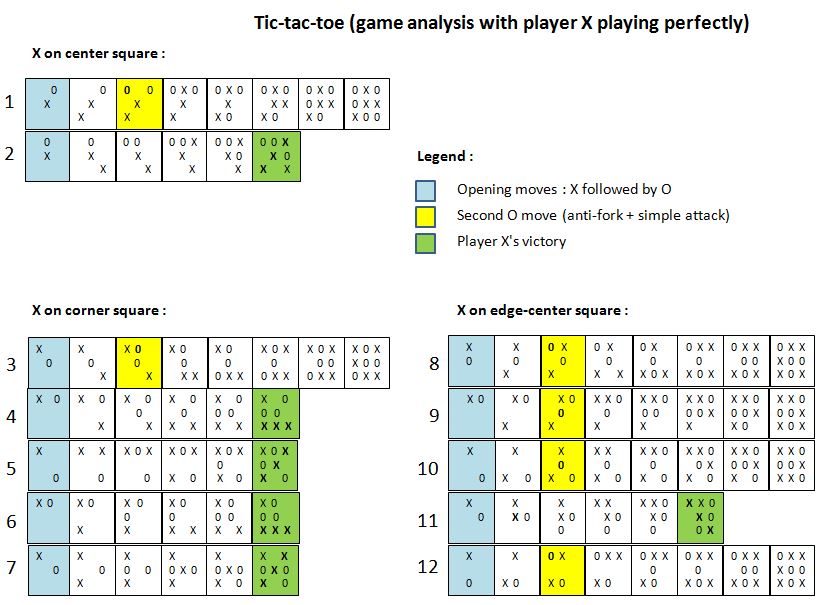
Tic-tac-toe is the standard reduced version of Gomoku-style game on 10 10 grid [WIK8]. The differences with the 10 10 version are as follows :
- 3 3 grid (instead of 10 10) with reduced square notation (A1, A2, A3, B1, B2, B3, C1, C2, C3).
- Alignment of 3 identical symbols (instead of at least 5 consecutive identical symbols).
- Possible replacement of the "pie rule" balance rule by the rule where each player plays two games, one as X and one as O. The winner is the player who wins at least one of the two games without losing any. In all other cases, the match is declared a draw.
- Victory on first alignment (the variant counting multiple alignments is excluded).
- Specific optimal strategy due to the immediate presence of grid edges (see below).
Game analysis :
If both players play perfectly, the game always ends in a draw.
Player X starts the game. Their first move can belong to one of three distinct position classes on the board : the central square, one of the corners, or one of the edge-center squares.
Player O responds with a move that can belong to one of five distinct position classes : the central square, one of the corners (adjacent or distant from X's square), or one of the edge-center squares (adjacent or distant from X's square).
This leaves 12 possible cases excluding equivalent cases by symmetry (see Figure above), with the following outcomes when player X plays perfectly :
- If X plays the central square, the game is won by X if O mistakenly plays an edge-center square (case 2 of the Figure), and drawn otherwise (O plays a corner square).
- If X plays a corner square, the game is won by X if O mistakenly plays a corner square or edge-center square (cases 4 to 7 of the Figure), and drawn otherwise (O plays the central square).
- If X plays an edge-center square, the game is won by X if O mistakenly plays an edge-center square adjacent to X's (case 11 of the Figure), and drawn otherwise (O plays the central square, a corner square, or the edge-center square opposite to X's).
The optimal opening strategies for each player are then as follows :
*
Player X :
-
To avoid unfavorable cases - in particular case 11 (X on an edge-center square followed by O on an edge-center square adjacent to X) - player X must open either on the center square or on one of the corners (cases 1 to 7).
-
In the majority of O's possible replies (cases 2, 4, 5, 6 and 7), this opening places X in a practically winning position.
- In the remaining cases (cases 1 and 3), X leaves O with a delicate defensive situation as early as O's second move, where O must play a often unique move combining fork prevention and a simple attacking threat in order to maintain a draw.
-
Any victory by player X therefore relies on a mistake by player O.
*
Player O :
- On O's first move, O must play the center square if it is free otherwise, one of the corners adjacent to X's initial square (cases 1, 3, 8, 9), immediately eliminating certain unfavorable cases. This strategy guarantees a draw if both players play perfectly. Any other response may lead to a defeat for O.
-
On O's second move, O must imperatively play the (often unique) square that simultaneously neutralizes all potential forks by X and forces X to respond to an O alignment, whenever such forcing is possible (see the squares highlighted in yellow in the Figure).
-
Player O is thus doubly disadvantaged : to secure a draw, O must play without any error in the two critical opening moves : the first (center or adjacent corner) and the second (anti-fork + simple attack).
-
Any victory by player O therefore requires a mistake by player X.
Winning strategy :
There is no guaranteed winning strategy in Tic-tac-toe. However, there exists an optimal strategy based on the following rules [PER][CHA] :
Rules to prioritize in the following order (Legend : 'X' for the player, 'O' for the opponent, '_' for an empty square) :
1. Immediate victory : Complete an XX_ or an X_X
2. Defeat avoided : Absolutely block an OO_ or an O_O
3. Fork avoided : Absolutely block an opponent's potential fork.
4. Double attack (fork) : Place an X creating two immediate threats simultaneously in two distinct lines, each forming an alignment XX_ or X_X
5. Simple attack : Create an XX_ or X_X
B2.6. Lottery games :
Lottery games, such as Loto, roulette, or slot machines, form a vast family of gambling games where chance prevails over strategy. In the long term, the player incurs inevitable losses due to a negative mathematical expectation.
The average loss for the player, expressed as a percentage of the bet (a grid or a token), is as follows :
- French Lotto FDJ (46 %)
- EuroMillions (46 %)
- Scratch-off ticket (33 %)
- Rapido (33 %)
- Boule (11 %)
- American Roulette - special 5-number bet (8 %)
- Classic 3-reel slot machine (6 %)
- American Roulette - other bets (5 %)
- French Roulette (3 to 1 % depending on special rules)
We thus observe that lotteries like Loto redistribute little to players, while better-structured casinos lead to lower losses, especially on French roulette.
Warning : Gambling organizations often announce a global redistribution rate (RTP) calculated from winnings weighted by their probability.
This rate is doubly misleading : rounded upward and, above all, masking the player's real loss. For example, in the game of Boule, the advertised RTP of 90 % actually corresponds to a negative expected value per bet (E = TRG - 1) of -11 %
B2.6.1. French Lotto :
The French Lotto is an individual or collective game of chance, with very limited strategic dimensions.
Two main variants exist :
- Traditional Lottery : Practiced during local festivals or in an associative setting, with game cards featuring 90 numbers.
- FDJ Televised Lottery : Offered by La Fran aise des Jeux (FDJ), with grids of 49 numbers + 10 numbers for the Chance number.
B2.6.1.1. Traditional lottery [PER][CHA] :
Materials :
- Drawing machine : Bingo cage or equivalent device.
- Balls : 90 balls numbered from 1 to 90.
- Game cards : Predefined cards distributed to players before the game (see Figure above).
- Each card contains 1 to 3 grids.
- Each grid = 3 rows 9 columns.
- Each row = 5 numbers and 4 empty spaces.
- Some cards have 2 rows of 5 numbered boxes (1 to 10) in the top left corner for administrative reference.
- All cards and all grids participate in the same draw, but winnings are calculated per grid.
Grid Filling :
- Players mark the drawn numbers on their grids.
- Empty spaces must not be marked. Any stray mark results in grid invalidation.
- Each grid is independent. Using multiple grids simply multiplies winning chances.
Winning Conditions :
- A win occurs when one of the following figures is obtained on a grid :
-
Quine : 5 marked numbers on a horizontal line.
-
Double quine : 10 marked numbers on two horizontal lines.
-
Full grid : 15 marked numbers across the entire grid.
- Only horizontal lines count. No other configuration (vertical, diagonal) is valid.
- Winnings amounts per grid are given in the following table :
| Figure | Gain (G) | probability (p) |
|---|---|---|
| Quine | Defined by organizer | 1/43 949 268 |
| Double quine | Defined by organizer | 1/(5,72 1012) |
| Full grid | Defined by organizer | 1/(4,58 1016) |
Note on this table :
The probability (p) represents the theoretical minimum probability, corresponding to a figure obtained exactly at the earliest possible moment.
In practice, the draw continues, which slightly increases the probabilities. Additionally, playing multiple grids increases the probabilities proportionally to the number of grids played.
The probability (p) is calculated as follows, with n = number of winning numbers required (5, 10, or 15) :
p(n) = C(n, n) C(90 - n, 0) / C(90, n) = 1/C(90, n) with :
Binomial coefficient C(a, b) = a! / (b! (a - b)!)
C(n, n) = 1 : number of ways to choose n winning numbers among the n numbers forming the figure.
C(90 - n, 0) = 1 : number of ways to choose zero losing numbers among the (90 - n) remaining numbers.
C(90, n)
: total number of possible draws of n numbers from 90.
The probabilities associated with the different figures (quine, double quine, and full grid) are therefore extremely low, practically negligible.
Draw procedure :
- Draw dates are set by the lottery organizer.
- Each figure (quine, double quine, full grid) is associated with a maximum number of balls that can be drawn, typically : 40 for the quine, then 20 additional for the double quine and 15 additional for the full grid. These cumulative limits are announced at the start of the evening by the organizer.
- The draw begins after card distribution.
- Numbers are drawn one by one, then announced or displayed.
- A player believing they have a figure raises their hand and announces it clearly.
- The draw is interrupted to verify and validate winnings.
- It continues until all planned figures are achieved or until all 90 numbers are exhausted.
Winning stratégy :
There is no winning strategy for traditional lottery. Unlike the FDJ Lottery where rational risk management remains possible, traditional lottery offers no viable strategy : neither grid choice (fixed card imposed), nor control over draws (sequential without intervention).
Given the extremely low probabilities associated with the different figures, traditional lottery cannot be considered a game of gain, but solely as a collective entertainment game.
B2.6.1.2. FDJ Televised Lottery [PER][CHA] :
Materials :
- FDJ drawing machine.
- Balls : 49 balls numbered from 1 to 49 for the 5 main numbers. A complementary ball ("Chance number") is then drawn from 10 balls numbered from 1 to 10.
- Game slips : purchased at tobacco shops (see Figure above).
- Each slip contains 1 to several grids to be freely filled by the player or automatically proposed by the FDJ terminal (Flash mode).
- Each grid = 5 numbers chosen from 49, and 1 optional number ("Chance number") chosen from 10.
- FDJ terminal in tobacco shops, featuring two input options (manual/Flash), a bulletin scanner, and paper output (participation receipt and legal proof).
Grid filling :
- Players fill their grids before the draw.
- Each grid is independent. Using multiple grids simply multiplies winning chances.
Winning conditions :
- A win occurs on a grid based on the number of correct numbers, including the complementary number.
- Winnings amounts for a single grid are given in the following table :
| Combinaison | Gain (G) | probability (p) |
|---|---|---|
| 5 + Chance | Average jackpot (7 440 000, including jackpot rollovers) | 1/19 068 840 |
| 5 | 200 000 | 1/1 906 884 |
| 4 + Chance | 800 | 1/86 676,55 |
| 4 | 300 | 1/8 667,655 |
| 3 + Chance | 40 | 1/2 015,73 |
| 3 | 20 | 1/201,573 |
| 2 + Chance | 7 | 1/143,98 |
| 2 | 4 | 1/14,398 |
| 1 + Chance | 2,20 | 1/28,09 |
| 1 | 0 | 1/2,809 |
| 0 + Chance | 2,20 | 1/17,56 |
| 0 | 0 | 1/1,756 |
Note on this table :
1. The gain (G) represents the gain (G) in euros, paid by the FDJ per standard grid for a participation cost c = 2.20 euros, corresponding to FDJ's official payout scale, which varies by draw. The G values shown are illustrative but plausible examples.
2. The probability (p) is the probability that a given combination results in gain G. It is calculated as follows, with n = number of winning numbers :
p(n) = C(5, n) C(44, 5 - n) / C(49, 5) and p(n + Chance) = p(n) x 1/10 with :
Binomial coefficient C(a, b) = a! / (b! (a - b)!)
C(5, n) : number of ways to choose n winning numbers among the 5 drawn.
C(44, 5 - n) : number of ways to choose (5 - n) losing numbers among the 44 not drawn.
C(49, 5) : total number of possible combinations of 5 numbers among 49
3. The mathematical expectation (E) of the grid is the difference between the expected gain ∑i [Gi pi] and the cost c, i.e.: Egrille = -1,01 euros
On average, for each single grid, the player therefore loses approximately 1.01 euros on a 2.20 euros cost, i.e. nearly 46 % of the amount wagered.
Draw procedure :
- Official draw dates are: Monday, Wednesday, and Saturday evenings.
- The draw is broadcast live or on official platforms.
- The 5 main numbers and the complementary number are drawn continuously.
- Results are individually verified after the draw.
- Winnings are automatically awarded according to official rules.
Winning strategy :
There is no winning strategy for FDJ lottery because chance operates at two levels :
- That of the winning numbers. All grids are equiprobable with a fixed probability independent of player choice.
- That of the winnings, which vary with the number of players. The Jackpot (5 numbers + Chance) and "5 numbers" are always shared among winners.
However, there exists a rational risk management strategy, based on the following rules [PER][CHA] :
1. Set a budget per draw : for example, 5 to 10 grids maximum, for a cost between 11 and 22 euros.
2. Strictly respect your budget : FDJ lottery remains an expensive entertainment, with an average statistical loss of 1.30 euros per grid, i.e. nearly 60 % of the cost.
3. Spread play over time, not to increase expected winnings (which remains negative), but to limit the psychological impact of occasional losses.
4. Vary the grids (personal choices and FLASH) to diversify combinations and make the game more enjoyable.
B2.6.2. Roulette [PER][CHA] :
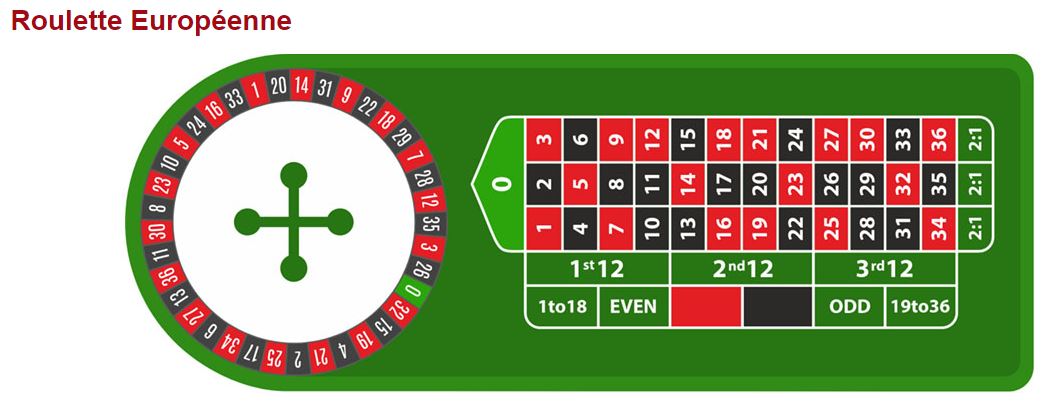
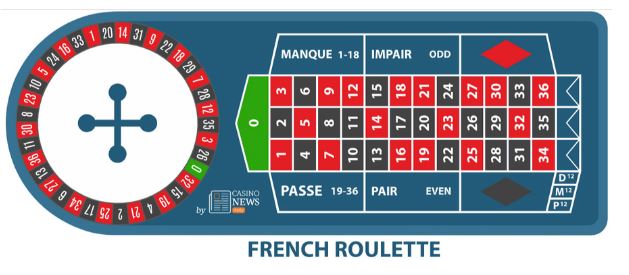
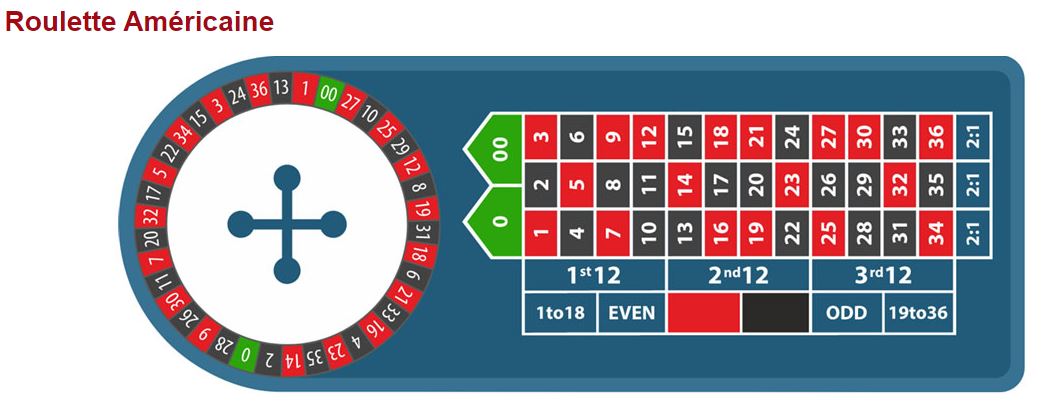
Roulette is a game of chance with several independent players and very limited strategic dimension.
It is generally played by 1 to 9 players, depending on the size of the betting layout.
Equipment :
1. A roulette wheel (or "cylindre") : circular wheel divided into numbered and colored pockets, mounted on an axle allowing free rotation. The wheel can be European or French (37 pockets with a single zero), or American (38 pockets with two zeros).
2. A ball : small sphere intended to circulate in the wheel and settle into one of the pockets when the wheel stops.
3. A betting layout (or table) : flat surface displaying the numbers and types of possible bets, on which players place their wagers.
4. Chips : units used by players to materialize their bets.
Wheel number layout :
In European, French, and American roulette, the exact order of numbers on the wheel, starting from zero and going clockwise, is historical and follows no simple mathematical rule. This order is as follows (see Figures above [BLE][GUI1][GUI2]) :
- European and French roulette (37 pockets with single zero) : 0, 32, 15, 19, 4, 21, 2, 25, 17, 34, 6, 27, 13, 36, 11, 30, 8, 23, 10, 5, 24, 16, 33, 1, 20, 14, 31, 9, 22, 18, 29, 7, 28, 12, 35, 3, 26
- American roulette (38 pockets with 0 and 00) : 0, 28, 9, 26, 30, 11, 7, 20, 32, 17, 5, 22, 34, 15, 3, 24, 36, 13, 1, 00, 27, 10, 25, 29, 12, 8, 19, 31, 18, 6, 21, 33, 16, 4, 23, 35, 14, 2
The number order on the wheel is designed to achieve an optimal balance and ensure game fairness. If the wheel is split in two at the zero :
- Each half contains exactly the same number of reds and blacks.
- Each half contains exactly the same number of evens and odds.
- Each half contains exactly the same number of Manque (1-18) and Passe (19-36).
- Each half contains exactly half of each dozen.
- Each half contains exactly half of each column.
Zeros (0 and 00) are green. The numbers 1 through 36 consist of 18 red and 18 black, arranged in a strictly alternating red/black sequence around the wheel, with no two adjacent numbers of the same color.
For all three variants, colors of numbers 1-36 can be memorized simply : Numbers whose digits sum to odd are red, even are black-with two exceptions : 10 and 28, which are black.
The wheel layout matters little from a probabilistic view point, if the roulette is mechanically perfect and unworn, i.e. without minor balancing flaws or roughness favoring a wheel section. Historically, this arrangement could slightly attenuate local mechanical biases [TOU], but today, with perfectly balanced wheels and rigorous statistical control by casinos, this effect has become practically null.
Spin course :
The goal of the game is to correctly predict the pocket or color where the ball will stop.
A typical spin unfolds as follows :
- The dealer spins the wheel and launches the ball in the opposite direction.
- Players place their bets on the table before the ball settles.
- The ball stops in a pocket.
- Winnings are paid based on the bets.
The dealer [WIK10] :
The dealer is a casino employee. He handles the ball and wheel, records bets, settles player winnings, and announces game phases using traditional formulas :
- "Faites vos jeux" (Make your bets) : start of the betting period.
- "Les jeux sont faits" (No more bets) : ball launch. No new bets accepted.
- "Rien ne va plus" (No more bets) : confirmation of betting closure. Outcome imminent.
- "4 rouge pair et manque" (e.g.) : announcement of winning number and characteristics (color, parity, range).
- "Rien au numéro" (No win on straight Up) : no player won on a Straight Up bet.
- "Rien ne va" (Nothing goes) : ball accidentally left the wheel before settling. Spin canceled and replayed.
Types of bets :
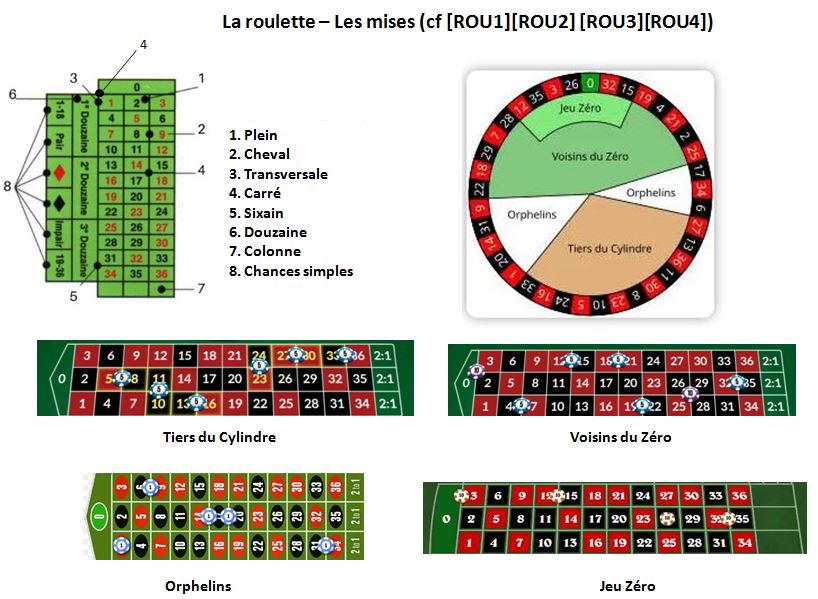
Bets can be classified into three main categories based on their placement on the layout :
- Internal bets (see Figure 1 above, markers 1 to 5) : Bets placed directly on one or more numbers on the layout, covering specific numbers (Straight Up, Split, Street, Corner, Six Line).
- Simple external bets (see Figure 1 above, markers 6 to 8) : Bets placed outside the layout, based on characteristics or regular groups of numbers (color, parity, Low/High, Dozen, Column).
- Special external bets (see Figure 2 above) : Bets announced by the player and made up of several internal bets distributed on the layout by the dealer, covering a specific sector of the wheel (Tiers du Cylindre, Voisins du Zéro, Orphelins, Jeu Zéro).
The following table covers all classic bet types in European (EU), French (FR) and American (US) roulette [WIK10] :
| Bet type | Name | Description | EU/FR/US : Payout (G) | EU/FR : probability (p) | EU/FR : Expectation (E) | US : probability (p) | US : Expectation (E) | Chance Type |
|---|---|---|---|---|---|---|---|---|
| Internal bets | Plein (Straight Up) | Bet on single number | 36 | 1/37 | -1/37 | 1/38 | -2/38 | Multiple Chance |
| Cheval (Split) | Bet on 2 adjacent numbers | 18 | 2/37 | -1/37 | 2/38 | -2/38 | Multiple Chance | |
| Transversale (Street) | Bet on row of 3 numbers | 12 | 3/37 | -1/37 | 3/38 | -2/38 | Multiple Chance | |
| Carré (Corner) | Bet on 4 numbers forming square | 9 | 4/37 | -1/37 | 4/38 | -2/38 | Multiple Chance | |
| Carré "Quatre Premiers" (First Four) | Bet on 4 numbers 0-1-2-3 | EU/FR : 9 | 4/37 | -1/37 | N/A | N/A | Multiple Chance | |
| Sixain (Six Line) | Bet on two adjacent rows (6 numbers) | 6 | 6/37 | -1/37 | 6/38 | -2/38 | Multiple Chance | |
| Five Number Bet | Bet on 5 numbers 0-00-1-2-3 | US : 7 | N/A | N/A | 5/38 | -3/38 | Multiple Chance | |
| Simple external bets | Rouge/Noir (Red/Black) | Bet on pocket color | 2 | 18/37 | -1/37 or FR : -1/74 (La Partage or En Prison) | 18/38 | -2/38 | Simple Chance |
| Pair/Impair (Even/Odd) | Bet on number parity | 2 | 18/37 | -1/37 or FR : -1/74 (La Partage or En Prison) | 18/38 | -2/38 | Simple Chance | |
| Manque/Passe (Low/High) | Bet on 1-18 (Low) or 19-36 (High) | 2 | 18/37 | -1/37 or FR : -1/74 (La Partage or En Prison) | 18/38 | -2/38 | Simple Chance | |
| Douzaine (Dozen) | Bet on 12 consecutive numbers (1-12, 13-24, 25-36) | 3 | 12/37 | -1/37 | 12/38 | -2/38 | Multiple Chance | |
| Colonne (Column) | Bet on one of three vertical layout columns (12 numbers) | 3 | 12/37 | -1/37 | 12/38 | -2/38 | Multiple Chance | |
| Special external bets | Tiers Du Cylindre | Bet covering 12 numbers opposite 0 (6 chips) | EU/FR : Variable depending on the number that comes up (composite bet) | Proportion of numbers covered on the wheel | -1/37 | N/A | N/A | Multiple Chance |
| Voisins Du Zéro | Bet covering 17 numbers around 0 (9 chips) | EU/FR : Variable depending on the number that comes up (composite bet) | Proportion of numbers covered on the wheel | -1/37 | N/A | N/A | Multiple Chance | |
| Orphelins | Bet covering 8 numbers not included in Tiers Du Cylindre or Voisins (5 chips) | EU/FR : Variable depending on the number that comes up (composite bet) | Proportion of numbers covered on the wheel | -1/37 | N/A | N/A | Multiple Chance | |
| Jeu Zero | Bet covering 7 numbers around 0 (4 chips) | EU/FR : Variable depending on the number that comes up (composite bet) | Proportion of numbers covered on the wheel | -1/37 | N/A | N/A | Multiple Chance |
Notes on this table :
1. The payout (G) is the total payout in chips (including the bet), paid by the casino for 1 chip bet (cost c = 1), when the bet is winning. For example, betting 1 chip on a winning Straight Up number returns 35 + 1 = 36 chips.
2. The probability (p) is the probability that a wheel spin results in a total payout G for 1 chip bet.
-
For fixed-payout bets (Straight Up, Simple Chance, Dozen, etc.), p is the physical probability that the winning event occurs.
- For composed bets or special rules (La Partage, En Prison), p can be an effective probability, taking into account partial payouts, neutralizations (zero), or conditional spins.
3. The mathematical expectation (E) is the difference between expected payout (G p) and the cost c : E = (G p) - c
In European/French roulette, and outside the special rules "La Partage" and "En Prison" (see below), we find : E = -1/37 = -0.027, or an average loss of 2.7 % per bet, regardless of (internal or external) bet type.
4. The indication N/A means : Not Applicable
5. Although expectation is identical across bets, distinguishing Simple and Multiple Chances matters for players because :
- Simple Chances offer low payouts but high probability, yielding less spectacular but more frequent wins - ideal for cautious players.
- Multiple Chances offer high payouts but low probability, yielding more volatile wins - suited for bold players.
6. For special external bets, the chip placement on the layout is as follows :
Warning : In some manufacturer wheel printings as well as in photographs used in articles, the number 27 is incorrectly classified among the Orphelins, whereas it actually belongs to the Tiers Du Cylindre.
- Tiers Du Cylindre (6 chips for 12 numbers, see Figure 3 above) : 6 chips, one on each split (5/8, 10/11, 13/16, 23/24, 27/30, 33/36)
- Voisins Du Zéro (9 chips for 17 numbers, see Figure 4 above) : 1 chip on 0 + 8 chips, one on each split (4/7, 12/15, 18/21, 19/22, 32/35), 2 chips on the street (0-2-3), and 2 chips on the corner (25-26-28-29)
- Orphelins (5 chips for 8 numbers, see Figure 5 above) : 1 chip on 1 + 4 chips, one on each split (6/9, 14/17, 17/20, 31/34)
- Jeu Zéro (4 chips for 7 numbers, see Figure 6 above) : 1 chip on 26 + 3 chips, one on each split (0/3, 12/15, 32/35)
7. Standard American roulette differs from European and French roulette by slightly lower probabilities (giving E = -2/38) and an added special bet : Five Number Bet 0-00-1-2-3 (giving E = -3/38). The expectation E increases from -2.7 % to respectively -5.26 % and -7.89 % , making it significantly less favorable for the player.
8. Bet limits, which vary according to bet type and roulette variant, typically range from 1 to 1000 euros for Simple Chances (to satisfy the majority of players) and from 1 to 100 euros for Multiple Chances (to protect the casino's cash reserves in case of very high occasional payouts).
Green numbers :
When the ball lands on a green number (0, or 00 in American roulette), all bets covering 0 win (Straight Up 0, Split 0-1, 0-2, and 0-3, Corner 0-1-2-3, Five Number Bet, Voisins du Zéro, Jeu Zéro). All other bets lose, except for Simple Chances in French roulette when they benefit from the following special rules :
"La Partage" where the player recovers half of their bet, which leads to an expectation E = -1/74 = -1,35 %
Proof : In the non-zero case, the casino pays the player G = 2 (including the bet) with probability 18/37. In the zero case, the casino pays G = 0.5 with probability 1/37. Thus, E = ∑[Gi pi] - c = 36/37 + 0.5/37 - 1 = -1/74
"En Prison" where the bet is held for the next spin and is only lost if that second spin is unfavorable, which leads to an expectation by bet E = -1/74 = -1,35 %
Proof : In the non-zero case, the casino pays the player G = 2 (including the bet) with probability 18/37. In the zero case, and assuming zero does not come up twice in a row, the casino pays G with probability 1/37, where G = 1 with probability 18/36 if the player succeeds on the second spin. Thus, the expected value E per bet = ∑[Gi pi] - c = 36/37 + 1/74 - 1 = -1/74
Warning : Some articles arrive at the erroneous result E = -1/73. The error stems from the arbitrary exclusion of one case out of 74, namely the zero + success case (probability (1/37)(18/36) with G = 1), resulting from a confusion between "net gain = 0" (which is correct) and "actual payment G = 1" (which is wrongly excluded as "not counting" [DEL2]). The biased calculation is : E = 72/73 + 0 - 1 = -1/73 and the correct calculation is : E = 72/74 + 1/74 - 1 = -1/74
General calculation for m consecutive zeros (m ≥ 1) :
We denote : a = 1/37
1. Non-zero case (first spin) : The casino pays the player (bet included) G = 2 with probability 18/37, which gives a contribution : 36 a
2. Consecutive zero cases : If zero comes up k times in a row (with k < m), then the casino pays G with probability ak, G being worth 1 with probability 18 a if the player succeeds on the following spin, which gives a contribution : ak 18 a = 18 ak + 1, for k = 1, 2,..., m - 1
3. Last zero case without continuation : On the m-th zero, the casino pays G with probability am, G being worth 1 with probability 18/36 = 1/2 if the player succeeds conditionally on the following spin (zero excluded), which gives a contribution : (1/2) am
The expected value E for a bet of 1 (cost c = 1) is therefore :
E = 36 a + 18 a2 + 18 a3 + ... + 18 am + (1/2) am - c
Setting : A = 1 + a + ... + am - 2 = (1 - am - 1)/(1 - a) = (1 - am - 1)/(36 a), E can be written as :
E = 36 a + B - 1
with : B = 18 a2 A + (1/2) am = 18 a2 (1 - am - 1)/(36 a) + (1/2) am = a/2
We finally obtain : E = 36 a + a/2 - 1 = 73 a/2 - 1 = -1/74
Conclusion : Whatever the number m of consecutive zeros considered in En Prison mode, the expected value of a unit bet remains exactly equal to E = -1/74, with no approximation whatsoever.
In these two special rules, Simple Chances are not lost entirely or inevitably. The player is thus at an advantage : Expectation improves from -2.7 % to -1.35 % with the rule La Partage or En Prison.
Winning Strategy :
There is no winning strategy at roulette. However, there is an optimal strategy aimed at limiting losses and managing risk, based on the following rules [PER][CHA] :
1. Limit the number of spins : Roulette being a game of chance with negative expectation, the longer you play, the closer average loss converges to theoretical expectation (-2.7 % in European/French roulette). Fewer spins reduce probability of significant losses.
2. Prefer Simple Chances (Red/Black, Even/Odd, Low/High) : All bets have identical negative expectation per spin (-2.7 %), but Simple Chances offer less spectacular but more frequent wins, thereby avoiding abrupt losses. In French roulette, this negative expectation drops to -1.35 % per bet with the rule La Partage or En Prison.
3. Playing so-called "frequent" numbers is an illusion, not due to the layout of numbers on the betting table, but because a mechanical defect localized on a specific pocket of the wheel is extremely unlikely, for two main reasons :
- A worn or defective roulette wheel favors a geographic zone of the cylinder (contiguous sector), not an isolated pocket.
- Casinos monitor, adjust, and replace wheels as soon as a statistical anomaly appears.
4. Palying on the opposite outcome after a series of identical results is also an illusion if one believes that the preceding streak changes the probability of the next spin. For a fair roulette wheel, each spin is indeed independent of the previous ones (for example, P[Odd | a series of Even results immediately beforehand] = P[Odd]) : the ball has no memory, and the probability remains the same on every spin. However, over a longer sequence, subsequent spins statistically tend to reduce the imbalance created by an atypical streak, as the observed frequencies move in the long run toward their theoretical value, without this altering the probability of the next spin.
5. A rational roulette strategy consists of setting an initial bankroll and a stop-loss threshold (e.g., -30 %), with the player psychologically accepting the potential total loss of any gains. It does not alter the game's negative expected value, but allows for serene and prolonged play while limiting losses before they worsen.
B2.6.3. Boule [PER][CHA] :
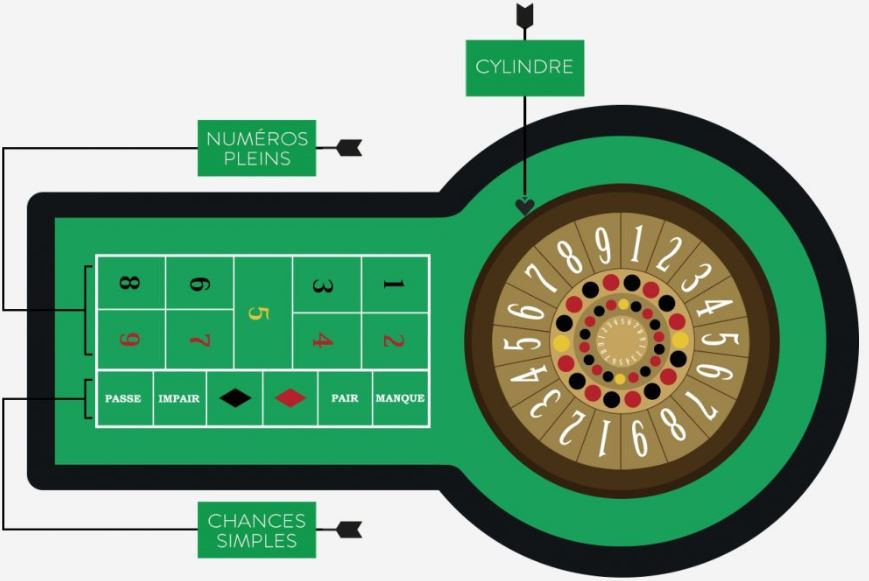
Boule game is a simplified variant of the roulette, using only the numbers from 1 to 9.
It is generally played by 1 to 8 players, depending on the size of the gaming mat.
Equipment :
- A gaming wheel (or "cylindre") : circular wheel divided into pockets numbered 1 to 9 and colored, mounted on an axle allowing free rotation.
- A ball : small sphere intended to circulate in the wheel and settle into one of the pockets when the wheel stops. The ball is a slightly larger ball than the one in roulette in order to fit the larger pockets.
- A gaming layout (or table) : flat surface displaying the numbers and types of possible bets, on which players place their bets.
- Chips : units used by players to materialize their bets.
Wheel number layout :
In casinos, the Boule game is primarily played on an 18-pocket wheel (with two successive series of 1 to 9).
Other versions (such as 27 pockets) exist but are rare and outside the standard framework.
The exact order of numbers on the wheel, starting from 1 and going clockwise, follows a linear sequence 1-2-3-4-5-6-7-8-9 (first sequence) followed by an identical second sequence (see Figure above [BON]) :
Number 1 is black. Reds and blacks numbers then alternate on the wheel, skipping number 5 which is green.
Spin course :
The spin course is identical to that of roulette.
The dealer :
The role of the dealer in the "spinning wheel" version of the Boule game is identical to that of roulette.
Types of bets :
Bets can be classified into two main categories based on their placement on the layout (see Figure above) :
- Internal bets : bets placed directly on one or more numbers on the layout, covering specific numbers (Plein).
- External bets : bets placed outside the layout, based on characteristics or regular groups of numbers (color, parity, Low/High).
The following table covers all classic bet types :
| Type de mise | Nom | Description | Payout (G) | probabilité (p) | Espérance (E) | Type de Chance |
|---|---|---|---|---|---|---|
| Internal bets | Plein (Straight Up) | Bet on single number | 8 | 1/9 | -1/9 | Multiple Chance |
| External bets | Rouge/Noir (Red/Black) | Bet on pocket color | 2 | 4/9 | -1/9 | Simple Chance |
| Pair/Impair (Even/Odd) | Bet on number parity | 2 | 4/9 | -1/9 | Simple Chance | |
| Manque/Passe (Low/High) | Bet on 1-4 (Low) or 6-9 (High) | 2 | 4/9 | -1/9 | Simple Chance |
Note on this table :
1. The payout (G) is the total payout in chips (including the bet), paid by the casino for 1 chip bet (cost c = 1), when the bet is winning. For example, betting 1 chip on a winning Plein number returns 7 + 1 = 8 chips.
2. The probability (p) is the physical probability that a wheel spin results in a total payout G for 1 chip bet.
3. The mathematical expectation (E) is the difference between expected payout (G p) and the cost c : E = (G p) - c
We find : E = -1/9 = -0.111, or an average loss of 11.1 % per bet, regardless of (internal or external) bet type .
4. Although expectation is identical across bets, distinguishing Simple and Multiple Chances matters for players because :
- Simple Chances offer low payouts but high probability, yielding less spectacular but more frequent wins - ideal for cautious players.
- Multiple Chances offer high payouts but low probability, yielding more volatile wins - suited for bold players.
The green number :
When the ball lands on the green number (5), only the Plein bet on 5 wins, and all other bets (Plein 1-4 and 6-9, and Simple Chances) lose.
Winning strategy :
There is no winning strategy for the Boule game. However, there is an optimal strategy aimed at limiting losses and managing risk.
This strategy is identical to that of roulette but with a significantly higher negative expectation (approximately -11 % versus -2.7 %).
In return, Boule is a simpler game, offering quick and intuitive spins.
B2.6.4. Slot machines [PER][CHA] :
Slot machines are individual chance games with very limited strategic dimension.
We mainly distinguish three categories of machines :
- Classic mechanical three-reel machines.
- Modern video machines with digital screens and virtual reels, often five in number.
- Progressive machines, where a portion of bets feeds a shared collective pot between several connected machines.
The rules of the classic three-reel machine are described below.
Equipment (see Figure above) :
1. A machine consisting of three mechanical reels arranged side by side. Each reel bears a specific number of distinct symbols distributed around its circumference. A horizontal payline crosses the reels. The symbols that align on it when stopped determine whether the combination is winning and the associated payout amount.
2. Tokens (or coins) : units used by players to participate in the game.
3. Lever or start button : mechanism activated by the player to trigger the simultaneous rotation of the three reels.
Symbol arrangement on the reel :
Each reel is a cylinder featuring a specific number of successive positions (typically 64), each marked with a standard symbol.
The most common symbols are as follows :
- Cherry : frequent symbol, modest payout.
- Bar (BAR) : less frequent symbol, higher payouts.
- Star or Bell : rare symbols, substantial payouts.
- Number 7 : very rare symbol, often associated with the maximum payout (Jackpot).
- Symbol without payout value (generally white).
The frequency of each symbol's appearance, as well as the payout table associated with the different winning combinations, are defined by the machine manufacturer to ensure a mathematical advantage for the house (casino), typically between 5 % and 10 % of the amounts bet.
Spin procedure :
- Bet : The player inserts 1, 2, or 3 tokens. 3 tokens are required to access the Jackpot.
- Start : The player pulls the lever or presses the button, causing the three reels to spin simultaneously.
- Stop : The reels stop successively. Payouts are awarded only when the three symbols aligned on the central payline are strictly identical. Otherwise, the spin is lost.
- End : The player's bet is permanently consumed. When the obtained combination is winning, the machine dispenses a number of tokens corresponding to the payout specified in the payout table.
Winning conditions :
- The payout amount depends on the obtained combination and the number of tokens bet (1, 2, or 3), according to the payout table.
- The payout table indicates the payout in tokens, paid by the machine for 1 token bet and consumed.
- On a classic three-reel machine, each reel featuring 64 symbols, the payout amounts by combination are given in the following table :
| Combinaison | Number of symboles per reel | Payout (G) | probability (p) |
|---|---|---|---|
| One cherry | c = 16 | 0 | 3 (c/64) ((64 - c)/64)2 = 0,422 |
| Two cherry | c = 16 | 0 | 3 (c/64)2 (64 - c)/64 = 0,0469 |
| Three cherry | c = 16 | 10 | (c/64)3 = 0,0156 |
| Three Bars | b = 8 | 120 | (b/64)3 = 1,95 10 -3 |
| Three Star or Bell | e = 4 | 250 | (e/64)3 = 2,44 10 -4 |
| Three 7 | s = 1 | 800 (Jackpot) | (s/64)3 = 3,81 10-6 |
Notes on this table :
1. Payout (G) is the payout in tokens, paid by the machine for 1 token bet and consumed (cost c = 1), according to the payout table. The G values shown are illustrative but plausible for a classic machine.
2. Probability (p) is the probability that a given combination results in payout G.
For example, the calculation of p for the "One cherry" combination is as follows :
3 = three possible positions for the cherry on the payline (left, center, or right).
(c/64) = probability of getting 1 cherry on the given position.
((64 - c)/64)2 = probability that the 2 other symbols are anything except cherry.
3. Mathematical expectation (E) for a spin is the difference between the expected payout ∑[Gi pi] and the cost c : E_spin = -0.055
On average, for each spin, the player loses approximately 5.5 % of their initial bet.
Winning strategy :
There is no winning strategy on a slot machine, as each spin is independent and governed by chance.
However, there exists an optimal strategy aimed at limiting losses and managing risk.
This strategy is identical to that of the roulette but with a significantly higher negative expectation (approximately -5.5 % vs. -2.7 %).
B2.7. Sports games :
Here are some sports games with or without associated betting.
B2.7.1. French PMU [PER][CHA] :
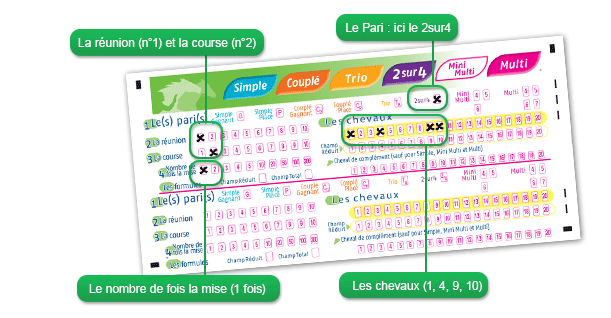
The French PMU ("Pari Mutuel Urbain") is a horse racing betting game where multiple independent players bet on the same event.
This game allows only limited strategic depth, as horse behavior remains predominant.
Equipment :
1. Official list of runners, published before each race, allowing players to know the numbers, names, jockeys (or drivers), and indicative odds of the entered horses.
2. Betting grid mentioning in the standardized order (see Figure above) :
- Race identification in the grid header : meeting number (corresponding to the hippodrome with date/time) and race number
- Bet type, selected using buttons or checkboxes
- Order/disorder mode, to be checked in specific boxes
- Numbers of the chosen horses on the main grid : boxes numbered 1 to 18
- Amount bet : unit amount (1.50, 2, 3 euros, etc.) or multiples
Example of Quinté+ order grid : [Meeting 1 - R5 Vincennes], [Quinté+], [Order], [Checked numbers : 2-8-11-14-6], [Stake : 2 euros].
3. Type of betting support : either paper ticket (filled manually and validated at an authorized point of sale counter), or digital recording made via an electronic terminal at a point of sale (example : partner tobacco shops), or mobile application or official PMU website (pmu.fr).
Race procedure :
- Start : The race begins with the presentation of the horses to the public and in the paddock (approximately 30 minutes before the start). Betting remains open until official closure, typically 2 to 5 minutes before the actual departure.
- Race : The event, lasting an average of 1 to 5 minutes (flat racing, trotting, or jumping), takes place under the supervision of officials and stewards responsible for enforcing the racing code. At the finish, a provisional ranking is established. In case of a close finish, photo-finish technology determines the order of arrival.
- Final results : Results become final after validation by the stewards, usually within 10 to 20 minutes following the finish, unless there is an objection or investigation. This validation triggers the official publication of odds and initiates payment of winnings to successful bettors.
Winning conditions :
The amount of winnings is proportional to the stake placed and inversely proportional to the total amount of winning stakes recorded on the same bet type.
For each bet type and each race, players' stakes constitute a common pool. After application of regulatory deductions (typically 20 %), the balance is distributed among winning bettors only, pro rata to their stake.
Example :
- Total pool of 100 euros.
- Amount to be distributed R = 80 euros (after 20 % deduction).
- If there are 2 sole winners who staked 1 and 3 euros respectively, the odds r are the ratio between the amount R to be distributed and the sum of winning stakes : r = 80/(1 + 3) = 20
- Each winner then receives an amount equal to stake ratio, i.e. 20 euros for the first player and 60 euros for the second.
- Each player's net gain, after deduction of their initial stake, is therefore 19 and 57 euros respectively.
The following table lists the main bet types offered by PMU, with their theoretical probability of winning (calculated for a race with n = 15 runners).
| Bet type | Description | Average odds (r) | probability (p) | Expectation (E) |
|---|---|---|---|---|
| Simple winner | Exact 1st | 6-12 | 1/n = 1/15 = 6.67 % | -0.60 to -0.20 |
| Simple placed | 1st, 2nd or 3rd | 1-3 | 3/n (for n ≥ 8) = 3/15 = 20.0 % | -0.80 to -0.40 |
| Exacta order | 1st and 2nd in order | 80-200 | 1/(n(n - 1)) = 1/210 = 0.476 % | -0.62 to -0.05 |
| Exacta disorder | 1st and 2nd any order | 25-60 | C(n - 2, 0)/C(n, 2) = 2/(n(n - 1)) = 2/210 = 0.952 % | -0.76 to -0.43 |
| 2 out of 4 | Selection of 4 horses with at least 2 finishing in top 4 | 3-15 | C(n - 2, 2)/C(n, 4) = 78/1365 = 5.71 % | -0.83 to -0.14 |
| Trio order | 1st, 2nd and 3rd in order | 800-1200 | 1/(n(n - 1)(n - 2)) = 1/2730 = 0.0366 % | -0.71 to -0.56 |
| Trio disorder | 1st, 2nd and 3rd any order | 25-40 | C(n - 3, 0)/C(n, 3) = 6/(n(n - 1)(n - 2)) = 6/2730 = 0.220 % | -0.95 to -0.91 |
| Tiercé order | 1st, 2nd and 3rd in order, with possible rollover | 800-2500 (no bonus B) 50-200 (with avg B = 0.08 %) | 1/(n(n - 1)(n - 2)) = 1/2730 = 0.0366 % + avg B = 0.12 % | -0.71 to -0.084 -0.067 to +1.92 |
| Tiercé disorder | 1st, 2nd and 3rd any order, with possible rollover | 80-300 (no bonus B or avg B = 0.25 %) | C(n - 3, 0)/C(n, 3) = 3!/(n(n - 1)(n - 2)) = 6/2730 = 0.220 % + avg B = 0.47 % | -0.82 to -0.34 -0.62 to +0.41 |
| Quarté+ order | 1st to 4th in exact order, with possible rollover | 10000-80000 (no bonus B or avg B = 0.15 %) | 1/(n(n - 1)(n - 2)(n - 3)) = 1/32760 = 0.00305 % + avg B = 0.153 % | -0.70 to +1.4 +14.3 to +121.4 |
| Quarté+ disorder | 1st to 4th any order, with possible rollover | 1000-15000 (no bonus B or avg B = 0.30 %) | C(n - 4, 0)/C(n, 4) = 4!/(n(n - 1)(n - 2)(n - 3)) = 24/32760 = 0.0732 % + avg B = 0.301 % | -0.27 to +10.0 +2.0 to +44.2 |
| Quinté+ order | 1st to 5th in exact order | 80000-300000 | 1/(n(n - 1)(n - 2)(n - 3)(n - 4)) = 1/360360 = 0.00028 % | -0.78 to -0.16 |
| Quinté+ disorder | 1st to 5th any order, with possible rollover | 2500-25000 (no bonus B or avg B = 0.11 %) | C(n - 5, 0)/C(n, 5) = 5!/(n(n - 1)(n - 2)(n - 3)(n - 4)) = 120/360360 = 0.0333 % + avg B = 0.143 % | -0.17 to +7.3 +2.6 to +34.8 |
| Tic 3 | Selection of 5 horses allowing simultaneous play on Tiercé, Quarté+ and Quinté+ disorder | 15-80 | C(5, 3)/C(n, 3) + C(5, 4)/C(n, 4) + C(5, 5)/C(n, 5) = 10/455 + 5/1365 + 1/3003 = 2.60 % | -0.61 to +1.08 |
Notes on this table :
1. The odds (r) are the final ratio (euros won per euro staked), published after the race.
2. The probability (p) is the purely combinatorial probability of winning the bet, assuming each horse is equiprobable.
Binomial coefficient C(a, b) = a!/(b!(a - b)!)
3. The Bonus B is the additional probability of the bet in case of pool rollover when no player wins the bet (redistribution of stakes to extended positions of the same race : 4th, 5th, etc., for Tiercé for example).
4. The mathematical expectation (E) of a unit stake bet (cost c = 1) is the difference between the expected winnings (c r) p and the cost c.
Example : For a c = 1 euro stake on Simple Winner with historical average odds r = 10, and n = 15 runners, E = (1 10) 1/15 - 1 = -0.33 euro, i.e. an average loss of 33% per euro staked.
The mathematical expectation E shows an average loss of 30 to 60 % across all bet types, but can exceptionally approach zero, particularly on Tiercé, Quarté+, or Quinté+ during significant rollovers.
Winning strategy :
There is no winning strategy for French PMU betting, but there exists a rational strategy aimed at reducing losses.
The expectation E is positive if and only if the odds r exceed the critical threshold 1/p. Consequently, the rational strategy is as follows [PER][CHA] :
- Target bets where the estimated pre-race odds (r) are very close to the critical threshold 1/p from the previous table.
- Identify underbet favorites (horses with high actual win probability but lightly bet, thus offering high odds r).
- Avoid bets on heavily oversubscribed pools (too many bettors on one horse).
- Diversify stakes across multiple bet types.
- Do not consider Tiercé, Quarté+, or Quinté+ bets as inherently preferable due to potential bonuses, as bonus situations remain statistically exceptional.
- For simple bets (single horse), avoid market extremes (overbet favorite and speculative longshot) and favor intermediate horses (2nd or 3rd favorites).
- For compound bets (multiple horses), build balanced combinations, often around a solid favorite, adding underbet intermediate horses.
B2.7.2. Soccer [PER][CHA] :
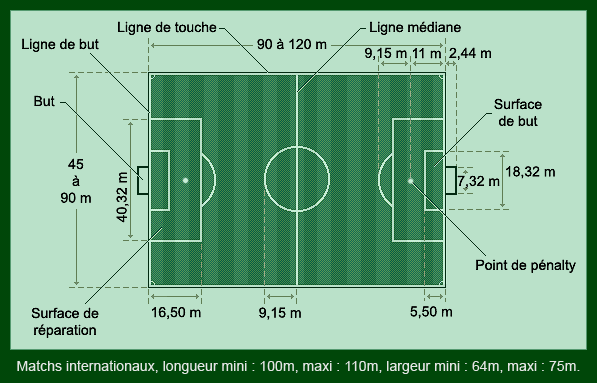
Soccer is a team sport pitting two teams of eleven players against each other on a field, aiming to score goals by propelling a spherical ball, primarily with the feet.
This game features a significant strategic dimension where collective tactics and individual qualities play an essential role.
Equipment :
- Field (see Figure above) : Rectangular area (length 90-120 m x width 45-90 m) with corner flags (minimum height 1.5 m), two goals with nets (width 7.32 m x height 2.44 m), penalty area in front of each goal (depth 16.5 m x width 40.32 m), goal lines, touchlines, halfway line.
- Ball : Spherical, circumference 68-70 cm, weight 410-450 g, pressure 0.6-1.1 atm.
- Players : 11 per team (10 outfield players + 1 goalkeeper), with mixed teams allowed in non-specific categories.
- Equipment : Numbered jersey, shorts, socks, shin guards mandatory, studded boots, distinct kit for the goalkeeper, jewelry prohibited.
Objective :
- Objective : Score more goals than the opposing team by propelling the ball into the opponent's goal, primarily with the feet (head and torso allowed).
- Duration : 90 minutes (2 x 45 min. with 15-min. halftime), extra time in case of tie (2 x 15 min. in knockout stages) and penalty shootout if necessary.
- Penalty shootout : If the tie persists after extra time, a session of 5 alternating penalties. If the tie remains, the session continues shot by shot in sudden death.
- Sudden death : As soon as one team leads and the other misses its corresponding shot.
Kick-off :
Kick-off : Ball at the center of the field, drop kick (drop consisting of releasing the ball from the hands and striking it with the foot after the bounce), either at the start of the match by the home team (or by toss) or by the team that did not score the last goal.
Other restarts :
- Throw-in : Ball gone out over the touchline, thrown in with two hands from the point of exit by an opponent.
- Goalkeeper clearance : Ball gone out over the goal line, last touched by a teammate, restarted by the goalkeeper from the penalty area.
- Corner : Ball gone out over the goal line, last touched by an opponent, kicked from the nearest corner.
- Free kick direct or indirect.
Fouls :
Direct free kick (or penalty if committed in own penalty area) :
- Violent charge : Excessive physical contact with an opponent.
- Dangerous tackle : Excessive use of feet or legs.
- Spitting : Projecting saliva at any person.
- Deliberate handball : Intentional touching of the ball with hand or arm (except goalkeeper in penalty area).
- Holding or pushing an opponent : Action with hands or body.
- Violent conduct against an opponent, even without contact.
Indirect Free Kick :
- Offside : A player located in the opponent's half of the field, nearer to the goal line than both the ball and the second-to-last opponent, at the moment a teammate plays the ball toward him (pass, cross, etc.). No offside if the player is in his own half, directly controls the ball (dribble, first touch), or if the ball comes from a throw-in, corner, or goal kick.
- Dangerous play without contact : Risky action without touching the opponent (e.g., foot raised to head height).
- Impeding without contact : Blocking an opponent without playing the ball.
- Simulation : Exaggerated dive to deceive the referee.
- Back-pass to goalkeeper : On a deliberate foot pass from a teammate, the goalkeeper may play the ball but not with hands.
- Goalkeeper double contact : If the goalkeeper releases the ball from hands, he cannot pick it up again until another player has touched it.
- Goalkeeper's 6 seconds : Goalkeeper holding the ball longer than 6 seconds.
- Antisporting behavior with goalkeeper : Repeated or unnecessary use of the goalkeeper to circulate the ball and waste time.
Sanctions :
- Yellow card : Warning (2 yellows = red).
- Red card : Immediate expulsion (serious foul, violent conduct, or accumulation of two yellow cards).
- Penalty : Single shot from the penalty spot (11 m), with only the goalkeeper as opponent.
Winning strategy :
The main rules aimed at dominating the opponent are as follows :
Defensive strategies :
- Collective pressing : Upon loss of possession, the team quickly repositions to apply pressure and slow down the opponent's progression.
- Zonal marking : Each player covers a specific zone rather than an individual opponent, reducing risks of simulation or obstruction.
- High defensive line : The defense positions itself advanced to trap attackers in offside positions.
Offensive strategies :
- Quick transitions : Upon ball recovery, immediately launch a counter-attack to exploit spaces left by the opponent.
- Short combinations : Use precise short passes to destabilize the opposing defense and create exploitable gaps.
- Wing play : Develop play on the flanks with overlaps and crosses to provoke corners or penalties.
Match management :
- Possession mastery : Keep the ball as long as possible with precise build-up play.
- Dominance periods management : Capitalize on periods of control to score, anticipating extra time and penalties if necessary.
- Foul exploitation : Provoke direct fouls from opponents to obtain yellow cards and strategic free kicks.
B2.7.3. Rugby union [PER][CHA] :
Rugby union is a team sport pitting two teams of fifteen players against each other on a field, aiming to score points, particularly by grounding an oval ball in the opponent's in-goal area for a try, primarily with the hands.
This game features a significant strategic dimension where collective tactics and individual qualities play an essential role.
Equipment :
- Field (see Figure above) : Rectangular area (width 68-70 m x length 94-100 m between goal lines), two H-shaped posts (spacing 5.6 m, crossbar at 3 m height) on each goal line, an in-goal area behind each goal line (width 68-70 m x depth 10-22 m), goal lines, touchlines, dead-ball lines, 22 m lines, halfway line.
- Ball : Oval, length 28-30 cm, circumference (long axis) 74-77 cm, weight 400-440 g, pressure 0.66-0.75 atm.
- Players : 15 per team (8 forwards + 7 backs), with substitutes (up to 8 in official competition).
- Equipment : Numbered jersey, shorts, socks, studded boots, mouthguard mandatory, soft protections allowed (helmet, shoulder pads, etc.), distinct kit for each team.
Objective :
- Objective : Score more points than the opposing team by grounding the ball in the opponent's in-goal area (try or by kicking the ball between the posts (conversion after try, penalty, drop goal), primarily with the hands.
- Duration : 80 minutes (2 x 40 min. with 10-15 min. halftime), extra time in case of tie (2 x 10 min. in knockout stages) and sudden death if necessary.
- Sudden death : The first scoring points decide the winner.
Kick-off :
Kick-off : Ball at the center of the field, dropped from hands and kicked after bounce (drop kick), either at the start of the match by the team drawn by lot, or by the team that did not score the last points (try, conversion, penalty, or drop goal).
Other restarts :
- Line-out : Ball gone out over the touchline, thrown in with two hands overhead from the point of exit by a player from the opposing team.
- Scrum : After certain minor infringements, 8 players from each team bind together to contest the ball introduced into the tunnel by the scrum-half.
- Penalty : After an opponent's foul, the benefiting team may choose: attempt the goal, kick to touch, play quickly by hand, or opt for a scrum.
- 22-meter drop-out : When the ball is made dead or grounded in the defending team's in-goal (the team not in possession) without a try being awarded, that team restarts with a drop kick from its own 22-meter line.
- Ruck : After a tackle with the ball on the ground, players from both teams bind upright over the ball to contest it with their feet.
- Maul : The ball carrier is held upright by an opponent and pushed forward by teammates to advance.
Scoring table :
Try (ball grounded in the opponent's in-goal area) : 5 pts
Conversion after try (place kick or drop, with ball passing between the posts) : 2 pts
Penalty (place kick with ball passing between the posts) : 3 pts
Drop goal (drop with ball passing between the posts) : 3 pts
Penalty try : 7 pts (5 + automatic conversion granted)
Fouls :
Penalty :
- Dangerous tackle : Tackle above the shoulders.
- Illegal tackle : Tackle without wrapping (e.g., from behind).
- Obstruction : Blocking an opponent without playing the ball.
- Offside : Player ahead of his ball-carrying teammate or in a prohibited position.
- Hands in ruck : Handling the ball in a formed ruck.
- Holding opponent : Grasping an opponent without attempting to play the ball.
Penalty try :
- Violent blows : Punch, deliberate kick.
- Dangerous conduct : Shoulder to face, head-first tackle.
Free kick :
- Minor offside : Irregular position in static phase (scrum, line-out, open play).
- Irregular scrum introduction.
- Irregular line-out (e.g., crooked throw).
Sanctions :
- Yellow card : Temporary player exclusion (10 minutes). The team plays with 14 players during the sanction.
- Red card : Permanent player expulsion for the rest of the match (serious foul, violence, or two yellow cards) with no replacement possible.
- Penalty.
Winning strategy :
The main rules aimed at dominating the opponent are as follows :
Defensive strategies :
- Collective pressing : Upon loss of possession, the team quickly repositions to apply pressure and slow down the opponent's progression.
- Aligned defense : Organized and compact defensive line to close central spaces and channel the attack toward the flanks.
- Ruck contestation : Legal pressure on ruck phases to attempt ball recovery or slow down the release.
Offensive strategies :
- Penetrating play : Straight runs by forwards to pin the defense and create gaps.
- Wide play : Use of passes to stretch the defense and exploit spaces on the wings.
- Rolling maul : Forwards bound together pushing the carrier to gain meters through successive phases.
Match management :
- Scrum mastery : Use scrums to secure possession and structure attacks.
- Dominance periods management : Convert periods of control into points.
- Penalty exploitation : Choose the best option based on field position.
B2.8. Sources relating to Strategy games
[BLE] Bleach-Mx, Comment fonctionne la roulette française ?.
[BON] Bonus Roulette, COMMENT JOUER AU JEU DE LA BOULE AU CASINO ?.
[CHA] ChatGPT, le moteur d'Intelligence Artificielle développé par OpenAI.
[CLA] Claude, le moteur d'Intelligence Artificielle développé par Anthropic.
[CUR] Courses de vecteurs, Course de vecteurs.
[DEL1] Jean-Paul Delahaye, Stratégies magiques au pays de Nim, Pour la Science - n 377 - Mars 2009.
[DEL2] Jean-Paul Delahaye, Les martingales et autres illusions, Pour la Science - n 251 - Septembre 1998.
[GUI1] Guide Roulette, Roulette Européenne.
[GUI2] Guide Roulette, Roulette Américaine.
[JEU] Jeux Solo ici et là, ACCORDEON #31 (Youtube, 11:54).
[PER] Perplexity, le moteur d'Intelligence Artificielle développé par Perplexity AI.
[ROU1] Roulette 17, Tiers Du Cylindre.
[ROU2] Roulette 17, Voisins Du Zero.
[ROU3] Roulette 17, Orphelins.
[ROU4] Roulette 17, Jeu Zero.
[TOU] Pierre Tougne, Roulette, Loto et probabilités, La mathématique des jeux, pp.147-156, Pour la Science, 1991.
[TRI1] Jean Tricot, Jeux et informatique - Le jeu des pièces de 10 francs, Science et Vie - n 722 - Novembre 1977.
[TRI2] Jean Tricot, Jeux et informatique - Le jeu de Northcott, Science et Vie - n 724 - Janvier 1978.
[WIK1] Wikipedia, Bataille (jeu).
[WIK2] Wikipedia, Bataille navale(jeu).
[WIK3] Wikipedia, Racetrack (game).
[WIK4] Wikipedia, Crapette.
[WIK5] Wikipedia, Yahtzee.
[WIK6] Wikipedia, Pig (dice game).
[WIK7] Wikipedia, Morpion (jeu).
[WIK8] Wikipedia, Tic-tac-toe.
[WIK9] Wikipedia, Poker.
[WIK10] Wikipedia, Roulette (jeu de hasard).
 Last page update : September 24, 2026.