| En Français | Home/Contact | Billiards | Hydraulic ram | HNS | Relativity | Botany | Music | Ornitho | Meteo | Help |
This chapter explores key aspects of climate change, including the role of the IPCC, the controversy surrounding the topic, greenhouse gases, individual and collective carbon footprints, and potential impacts and solutions to help us better understand how to address this global challenge.
C1.1. Definition :
Climate change, also called "global warming", is the significant increase in the average temperature of the earth's surface since the beginning of the 20th century.
Be careful not to confuse "climate" and "weather". Weather refers to the weather over a short period (a day, a week). Climate refers to past and future time over long periods (year, century, millennium).
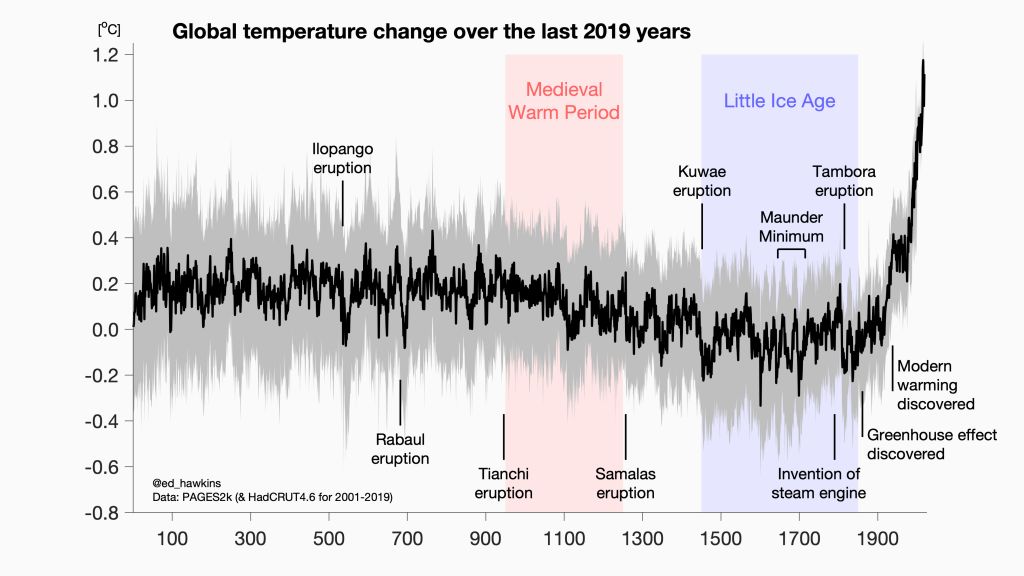
The graph above in left Figure shows that this increase (from 1900 to 2019) is unprecedented in the last 2000 years. The graph is a reconstruction including data from a wide variety of records such as tree rings, cave deposits, corals, etc. Added some relevant world events such as major volcanic eruptions, the Maunder Solar Minimum and historical dates of scientific discoveries. The oft-cited Medieval Warm Period and Little Ice Age are real phenomena, but small compared to recent changes [HAW].
Caption : Evolution of the global average annual temperature of the earth's surface from year 1 to 2019, relative to the pre-industrial reference (1850-1900) [HAW].
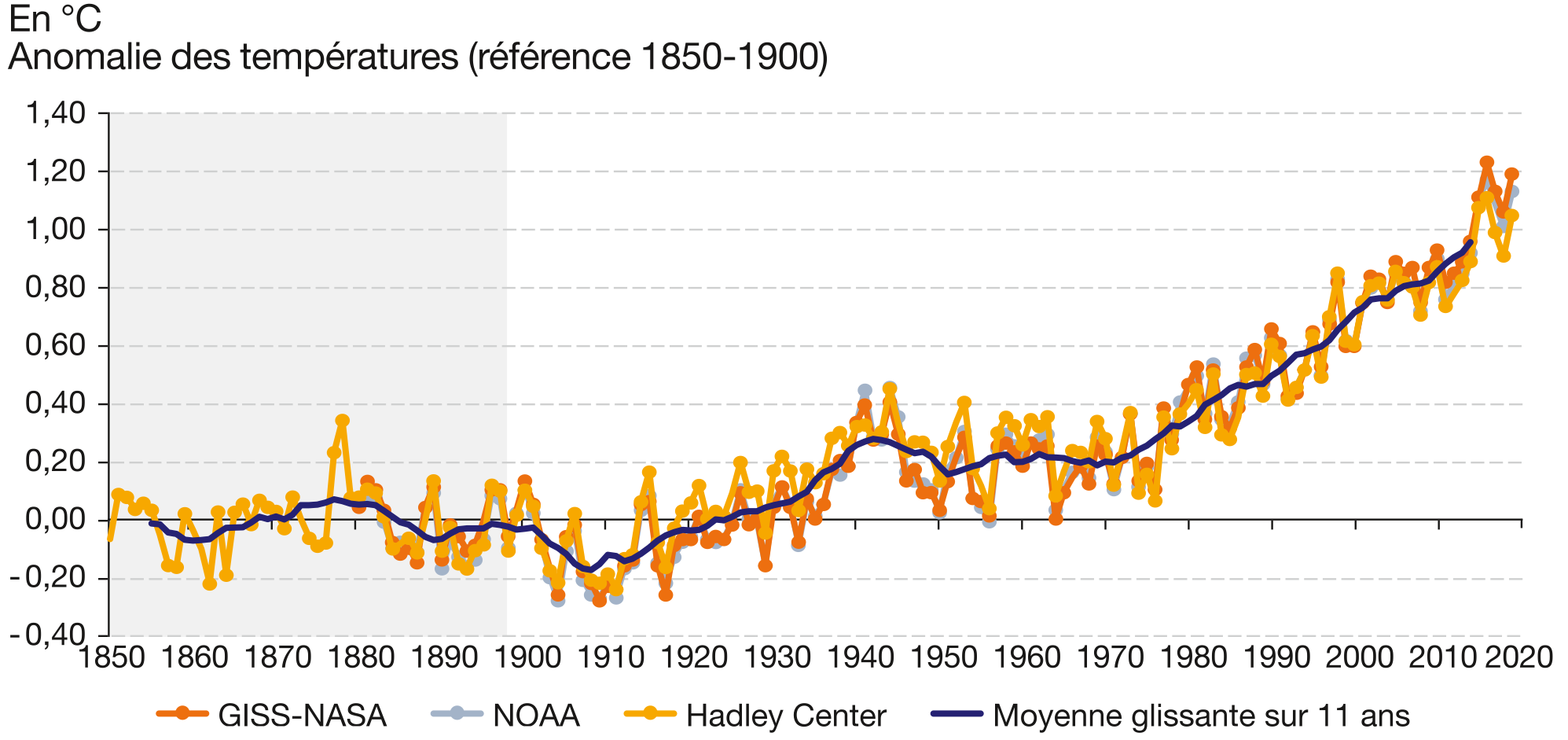
The graph above in right Figure shows that the decade 2011-2020 was 1.1 C warmer than the pre-industrial reference (1850-1900), with warming being greater on the continents (+1.6 C) than in above the oceans (+0.9 C) [TSP][GIE][MTE3].
Caption : Evolution of the global average annual temperature of the earth's surface from 1850 to 2020, relative to the pre-industrial reference (1850-1900) [MTE3]. The connected dots show the data year by year. The solid black curve is a rolling average of the annual totals over 11 years (average of years N-5 to N+5 for year N) making it possible to overcome the modulation due to the cycle of solar activity (11 years) [POI].
C1.2. IPCC :
The IPCC (Intergovernmental Panel on Climate Change) is a scientific body created in 1988, responsible for assessing the extent, causes and consequences of ongoing climate change.
The IPCC position confirms this warming and attributes it unequivocally to greenhouse gas (GHG) emissions of human origin, called "additional or additive or anthropogenic greenhouse effect" [WIK1].
A very broad scientific consensus endorses the IPCC position and agrees that solar irradiation is not the cause of climate change for two reasons [NAS1][NAS2] :
- Since the beginning of the 20th century, the average amount of solar energy received by the Earth has remained constant within 0.1 % [BLA] ;
- If the Sun were responsible for global warming, this warming would act in all layers of the atmosphere, from the surface to the upper atmosphere (stratosphere). However, the observations instead show warming at the surface and cooling in the stratosphere, which is consistent with the fact that the warming is caused by an accumulation of heat-trapping gases near the Earth's surface.
C1.3. Controversy :
Some people, called "climate skeptics", express denial of global warming and are divided into four main trends [WIK7] :
1. those who deny global warming ;
2. those who admit global warming but deny its human origin ;
3. those who admit global warming but deny its impacts ;
4. those who have no opinion on global warming but deny the scientific consensus on the topic (conspiracy theory).
The motivations are varied and lie essentially between two positions : doubt in good faith and doubt proclaimed out of interest [POI].
In the United States, in 2023, one in two inhabitants is climate skeptic [RFI] with motivations essentially oriented towards economic interest. Positions of denial, sometimes violent, are mainly held by "skeptical bloggers", supporters of conservative economic policies, industrialists opposed to the taxation of CO2 emissions and some groups financed by the tobacco and fossil fuel industries [ WIK7][RFI].
In the "top 3" of the most climate-sceptical countries, we find Saudi Arabia at the top, then come the United States and Australia, these countries being also three major producers of hydrocarbons (oil, gas and coal) [RFI].
In France, in 2022, 37 % of people consider themselves climate skeptics, including 8 % belonging to trend no. 1 [FJJ]. We can cite :
The controversy is therefore not scientific but societal [AFI].
When the doubt is in good faith, the controversy is rather passive, experienced in public opinion as a possible, probable and uncertain scenario, in a word a "discreet" and silent catastrophe [MDS].
When the doubt is proclaimed out of interest, the controversy is active, often polluted with verbal violence, particularly on the X platform (formerly Twitter).
C1.4. Greenhouse gas :
The Earth constantly receives energy from the sun in the form of visible light. 30 % is reflected by the atmosphere and the earth's surface, 20 % is absorbed by ozone and water vapor in the atmosphere, 50 % is absorbed by the earth's surface which heats up and emits infrared radiation from all the more intense as the surfaces are hot.
10 % of this radiation is emitted towards the universe, 90 % is absorbed by some gases called "greenhouse gases" and partly reradiated towards the surface, thereby slowing the loss of heat into space and causing global warming.
The Earth thus maintains an average temperature of +15 C by a natural balance between the energy of the sun absorbed and that re-emitted in the form of infrared radiation. Without these gases, the average temperature on Earth would be -18 C, and life as we know it would become impossible [NAS1][MTE1][DUF][WIK2][WIK3].
Since the beginning of the 20th century, man has considerably increased the quantity of greenhouse gases naturally present in the atmosphere, thus modifying the climatic balance through an additional greenhouse effect [MTE1].
These gases are essentially made up of the following elements [NAS1][WIK1][DUF][CDE][FRA1][ADT][CAR][BEN] :
In summary, according to these figures, global warming of human origin (additional greenhouse effect) is mainly due to fossil fuels (47 %), agriculture (25 %) and deforestation (20 %).
In France, the transport sector constitutes the largest source of greenhouse gas emissions, accounting for 30 % of national emissions.
Over the entire life cycle of vehicles (extraction and processing of raw materials, manufacturing, transportation and use of the vehicle), these emissions are attributable as follows : passenger cars (53 %), heavy goods vehicles (27 %), utility vehicles light (15 %), air transport (3 %) and other modes of transport (2 % : two-wheelers, rail and maritime) [GRE].
C1.5. Carbon footprint :
The carbon footprint (or GHG balance) of a product, a person, a company, a sector of activity or a territory is a measure of the cumulative quantity of all greenhouse gas emissions that can be attributed to it. This measure can be evaluated according to two conventions :
- either in direct emissions due to the use of energy by the final consumer ;
- either in life cycle analysis taking into account emissions due to the use of energy but also indirect emissions due to all upstream energy transformations (research and development, production, transport, distribution ), or even downstream (recycling, dismantling) [WIK4].
Example of carbon footprint for different modes of transport (in CO2 equivalent per passenger over 100 km) : plane (20 kg), motorcycle (19 kg), gasoline car (15 kg), diesel car (14 kg), electric car (10 kg), coach (3 kg), TGV (0.2 kg) [SEL].
For a greenhouse gas, its contribution to the greenhouse effect is measured by its Global Warming Potential (GWP) defined as the radiative forcing (i.e. the radiative power that the gas returns to the ground), accumulated over a reference period of 100 years and measured relative to the same mass of CO2.
The GWP is 1 for CO2 ; 8 for water vapor ; 30 for CH4 ; 300 for N2O ; 700 to 15,000 for CFC, HFC and PFC ; 17,000 for the NF3 ; 25,000 for SF6.
The carbon footprint of gas is then expressed in grams of CO2 equivalent per kilowatt-hour (gCO2eq/kWh) corresponding to the product of the mass of gas (mog) by its Global Warming Potential (GWP).
The carbon footprint of gas is sometimes also expressed by a Carbon Equivalent (CE) which only measures the mass of carbon (C) contained in the CO2 emitted. We then have the relationship : CE = 0.2727 x mog x PRG
The Bilan Carbone is a method of calculating the carbon footprint according to three distinct scopes of emissions (direct induced by the combustion of fossil fuels, indirect induced by energy consumption, indirect other).
It takes into account the six greenhouse gases designated by the Kyoto Protocol (CO2, CH4, N2O, hydrofluorocarbons (HFC), perfluorocarbons (PFC) and sulfur hexafluoride (SF6)), as well as trifluoride nitrogen (NF3), and water vapor in the case of air transport [WIK5].
The ecological footprint (or environmental footprint) covers a broader spectrum and consists of estimating the quantity of land and water necessary for an individual or population to meet its needs without depleting natural resources or disrupting the ecosystem.
More than half of the French ecological footprint is due to the carbon footprint [WIK6].
C1.6. Impacts :
The main effect of global warming is [NAT1] :
By the end of the century, if GHG emissions follow their current trajectory without additional climate policy and with high population growth (IPCC SSP3-7.0 scenario), warming will be +4 C with sea levels rising 1 m relative to the pre-industrial reference (1850-1900) [MTE4].
In this probable scenario, particularly if States engage in regional or global conflicts to the detriment of international climate policies, the IPCC identifies several key risks for Europe, which directly concern France [RCA1] :
C1.7. Solutions :
The fight against climate change relies on two levers :
The recommended solutions are as follows [RCA2] [MTE2][MTE3] :
C1.8. Sources relating to climat change :
[ADT] Académie des technologies, Le méthane - d'où vient-il et quel est son impact sur le climat ?.
[AFI] Afis Science, Le "climato-scepticisme" : un concept fourre-tout.
[ALL] Vanessa Allnutt, Les climatosceptiques contre la science.
[AMB] Valentine Ambert, Va-t-on manquer d'eau ?, Youmatter.
[BEN] Marc Benoît, Pollutions agricoles, CNRS Editions.
[BLA] Guillaume Blanc, Le réchauffement climatique.
[CAR] Carbone4, L'ozone des basses altitudes, une épée à double tranchant.
[CCE] Cour des Comptes Européenne, Lutte contre la désertification dans l'UE : le phénomène s'aggravant, de nouvelles mesures s'imposent.
[CDE] CDE - Connaissance des Energies, Gaz à effet de serre : d'où proviennent les émissions de méthane ?.
[DEL] Céline Deluzarche, Pourquoi manque-t-on de plus en plus d'eau alors que les pluies augmentent ?, Futura.
[DUF] Jean-Louis Dufresne, L'effet de serre, Planet Terre.
[FJJ] Fondation Jean Jaurès, Climatoscepticisme : Le nouvel horizon du populisme français.
[FRA1] Franceinfo, COP26 : on vous explique ce qu'est le méthane, l'autre gaz à effet de serre qui réchauffe le climat.
[FRA2] Franceinfo, Changement climatique : on vous explique pourquoi sécheresse et inondations sont parfois liées.
[FRI] France Inter, Algorithmes : les meilleurs amis des climatosceptiques.
[GIE] GIEC, Synthèse du rapport AR6 du GIEC publié le 27/03/2023.
[GRE] Greenly, Les transports, premier secteur émetteur en France.
[HIL] David Hiler, Réchauffement climatique : comprendre ceux qui n'y croient pas, Le Temps.
[IDV] idverde, Comment réduire les risques de pénurie d'eau ?.
[LAP] Pascal Lapointe, Les réseaux sociaux favorisent le discours climatosceptique ? Vrai, Agence Science-Presse.
[LAR] Larousse, Désertification.
[MDS] Martin de La Soudière, Le changement climatique, une "grande peur" collective ?.
[MEF1] Meteo France, Climat HD.
[MEF2] Meteo France, Tempêtes en France métropolitaine.
[MTE1] Ministère de la transition écologique et de la cohésion des territoires, Pourquoi la Terre chauffe ? 14 septembre 2018.
[MTE2] Ministère de la transition écologique et de la cohésion des territoires, Dossier de presse - 1er Plan national d'adaptation au changement climatique, 20 juillet 2011.
[MTE3] Ministère de la transition écologique et de la cohésion des territoires, Observations du changement climatique.
[MTE4] Chiffres clés du climat - France, Europe et Monde (décembre 2022).
[NAS1] NASA, Les causes du changement climatique.
[NAS2] NASA, Le Soleil est-il à l'origine du réchauffement climatique ?.
[NAT1] Nations Unis, Causes du changement climatique.
[NAT2] Nations Unis, L'eau - au coeur de la crise climatique.
[ONE] ONERC, Les évènements météorologiques extrêmes dans un contexte de changement climatique.
[POI] Jean Poitou, Climat : distinguer le vrai du faux, Progressistes.
[RCA1] Réseau Climat Action France, 6e rapport du GIEC : quelles sont les conséquences réelles du changement climatique ? 28-02-2022.
[RCA2] Réseau Climat Action France, Synthèse du 6e rapport du GIEC : l'urgence climatique est là, les solutions aussi, 20-03-2023.
[RCA3] Réseau Climat Action France, 6e rapport du GIEC : quelles solutions face au changement climatique ? 04-04-2022.
[REP1] Reporterre, Le réchauffement des sous-sols, une "menace silencieuse".
[REP2] Reporterre, Déni de réalité : pourquoi le climatoscepticisme progresse.
[RFI] RFI, Pourquoi y a-t-il encore autant de climatosceptiques aux Etats-Unis et dans le monde ?.
[RIV] Johan Rivalland, La Démocratie des crédules - Critique du dernier livre de Gérald Bronner.
[ROY] Florentin Roy, Les forêts en Méditerranée vont-elles disparaître ?, Youmatter.
[SEL] Selectra, Empreinte Carbone : calcul, définition et conseils de réduction.
[SEN] Sénat, Adapter la France aux dérèglements climatiques à l'horizon 2050 : urgence déclarée.
[TSP] The Shift Project, Climat : synthèse vulgarisée du 6ème rapport du GIEC (mars 2023).
[WIK1] Wikipedia, Gaz à effet de serre.
[WIK2] Wikipedia, Effet de serre.
[WIK3] Wikipedia, Changement climatique.
[WIK4] Wikipedia, Empreinte carbone.
[WIK5] Wikipedia, Bilan carbone.
[WIK6] Wikipedia, Empreinte écologique.
[WIK7] Wikipedia, Déni du réchauffement climatique.
[WIK8] Wikipedia, Elévation du niveau de la mer.
[ZEK] Marie Zekri, 37 % des Français se considèrent climato-sceptiques, National Geographic.
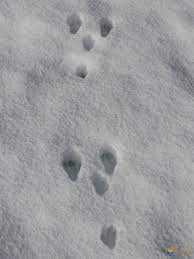
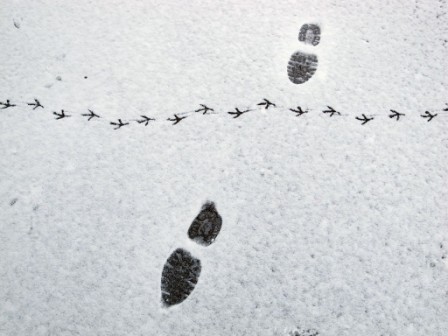
Footprints printed on the ground or in the snow allow most mammals and birds to be identified.
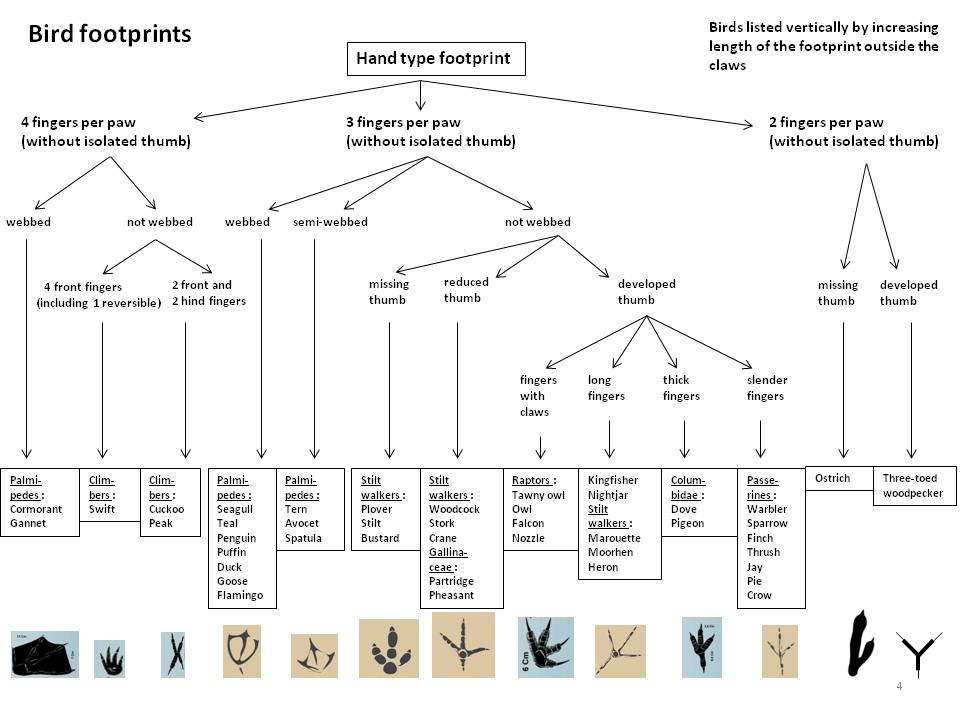
For birds, the identification method is based on each Isolated footprint, a bird being able to only walk or hop on the ground.
For mammals, the identification relies on the joint use of three different methods based on the following observations :
- Isolated footprint,
- Succession of footprints, giving the movement pattern of the animal,
- Droopings of the animal.
C2.1. Isolated footprint
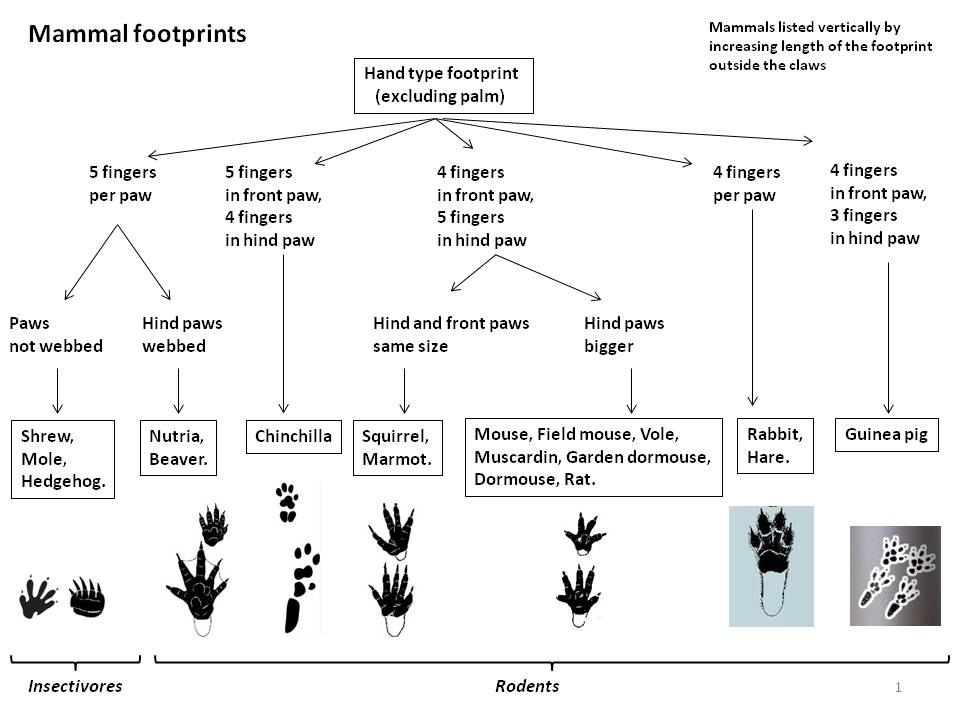
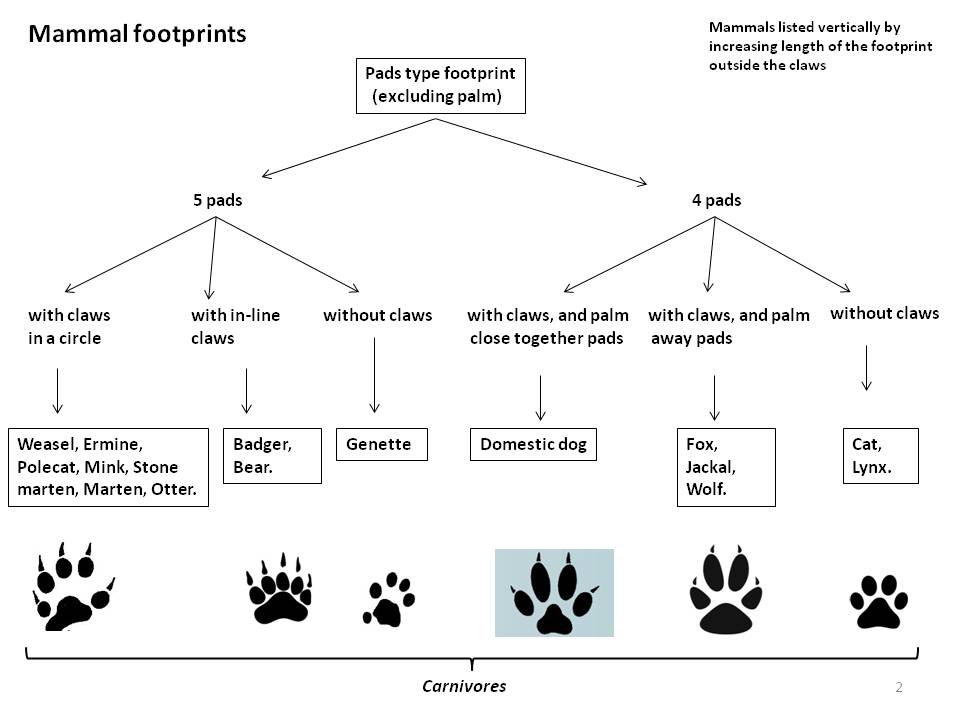
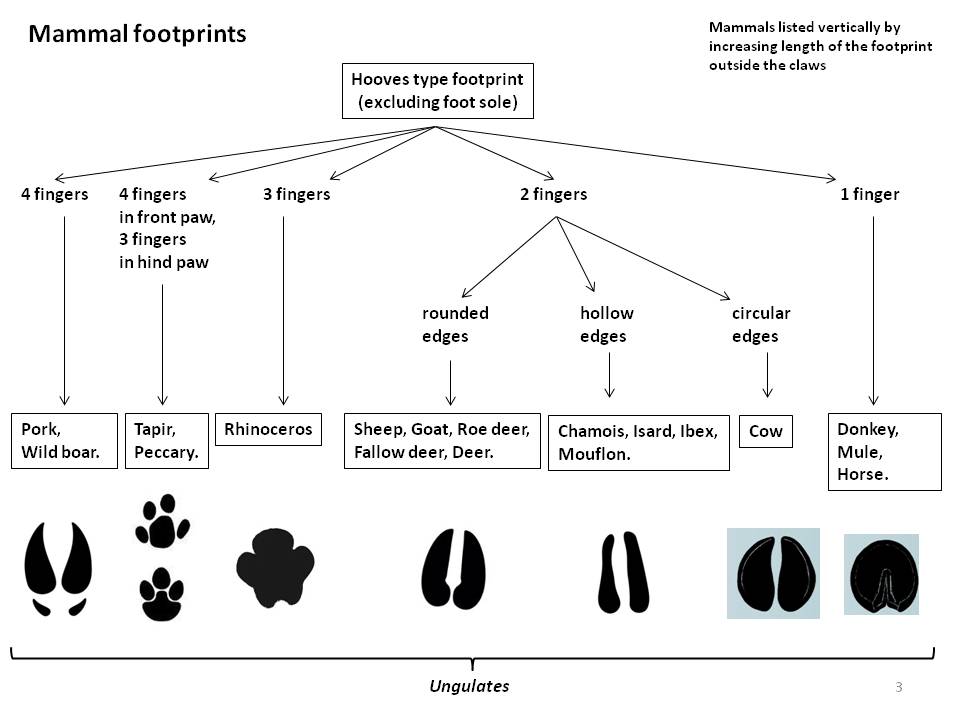
Mammal footprints are all Hand type (with 3, 4 or 5 fingers per paw, excluding palm), Pads type (with 4 or 5 digital pads per paw, excluding palm) or Hooves type (with 1, 2, 3 or 4 fingers per paw, excluding foot sole).
Bird footprints are all Hand type comprising, with some exceptions, 3 fingers per paw supplemented by a fourth opposite finger (thumb) which may be reduced or completely absent.
The 4 slides below present a method of identifying mammals and birds from their isolated footprints.
Sources :
(empreintes des mammifères) Ma Chasse, Les mammifères.
(empreintes des mammifères) France Nature Environnement - Haute-Savoie, Les empreintes.
(empreintes des mammifères) Gilles Christophe, FRAPNA, Les mammifères de Rhône-Alpes- les empreintes.
(empreintes des mammifères) Salamandre, Empreinte de mammifères.
(empreintes des oiseaux) Ma Chasse, Les oiseaux.
(oiseaux) Zadi Bridge, Combien les oiseaux ont-ils de doigts ?.
(ongulés) Puverel Camille, Leprince Julie, Atlas des mammifères de Rhône-Alpes - Les ongulés.
 |
 |
 |
 |
C2.2. Succession of footprints
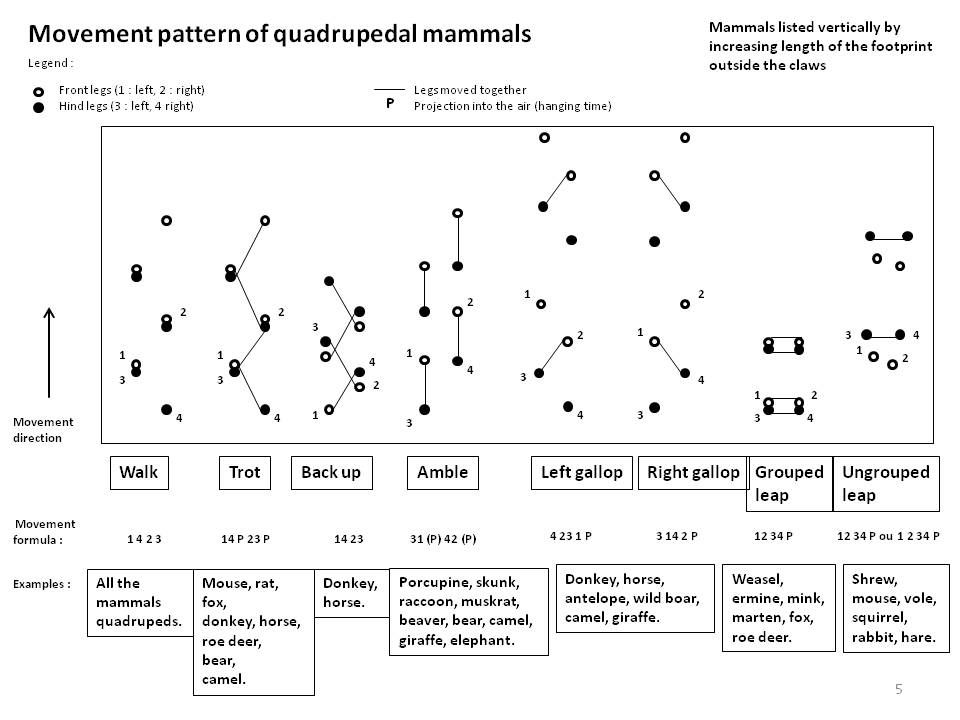
The slide below presents a method of identifying quadrupedal mammals from their movement pattern.
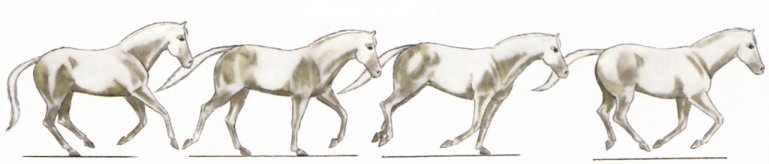
The legs are marked as follows : 1 left front leg, 2 right front leg, 3 left hind leg, 4 right hind leg, P projection in the air (hanging time).
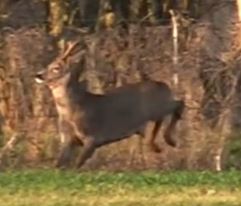
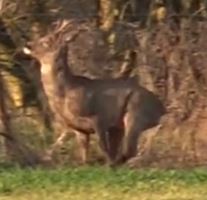
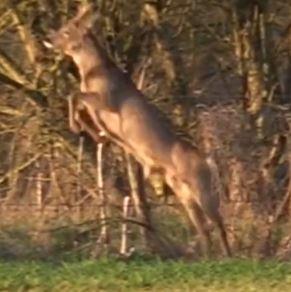
The main movement patterns are as follows :
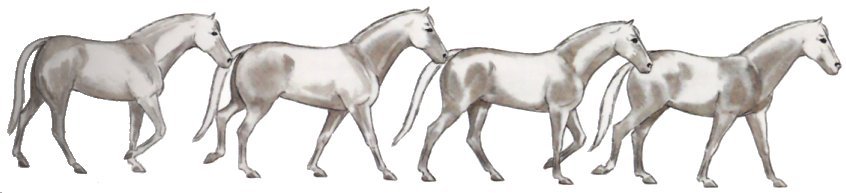
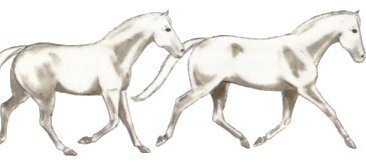
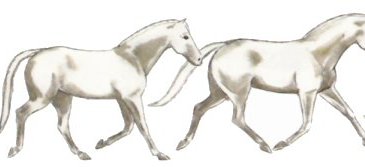
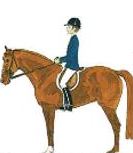
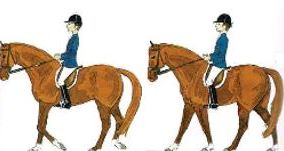
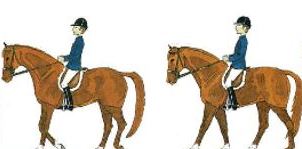
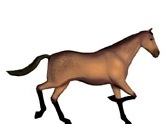
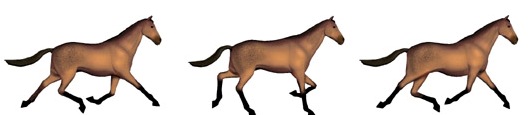

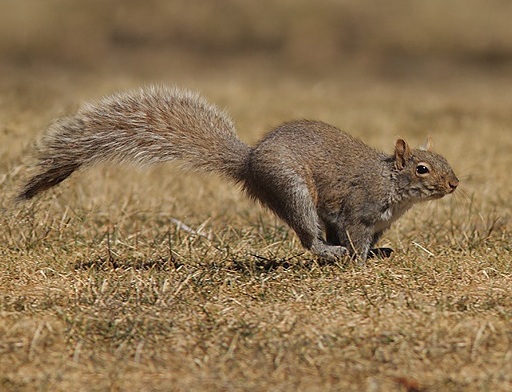
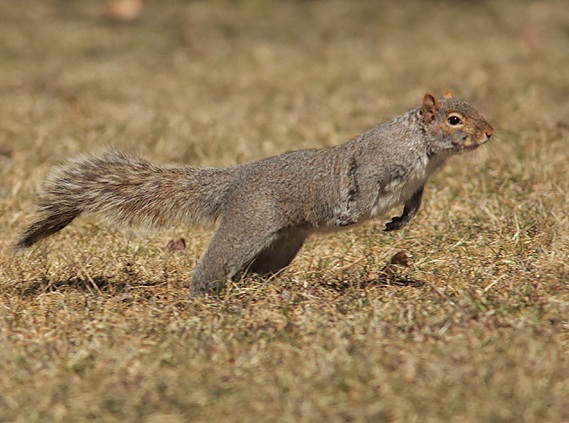
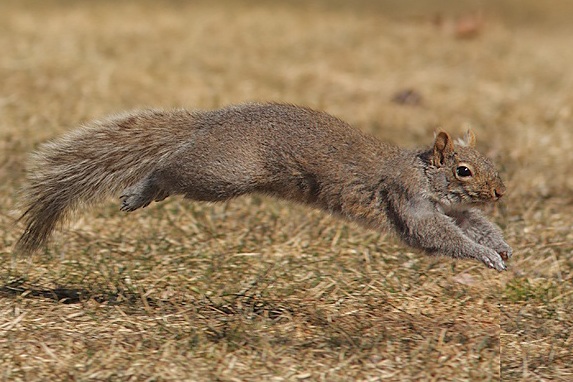
Nota :
- Walking exists in all quadrupedal mammals. For some, it is sometimes slow and infrequent (that of the squirrel for example).
- For the first five movement patterns (Walk, Trot, Back up, Amble, Gallop), the order of legs movement is always the same : 1 4 2 3, with some legs sometimes being moved together, being part of the same diagonal or the same side.
Sources :
(amble) Wikipedia, Amble.
(amble et galop du cheval) Dictionnaire visuel - Allures du cheval.
(bond du renard, lièvre et écureuil) Espaces, Suivre à la trace.
(bond de la belette) J'ai suivi une petite belette sauvage (Youtube, 5:45).
(bond de l'écureuil) Pilon Michel, Forum Image et Nature.
(démarche des mammifères) Les Chasseurs à l'Arc de la Réunion, LES TRACES D'ANIMAUX DANS LA FORET (EUROPE).
(démarche des mammifères) Couzi Laurent, Planche N 1 intitulée "Empreintes animales" du livre Phénomènes, Juzeau C. , Rébulard M., Caradec C., Editions du Chêne, 2023.
(marche, amble et bonds) La Presse+, Jouer au détective dans la neige.
(marche, amble et bonds) Fédération Canadienne de la Faune, A la découverte du monde du pistage d'animaux.
(pas, trot et galop du cheval) Le Monde des Chevaux, Les allures.
(pas, trot et galop du cheval) Wikipedia, Allure (équitation).
(pas, trot et galop du cheval) Lenoble du Teil Jules, Etude sur la locomotion du cheval et des quadrupèdes en général, 1873, LENOBLE_ETUDE_SUR_LA_LOCOMOTION_1873.pdf (accompagné d'un atlas de 23 planches).
(reculer du cheval) Blog Equitation Nord, Hippologie : les allures.
(reculer du cheval) Devos Emma, chevalogie.free.fr, Le reculer.
(vidéos du cheval) Hippologie.fr, Les allures du cheval.
(vidéo du trot du cerf) Cerf qui court et au trot (Youtube, 4:11).
(vidéo du galop du cheval) galop au ralenti (Youtube, 1:08).
(vidéo du galop du chameau) Course de chameaux en Egypte (Youtube, 1:54).
(vidéo du bond du chevreuil) CHEVREUIL/Sauts et Course ! BRUITX (Youtube, 2:00).
 |
C2.3. Droppings
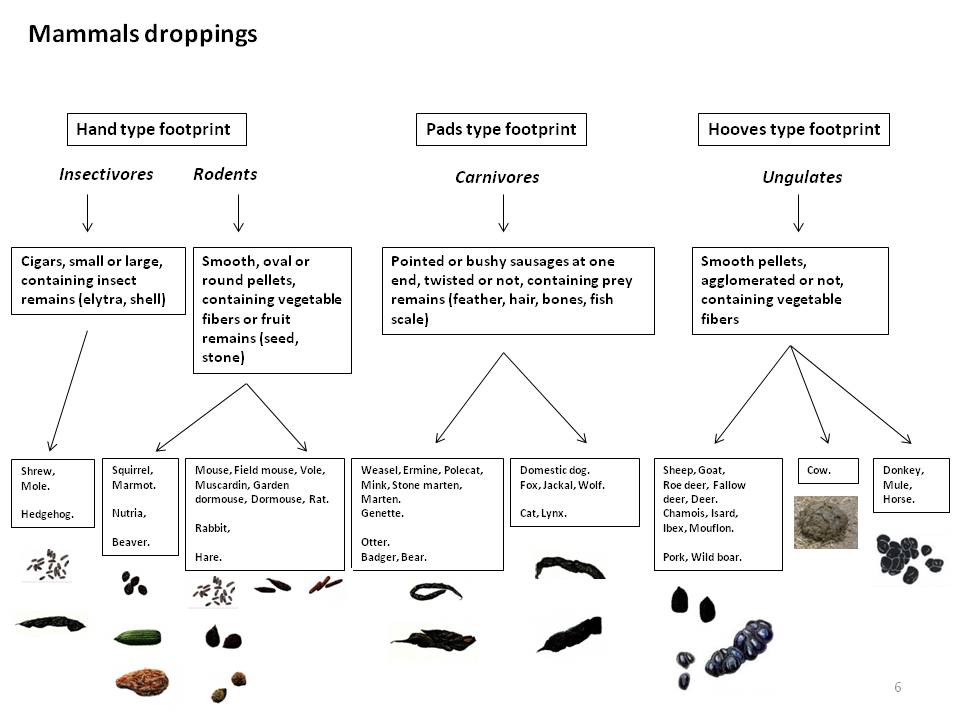
The slide below presents a method of identifying mammals from the shape and texture of their droppings.
Size is another clue. It is generally proportional to the length of the animal's rectum, therefore also to the size of the animal.
Color is also another clue, but it depends on the freshness of the deposit and the ingestion of some foods. For examples :
- Fresh mouse droppings are black and turn brown after about 24 hours.
- The color of hedgehog droppings can vary from black to brown to different shades of gray, depending on its diet which mainly consists of insects, molluscs and small vertebrates.
- A dog that eats too many bones or industrial food containing too much animal flour will produce white droppings. In the sun, the white color will be even more pronounced because the water contained in the droppings evaporates, bringing out the calcium.
- A wolf that swallows the bones of its prey will produce white droppings.
The deposit of droppings is generally done on the paths taken by the animal. For carnivores, in addition to the natural evacuation function, the deposit corresponds to the visual and odorous marking of the territory, often at crossroads between paths.
Sources :
(détail) Gilles Christophe, FRAPNA, Les mammifères de Rhône-Alpes - Les fèces.
(détail) Martin Alexis, Petit guide illustré des crottes de mammifères.
(détail) Salamandre, Crottes de mammifères.
(général) Espace pour la vie Montréal, Des crottes qui en ont long à dire.
(images) Lahaye Romain, Atlas préliminaire des Mammifères sauvages de Bourgogne.
(tableau) France Nature Environnement - Haute-Savoie, Les crottes.
(tableau) Carbala, Espace outil pédagogique.
 |
The planetary motion is directly derived from Newton's law of universal gravitation, which governs the behavior of a system of two bodies in gravitational interaction.
Formulation : Two point bodies M and m separated by a distance d between their centers attract each other with a force F whose intensity is given by the formula :
(R1) F = G M m / d2
where G is the universal gravitational constant (G = 6.67408 10-11 kg-1.m3.s-2).
This force is attractive and acts along the straight line connecting the centers of the two bodies.
In the case of an isolated system, the law of universal gravitation induces the following laws, called "corrected Kepler's laws", which may be slightly disturbed in a real context by gravitational interactions with other bodies.
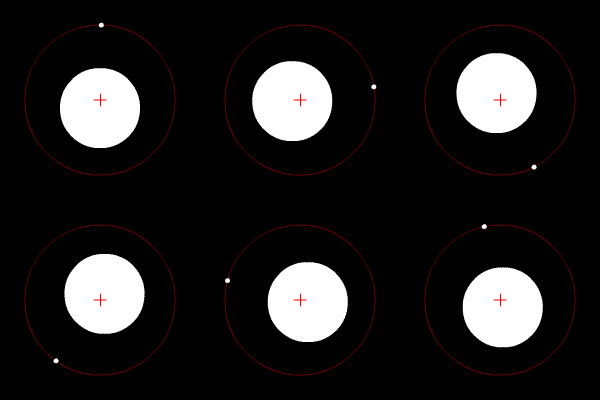
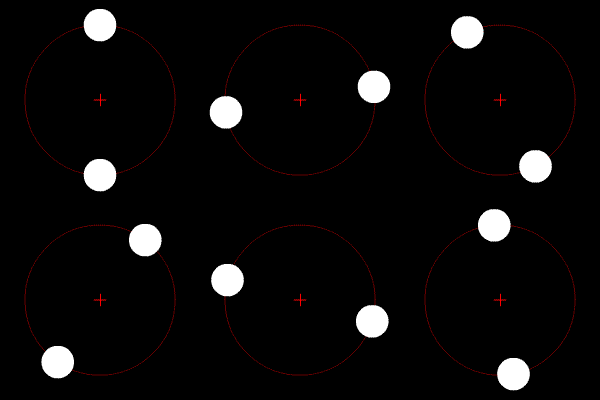
Figures 1 and 2 : Motion of two bodies A and B of very different masses (Figure 1) and of the same mass (Figure 2) under the gravitation effect [SES].
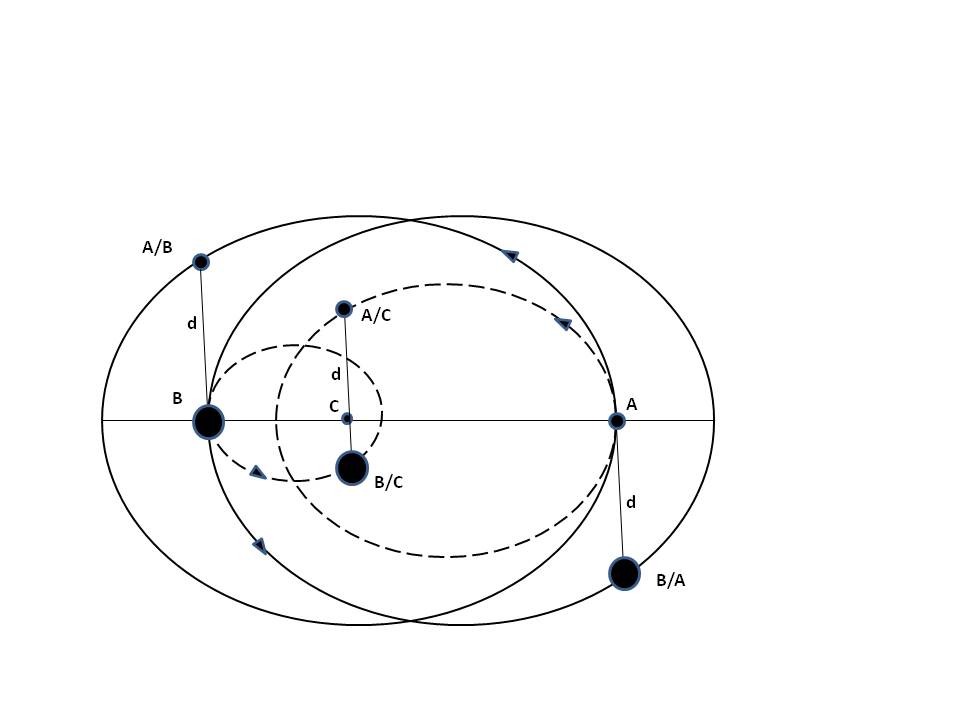
Figure 3 : Link between trajectories (ellipse A/C, ellipse B/C, relative ellipses A/B and B/A) with C = barycenter of the system and d = distance between bodies A and B
1. Galilean reference frame :
Formulation :
- We consider an isolated system of two bodies A and B in gravitational interaction (two-body problem).
- The reference frame centered at the center of mass C (barycenter) of the system is an inertial (or Galilean) reference frame.
|
Proof : The reference frame RC is a Galilean reference frame [SOR] : We study the motion of two bodies A and B assumed to be punctual, of mass mA and mB centered at points A and B, in gravitational interaction in a Galilean reference frame RO of fixed origin O. The system of two bodies being isolated, its momentum is conserved and is written as : d(mA vA + mB vB)/dt = 0 The barycenter C of the system of two bodies is defined by : (R10) (mA + mB) OC = mA OA + mB OB By derivation, we deduce : (mA + mB) vC = mA vA + mB vB which we report in the conservation law as follows : d(mA vA + mB vB)/dt = (mA + mB) d(vC)/dt = 0 C is therefore animated by a motion at constant velocity, therefore uniform rectilinear, which shows that the reference frame RC of origin C is itself Galilean. For the rest, we will note that the relation (R10) is equivalent to : (R11) CA = -(mB/mA) CB = BA/(1 + mA/mB) |
2. Flatness of trajectories :
Formulation : The trajectories of the two bodies are located in the same orbital plane, perpendicular to the kinetic momentum vector of the system of the two bodies, calculated relative to the barycenter of the system.
Associated Kepler's law : The orbits of the planets are planar.
|
Proofs [CHE] : Orbital plane : We place ourselves in the Galilean reference frame RO. The fundamental relation of the dynamics applied to each body A and B is written : (R20) mA d2OA/dt2 = FB/A = -G mA mB BA/||BA||3 (R21) mB d2OB/dt2 = FA/B = -G mB mA AB/||AB||3 The kinetic moment of the system σsyst/O relative to the point O is written : (R22) σsyst/O = σA/O + σB/O σA/O = OA x mA dOA/dt σB/O = OB x mB dOB/dt By differentiating with respect to time t, we obtain : dσsyst/O/dt = OA x mA d2OA/dt2 + d(OA)/dt x mA dOA/dt + OB x mB d2OB/dt2 + d(OB)/dt x mB dOB/dt After simplifications and taking into account the relations (R20)(R21), we obtain : dσsyst/O/dt = -G mA mB (OA - OB) x BA/||BA||3 = 0 The kinetic moment σsyst/O is therefore conserved over time in modulus and direction. Let us now try to show under what conditions this constant kinetic moment is perpendicular to the vector BA. This proposition is written as : 0 = σsyst/O.BA = (OA x mA dOA/dt + OB x mB dOB/dt).BA Given the property of the mixed product between any vectors v1, v2 and v3 : (v1 x v2).v3 = (v3 x v1).v2, this relation is transformed into : 0 = mA (BA x OA).dOA/dt + mB (BA x OB).dOB/dt Given the relation : BA = OA - OB, this relation is simplified into : 0 = (OA x OB).(mA dOA/dt + mB dOB/dt) Given the relation (R11) inducing : (CA x CB) = 0, the term (OA x OB) is zero for any point A and B only in the case where point O coincides with the barycent C of the system. Consequently, points A and B are located in the same plane perpendicular to σsyst/C Relations between kinetic moments : Given relations (R11) and (R22) applied in O = C, the kinetic moment σsyst/C of the system is linked to the kinetic moments of each body σA/C and σB/C by the following relations : (R23) σsyst/C = (1 + mA/mB) σA/C = (1 + mB/mA) σB/C = (1/(1 + mA/mB)) σA/B = (1/(1 + mB/mA)) σB/A The five kinetic moments σsyst/C, σA/C, σB/C, σA/B and σB/A are therefore conserved over time in modulus and direction. This property is specific to the isolated system of two bodies in central interaction. Expression of the angular momentum σA/C : We place ourselves in polar coordinates (r, θ) in the orbital plane of the body A. If ur and uθ denote the radial and angular unit vectors, we have the relations : CA = r = r ur v = dr/dt = (dr/dt) ur + r (dθ/dt) uθ (R24) v2 = v.v = (dr/dt)2 + (r dθ/dt)2 Hence the expression of σA/C : (R25) σA/C = r x mA v = mA r2 dθ/dt (ur x uθ) (R26) σA/C = ||σA/C|| = mA r2 dθ/dt |
3. Elliptical orbits :
Formulation :
- Each body in the system describes an elliptical orbit with one focus being the barycenter of the two-body system.
- In the case of the Sun-planet system, since the Sun is much more massive, the barycenter is very close to the center of the Sun. Consequently, the planet appears to orbit the Sun when in reality the Sun also describes a small ellipse around this barycenter (see Figure 1 above).
- This small ellipse can become significant in systems where the mass difference is less important such as in a binary star system (see Figure 2 above).
- The semi-major axes of each ellipse are aligned. Thus, when one of the bodies reaches its pericenter (the point of the orbit closest to the focus), the other body is also at its pericenter.
Associated Kepler's law : The planets describe elliptical orbits with the Sun at one of the foci.
Elliptical orbit equation (in polar coordinates) : r = p/(1 + e cos[θ])
with :
θ r = distance from the body to the occupied focus of the ellipse
p = focal parameter
e = eccentricity
θ = polar angle
We have the relations :
(R29)
a = p/(1 - e2)
b = p/(1 - e2)1/2
c = (a2 - b2)1/2 = e a
b2 = a2(1 - e2)
p = b2/a
S = π a b
with :
a = semi-major axis
b = semi-minor axis
c = semi-focal distance (or distance between the ellipse center and one of the foci)
S = area
|
Proofs : Orbit of body A relative to the barycenter C of the system [CHE][VIE] : We place ourselves in the Galilean reference frame RC centered at the barycenter C of the two bodies. Given the relations (R20)(R21) and the relation : BA = OA - OB, we can write : (R30) d2BA/dt2 = -G (mA + mB) BA/||BA||3 Given the relation (R11) giving CA as a function of BA, the equation of motion of A in RC is then written : (R31) d2CA/dt2 = -G (mB3 / (mA + mB)2) CA/||CA||3 (R32) By setting r = CA and kA = G (mB3 / (mA + mB)2), the relation (R31) becomes : (R33) d2r/dt2 = -kA r/r3 which is the equation of Kepler's problem. By multiplying the relation (R33) by the vector dr/dt = v, we obtain : (dr/dt).(d2r/dt2) = v.(dv/dt) = -(kA/r3) (dr/dt).r Noting that : v.dv = (1/2) d(v.v) = (1/2) d(v2) dr.r = (1/2) d(r.r) = (1/2) d(r2) = r dr We then obtain : (1/2) d(v2)/dt = -(kA/r3) r dr/dt = -(kA/r2) dr/dt = kA d(1/r)/dt which is integrated into : (R34) (1/2) v2 - kA(1/r) = constant noted hA To solve relation (R34), we eliminate dt between relations (R24) and (R26) : v2 = (σA/C / mA)2 ( (1/r4) (dr/dθ)2 + 1/r2 ) By setting u = 1/r (and therefore du = -u2 dr), we obtain the first Binet formula : (R35) v2 = (σA/C / mA)2 (u2 + (du/dθ)2) Given relation (R34), we obtain : (1/2) (σA/C / mA)2 (u2 + (du/dθ)2) = hA + kA u By differentiating this relation with respect to θ, we obtain : (σA/C / mA)2 (u (du/dθ) + (du/dθ) d2u/dθ2)) = kA (du/dθ) which gives the second Binet formula : (R36) d2u/dθ2 + u = kA (mA/σA/C)2 which is a second-order linear differential equation with constant coefficients with right-hand side, whose solutions are written as : 1/r = u = kA (mA/σA/C)2 + λ cos[θ - α] λ and α being constants fixed by the initial conditions. (R37) By setting p = (σA/C / mA)2 / kA and e = λ p, we obtain : (R38) r = p/(1 + e cos[θ - α]) which is the equation of a conic (ellipse if |e| < 1, parabola if |e| = 1, hyperbola if |e| > 1), and where α represents the direction of the pericenter (point of the orbit closest to the focus). In the case of planets, their orbit is naturally elliptical. If their speed were too low, they would end up crashing into the central star. Conversely, if their speed were too high, they would escape gravitational attraction, adopting a parabolic or hyperbolic trajectory. The eccentricity eA/C of the ellipse is given by the relations (R46)(R80) as a function of the mechanical energy of the system. Orbit of body B relative to the barycenter C of the system : In the case where r = CB, it is sufficient to exchange the roles of A and B in the case above. The trajectory of B relative to C is also a conic (ellipse) with the following characteristics : (R39) kB = G (mA3 / (mA + mB)2) (R40) pB/C = (σB/C / mB)2 / kB = (mA/mB) pA/C, taking into account relations (R23)(R32). eB/C = e according to the relations (R46)(R80). Orbit of body A relative to body B : In the case where r = BA, We must take relation (R30) instead of relation (R31) and we find that the trajectory of A relative to B is also a conic (ellipse) with the following characteristics : (R41) kA/B = G (mA + mB) (R42) pA/B = (σA/B / mA)2 / kA/B = (1 + mA/mB) pA/C = pA/C + pB/C, taking into account relations (R23)(R32). eA/B = e according to the relations (R46)(R80). These results can also be demonstrated by introducing the notion of a fictitious particle of reduced mass μ = mA mB / (mA + mB), of radius vector r = BA = rA/C - rB/C (equivalent to BA = CA - CB), and of velocity v = dr/dt Orbit of body B relative to body A : In the case where r = AB, it is sufficient to exchange the roles of A and B in the case above. The trajectory of B relative to A is a conic (ellipse) geometrically identical to that of the trajectory of A relative to B, with the following characteristics : (R43) kB/A = G (mB + mA) = kA/B (R44) pB/A = pB/C + pA/C = pA/B eB/A = e according to the relations (R46)(R80). Homothety of ellipses : In the problem of the two bodies A and B, there are four different elliptical orbits (see Figure 3 above) : - the ellipse of A relative to the barycenter C - the ellipse of B relative to the barycenter C - the relative ellipse of A relative to B - the relative ellipse of B relative to A Given the relation (R11), the radius vectors r of these ellipses are as follows : (R45) rA/C = CA = mB/(mA + mB) rA/B rB/C = CB = -mA/(mA + mB) rA/B rA/B = BA = -rB/A = rA/C - rB/C All the ellipses are therefore homothetic. The eccentricity of an ellipse being preserved under homothety (since according to (R29) : b2 = a2(1 - e2)), we deduce that all eccentricities are equal : (R46) e = eA/C = eB/C = eA/B = eB/A Taking into account relations (R29)(R40)(R42)(R44), we also deduce that : - Ellipses A/C and B/C have their semi-major axes a (and also semi-minor axes b) inversely proportional to their respective masses : (R47) aA/aB = bA/bB = mB/mA - Relative ellipses A/B and B/A are geometrically identical but larger than the other two with a semi-major axis a equal to the sum of the semi-major axes of ellipses A/C and B/C : (R48) aA/B = aB/A = aA + aB Alignment of semi-major axes : We place ourselves in the barycentric reference frame RC. The radius vectors rA/C, rB/C, rA/B and rB/A of each ellipse being all in a constant ratio according to the relations (R45), imply that their extrema occur simultaneously. Consequently, all the semi-major axes are aligned (see Figure 3 above). |
4. Area law :
Formulation : The radius vector connecting a body to the occupied focus of the ellipse sweeps out equal areas in equal times.
Associated Kepler's law : The radius vector connecting the Sun to a planet sweeps out equal areas in equal times.
Expression of the area law : dS/dt = (1/2) r2 dθ/dt = constant = (1/2) σ/m
with :
S = area swept out by the radius vector in the orbital plane
r = distance of the body from the occupied focus of the ellipse
θ = polar angle
t = time
σ = angular momentum of the body relative to the occupied focus
m = mass of the body
|
Proof [VIE] : Case of body A rotating around the barycenter C of the system : We denote by dS the element of area covered by the radius vector r during the element of time dt. Hence the expression of dS : (R60) dS = (1/2) ||r x dr|| Given relation (R33), we can write : (R61) r x d2r/dt2 = -kA r x r/r3 = 0 (R62) d(r x dr/dt)/dt = r x d2r/dt2 + dr/dt x dr/dt which simplifies to : d(r x dr/dt)/dt = 0 Hence : r x dr/dt = vector constant noted H and relation (R60) becomes : (R63) dS/dt = (1/2) ||H|| = constant Given relation (R25), relation (R60) is written as : (R64) dSA/dt = (1/2) σA/C / mA |
5. Period law :
Formulation : The orbital period of each body is given by the formula :
(R70) T2/a3 = 4 π2 / k
with :
T = orbital period
a = semi-major axis of the ellipse
m and M = respective masses of bodies A and B
Case of body A rotating around body B : k = kA/B = G (m + M)
Case of body A rotating around the barycenter C of the system : k = kA = G (M3 / (m + M)2)
Case of body B rotating around the barycenter C of the system : k = kB = G (m3 / (M + m)2)
Associated Kepler's law : The square of the orbital period of a planet is proportional to the cube of the semi-major axis of its orbit.
Invariance of orbital period : Given the relation (R89), T depends only on the mechanical energy Emec of the system.
|
Proof : Case of body A rotating around the barycenter C of the system : Given relation (R64), the area S swept by body A over a complete revolution is expressed by : S = ∫0T [(dS/dt) dt] = ∫0T [(1/2) (σA/C / mA) dt] = (1/2) (σA/C / mA) T where T is the orbital period of body A. Given relation (R37), we obtain : S = (1/2) (p kA)1/2 T Given the standard identities of the ellipse : p = b2/a and S = π a b, we can eliminate b and we obtain : T2/a3 = 4 π2 / kA |
6. Conservation of mechanical energy :
Formulation : The mechanical energy of the system, the sum of the kinetic energy of the relative motion between bodies and the potential energy of interaction, is conserved over time.
Expression of the mechanical energy Emec as a function of the parameters p and e of the ellipse :
(R80) Emec = (1/2) (G m M / p) (e2 - 1)
with :
m and M = respective masses of bodies A and B
p = focal parameter of the relative ellipse in the motion of A relative to B, or of B relative to A
p = pA/B = pB/A = pA/C (1 + mA/mB) = pA/C + pB/C
e = eccentricity of the ellipse
This energy is always negative for an ellipse (|e| < 1).
|
Proofs : Conservation of mechanical energy : In an isolated system of two bodies, internal forces exchange energy between kinetic energy and potential energy. Since these exchanges do not lead to a loss of energy (since there are no dissipative forces such as external friction), the mechanical energy of the system is conserved over time. Expression of mechanical energy as a function of the parameters of the ellipse [PST] : We place ourselves in the Galilean reference frame RC centered at the barycenter C of the two bodies, using simplified variables : reduced mass μ = mA mA / (mA + mB) radius vector r = BA = rA/C - rB/C velocity v = dr/dt The mechanical energy of the system Emec is the sum of the kinetic energy Ecin and the potential energy Epot: (R81) Emec = Ecin + Epot (R82) Ecin = (1/2) (mA vA2 + mB vB2) = (1/2) μ v2 (R83) Epot = -G mA mB / r Given the relation (R38), the potential energy becomes : (R84) Epot = -(G mA mB / p) (1 + e cos[θ - α]) By deriving equation (R38) with respect to time, we also obtain : (R85) dr/dt = -p e (dθ/dt)2 sin[θ - α]/(1 + e cos[θ - α])2 Given the expressions for the kinetic moment of the system ((R26) σ = μ r2 dθ/dt), of the speed v as a function of the angular speed ((R24) v2 = (dr/dt)2 + (r dθ/dt)2) and of the equation of the ellipse (R38), the relation (R82) becomes, after elimination of the term (dθ/dt) : Ecin = (1/2) (μ (dr/dt)2 + σ2/(μ r2)) = (1/2) (σ2 / (μ p2)) (1 + e2 + 2 e cos[θ - α]) Taking into account the expression of the focal parameter (p = (σ/μ)2 / kA/B), we obtain : (R86) Ecin = (1/2) (G mA mB / p) (1 + e2 + 2 e cos[θ - α]) Taking into account the relations (R81)(R84)(R86), the mechanical energy Emec simplifies to : (R87) Emec = (1/2) (G mA mB / p) (e2 - 1) with : p = focal parameter in the motion of A relative to B Taking into account relations (R40)(R42)(R44), we also have : (R88) p = pA/B = pB/A = pA/C (1 + mA/mB) = pA/C + pB/C Taking into account the relation (R29) and the reduced mass μ = mA mB / (mA + mB), we can express the specific mechanical energy (Emec/μ) as a function of the semi-major axis aA/B : (R89) Emec/μ = -(1/2) G (mA + mB)/aA/B |
7. Sources relating to planetary motion :
[CHA] ChatGPT, le moteur d'Intelligence Artificielle développé par OpenAI.
[CHE] Jonathan Chenal, Introduction à l'astronomie de position
[FEM1] FEMTO - Mécanique, Problème à deux corps
[FEM2] FEMTO - Mécanique, Forces centrales
[PER] Perplexity, le moteur d'Intelligence Artificielle développé par Perplexity AI.
[PST] Gravitation : le problème des deux corps avec PSTricks - partie 1
[SES] SESP, Mouvement de deux corps sous l'effet de la gravitation
[SOR] Joël Sornette, Le problème à deux corps - Mouvements à force centrale
[VIE] Alain Vienne, Eléments d'astronomie fondamentale
Constellations, apparent groupings of stars forming imaginary figures in the sky, have fascinated humanity for millennia.
Today, 88 official constellations are used to map the sky. Some, such as The Little Bear or Cassiopeia, are visible all year round, while others, such as The Swan in summer or Orion in winter, are only revealed in certain seasons.
The zodiacal constellations, crossed by the Sun during the year, are part of these 88 official ones and play a special role in astrology.
Observing the sky also reveals remarkable stars, such as Sirius or Vega, real landmarks in the celestial vault. To make the most of them, it is then important to follow certain practical observation tips.
C4.1. General information [CHA][PER] :
Definitions :
- A constellation is an apparent grouping of stars in the night sky as seen from Earth.
- A circumpolar constellation is one that, for an observer at a given latitude (north or south), remains visible year-round.
- A seasonal constellation is a non-circumpolar constellation, therefore visible only during or around a given season, and absent from the night sky the rest of the year.
- The ecliptic is the plane of the Earth's orbit around the Sun or, as seen from Earth, the circle traced by the Sun on the celestial vault over the course of a year.
- The horizon is the horizontal circular line where the sky and the Earth (or the sea) appear to meet.
- The zenith is the point in the sky located exactly vertically above the observer's head.
- The North Celestial Pole is the point in the sky located above the northern horizon, at a height equal to the observer's latitude. For Paris (approximately 49 north latitude), on a rotating disk sky map, this point appears halfway between the center of the disk (zenith) and its northern edge (northern horizon). To use the disc correctly, it must be held above the head and the northern edge of the disc must be oriented towards geographic north, using a compass for example.
- Warning : On a sky map, the east and west directions are reversed compared to a traditional map, in order to correspond to the viewpoint of the observer holding their map towards the sky. Turning a map over (putting it upside down) while keeping north in front of you effectively reverses right and left.
- The North Star (Polaris) is an excellent representative of the celestial north pole, through which the Earth's own rotational axis passes. The angular difference between these two points (approximately 0 38' in 2025) is in fact imperceptible to the naked eye because the north celestial pole is only an abstract point in the sky, located very close to Polaris.
Movement and position of the constellations :
- The movement of the constellations is as follows : Due to the daily rotation of the Earth on its axis, all the constellations visible from the northern hemisphere describe a circle around Polaris in 24 hours, counterclockwise, but only the circumpolar ones remain visible at all times. The seasonal ones pass below the horizon during their rotation, rising in the east and setting in the west each day.
- The relative geometric position between constellations, as well as between stars in the same constellation, does not change significantly during the Earth's daily rotation (diurnal motion) or during its annual revolution around the Sun (seasonal motion). This is explained by the very great distance between Earth and the stars in these constellations. Only the portion of the sky visible from a given location on Earth at a given time changes.
- The "open hand" is a good guide to measuring the distance between two points in the sky : Hold your hand at arm's length, fingers spread, and consider the width extending from the tip of your thumb to the tip of your little finger. This width corresponds to an angular difference of about 20 measured from the observer.
Stars, planets, the Moon, artificial satellites, aircraft, shooting stars, star cluster :
- To the naked eye, both stars and planets appear as simple points of light. However, stars twinkle strongly because their light comes from a point-like source and passes through Earth's atmosphere as a single beam, highly sensitive to turbulence in atmosphere. Planets, on the other hand, reflect sunlight from many points across their disk, even though the disk itself is invisible to the naked eye. The effects of turbulence on the different rays average out, resulting in little or no twinkling.
- Planets and the Moon always stay very close to the ecliptic, and therefore cross almost exclusively the constellations of the astronomical zodiac, never the circumpolar constellations (too far from the ecliptic, around the celestial pole).
- Planets and the Moon are not circumpolar : They rise and set every day, while gradually moving relative to the distant stars in the background sky. The Moon advances about 13 degrees eastward each day relative to these stars, and therefore takes 27.3 days to return to the same apparent position among them (sidereal month). The planets move much more slowly and take several months (Mercury, Venus) or several years (Mars, Jupiter, Saturn, Uranus, Neptune) to complete a full orbit.
- The Moon is absent from the night sky during nights close to the new moon at certain times (see Tips for good observation), which allows optimal observation of the constellations.
- Artificial satellites in low Earth orbit appear as a white, non-blinking point of light that crosses the sky in a few minutes, generally from west to east (but sometimes also from north to south or vice versa).
- Aircraft flying at high altitudes appear as a flashing white point of light (anti-collision strobe light), which moves more slowly than artificial satellites. At medium or low altitudes, aircraft are distinguished by several fixed colored points of light (position lights), in addition to the flashing white point, all of which can appear separate or merged depending on the distance from the observer.
- Shooting stars (or meteors) are luminous trails visible for one to two seconds. They come from dust clouds left by comets or asteroids. Each year, the Earth crosses the orbit of these clouds, causing their dust to burn up upon contact with the Earth's atmosphere. On average, 5 to 10 shooting stars are observed per hour, and up to 50 to 100 during peak activity of these meteorite clouds, particularly between mid-July and mid-August in the constellation of Perseus, and early to mid-December in the constellation of Gemini.
- A star cluster is a local grouping of stars bound together by gravity, born from the same region of gas and dust within the same galaxy. Seen from Earth, it appears projected into a constellation.
Brightest objects :
The brightest natural objects in Earth's night sky, visible from the Northern Hemisphere, are as follows, in descending order of brightness :
C4.2. List of constellations :
The International Astronomical Union (IAU) defined 88 official constellations in 1922 [IAU1]. They cover the entire celestial sphere, divided between the northern and southern hemispheres.
They are distributed as follows :
* 54 constellations visible totally or partially from Metropolitan France
- 7 constellations visible all year round
- 20 seasonal constellations visible during the extended summer (May to October)
- 15 seasonal constellations visible during the extended winter (November to April)
- 12 constellations that are difficult to see with the naked eye
* 34 constellations not visible from Metropolitan France
The 54 constellations visible totally or partially from Metropolitan France are as follows, listed in alphabetical order :
These constellations are described below, classifying them by period of year and then by position in the sky, according to the following definitions :
|
In synthesis, the constellations are then precisely located in the sky according to a neutral representation that uses neither cardinal points, nor relative directional notions, nor the observer's position on Earth, nor reference to the hour or day of the year. This method of celestial location, developed by the Author, relies exclusively on the following principles : - The initial identification of major stars or constellations, visible and recognizable without error to the naked eye. - The construction of imaginary straight lines between these celestial landmarks, allowing for recursive triangulation : Each new landmark is located by geometric alignment with the landmarks already identified, which gradually expands the mental map of the sky. - The estimation of apparent angular distances using the width of an open hand held at arm's length, used as a natural and universal unit of measurement. This pragmatic method is particularly suited to progressive learning of visual astronomy and celestial navigation without instruments. |
C4.3. Constellations visible all year round
:
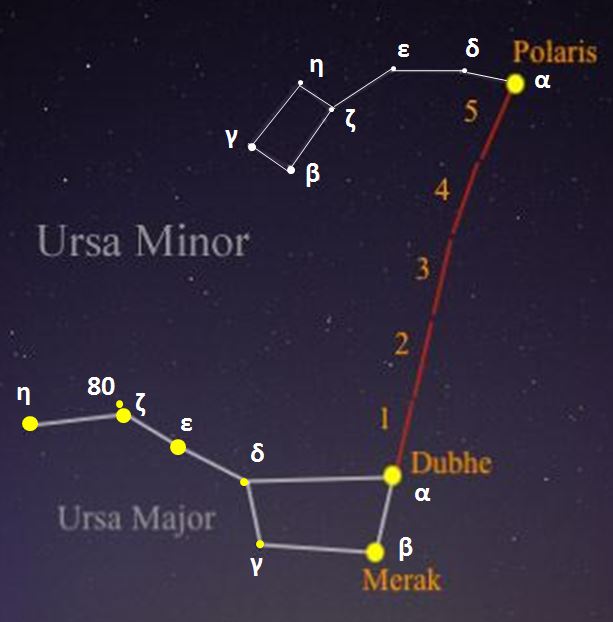
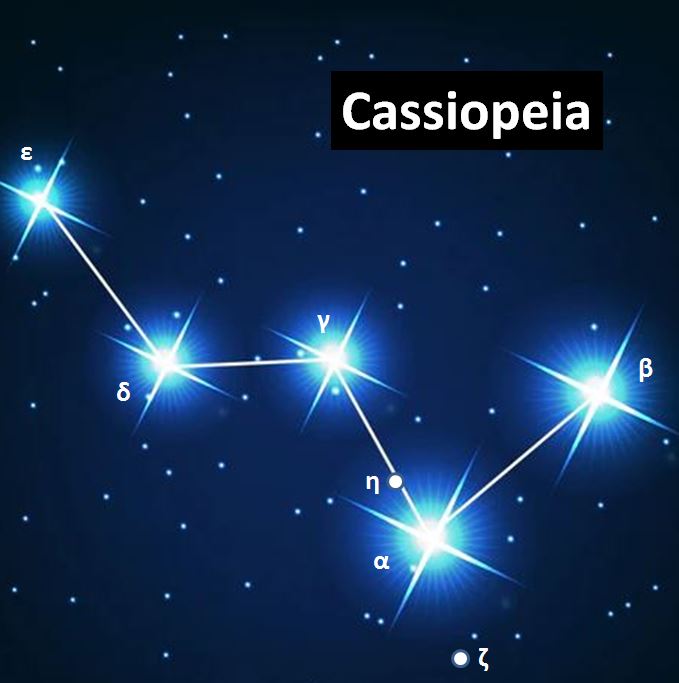
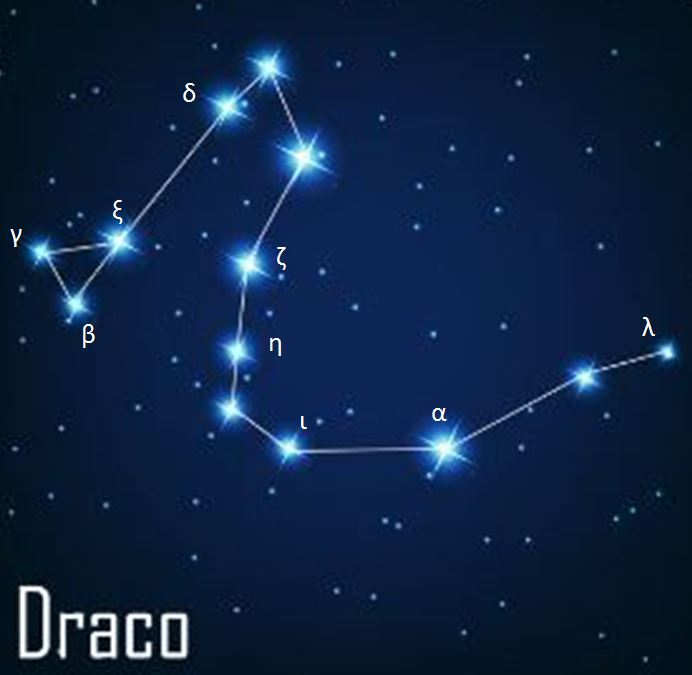
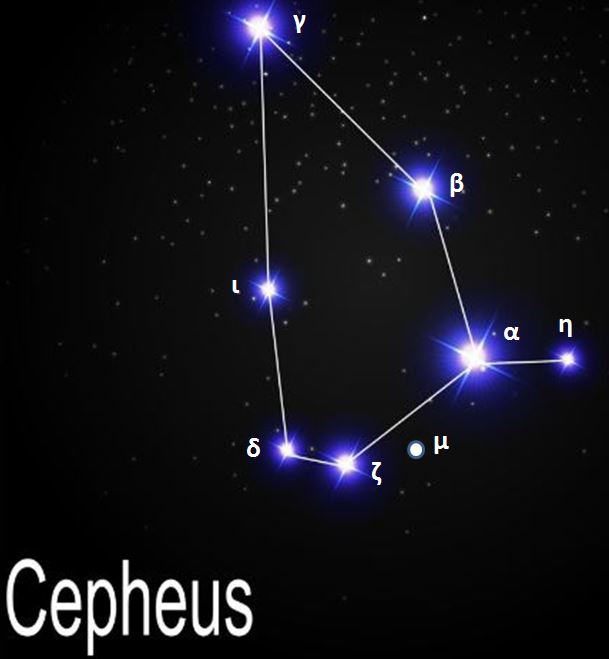
The constellations visible from Metropolitan France all year round (circumpolar constellations) are as follows (see Figures below [IST][LES]) :
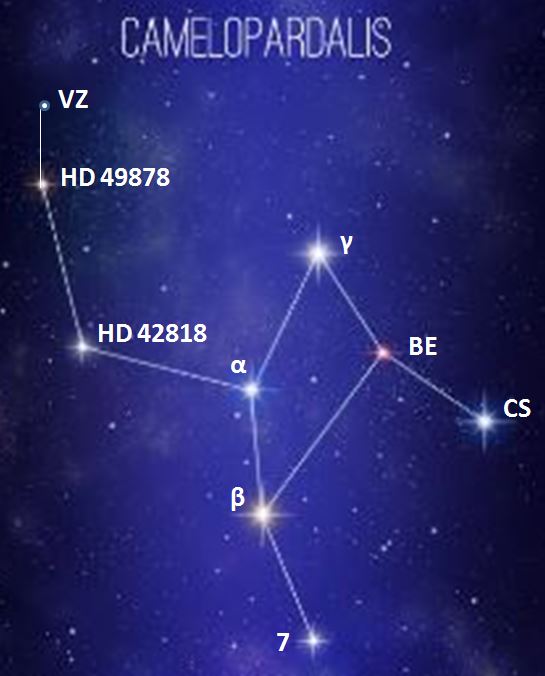
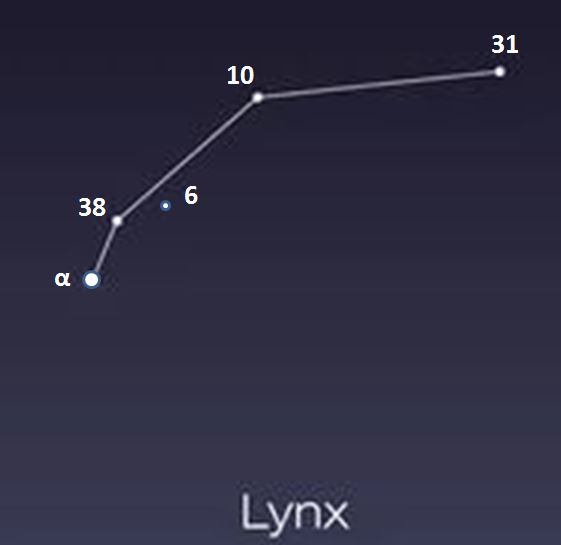
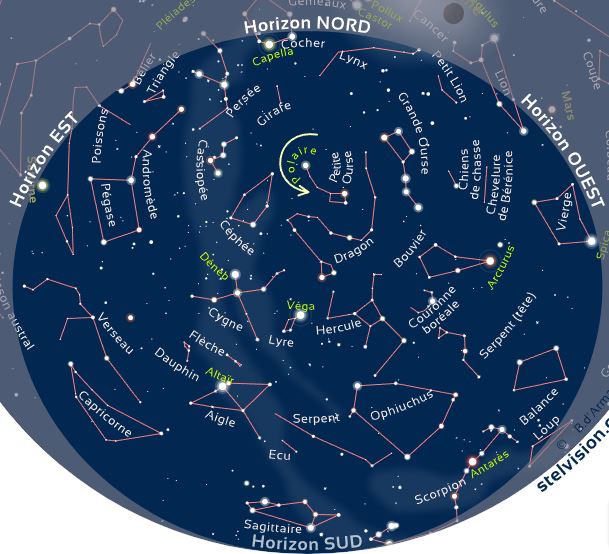
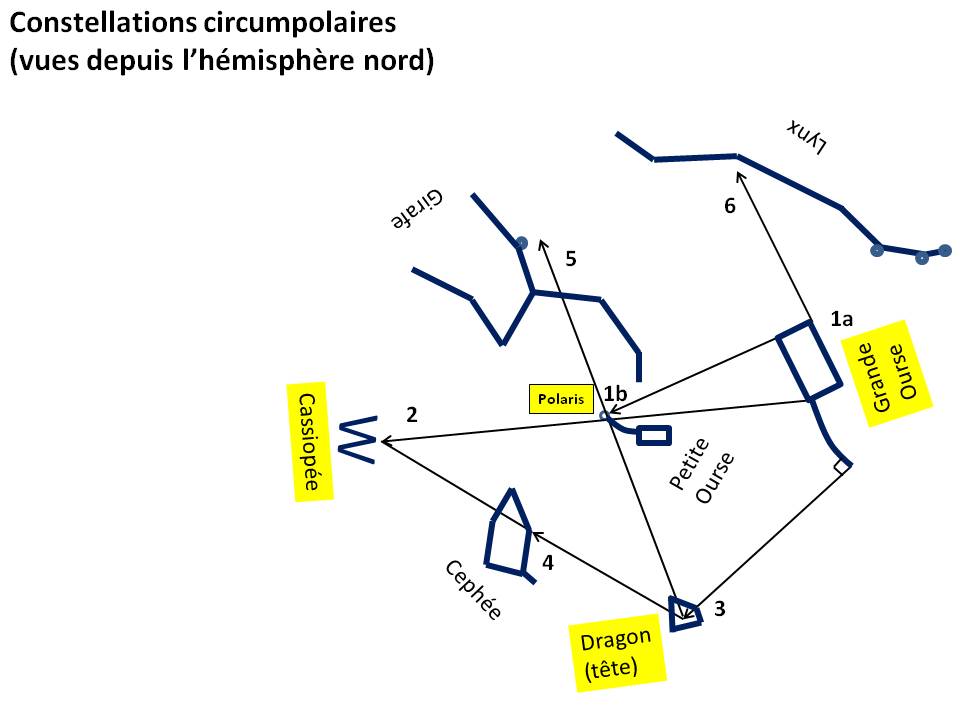
|
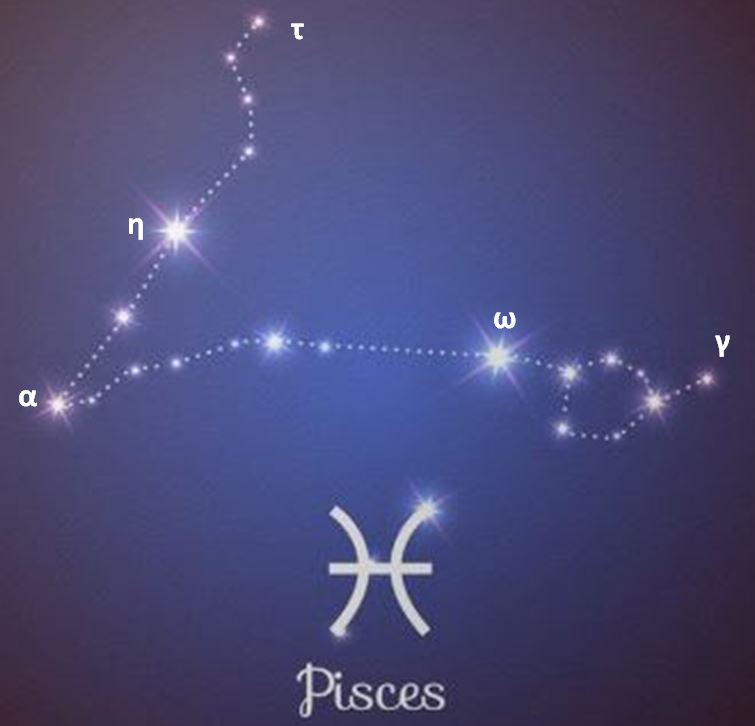
Synthesis : To find these constellations in the sky, the simplest method is as follows [DAR][CHA][PER], by referring to the maps above : - Map from July 25, 2025 at 00:00 for mainland France or latitudes from 40 to 55 N, with zenith at the center of the portion of visible sky [STE]. - Guide to locating circumpolar constellations (in neutral representation). 1a. Find The Great Bear : Large dipper with seven bright stars, located in the northern half of the sky. Its height is low (near the horizon) in autumn and winter, and very high (near the zenith) in spring and summer. Its length, from the handle end (η) to the outer edge (α or β) of the dipper, is one open hand width. 1b. Find the North Star Polaris : Bright star located near the Great Bear in the extension of the outer edge of the dipper, in the opposite direction to its bottom, at a distance equivalent to an open hand width or five times the distance between the two stars (α and β) on this edge (see Figure 1 above). Find The Little Bear : Small dipper with three bright stars, including Polaris (α) at the end of the handle and two stars (β and γ) at the outer edge of the dipper (see Figure 1 above). The four intermediate stars (δ, ε, ζ, η) are often not very visible. 2. Find Cassiopeia : Characteristic W shape, located opposite the center of the Great Bear (attachment point of the dipper handle) from Polaris. 3. Find The Dragon : Its head is a distorted square of four bright stars (γ β, ν, ξ) located near the Great Bear, two open hand widths apart, by drawing from the end (η) of the dipper handle a perpendicular in the direction in which the handle is curved. The body (δ, ζ, η, ι, α) and tail (λ) of the Dragon form a large inverted S (as seen in a mirror) of six bright stars that partially wraps between the Great Bear and the Little Bear. 4. Find Cepheus : Polygon with seven bright stars forming a child's house (rectangle α, β, ι, ζ) with pointed roof (γ), located halfway between Cassiopeia and The Dragon's head. 5. Find The Giraffe : Group of nine stars including a long neck (α, HD 42818, HD 49878, VZ) pointing towards Polaris. The brightest star (β) is located opposite the Dragon's head from Polaris. 6. Find The Lynx : Broken line of seven stars including three bright ones (α, 38, 10 UMa), fully visible in late winter and spring, located near the Great Bear, one open hand width apart, in line with the bottom of the dipper, in the opposite direction to the handle. |
C4.4. Summer seasonal constellations :
The seasonal constellations visible from Metropolitan France during the extended summer (May to October) are the following (see Figures below [IST][LES]) :
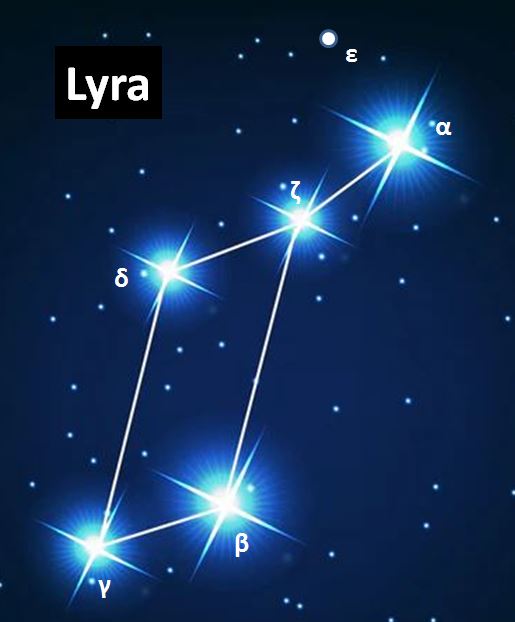
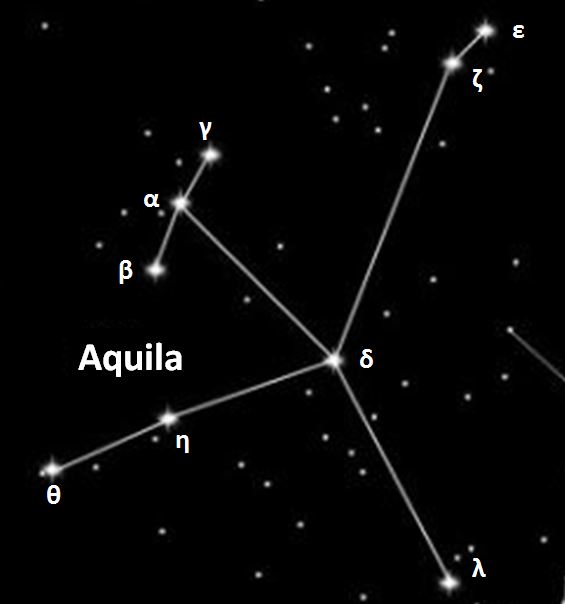
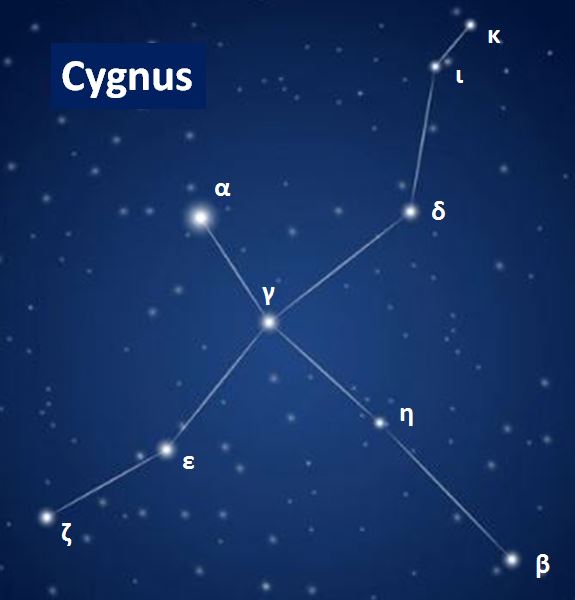
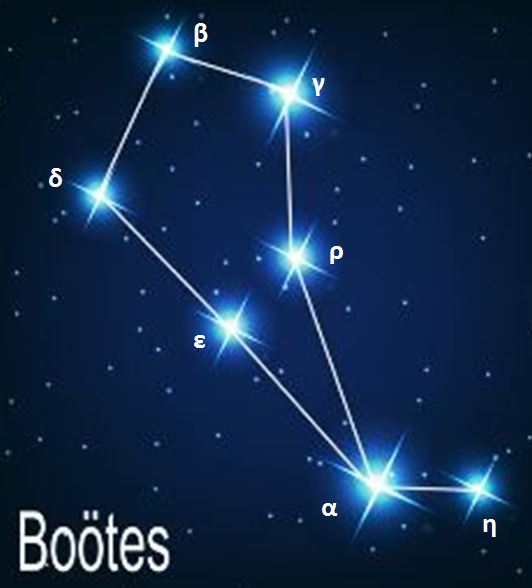
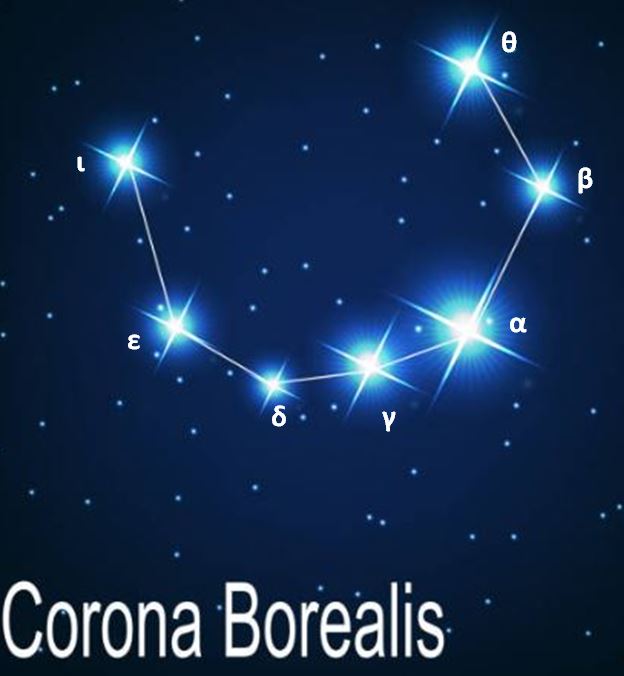
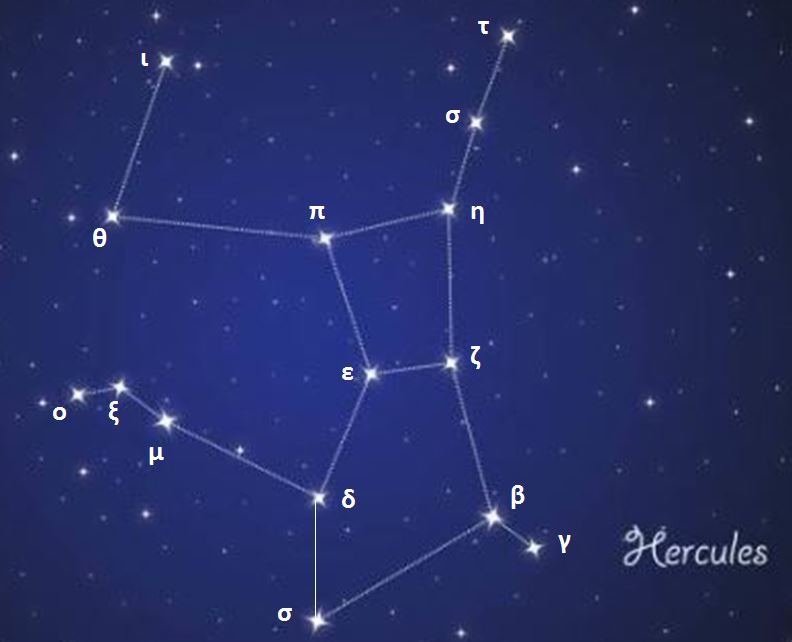
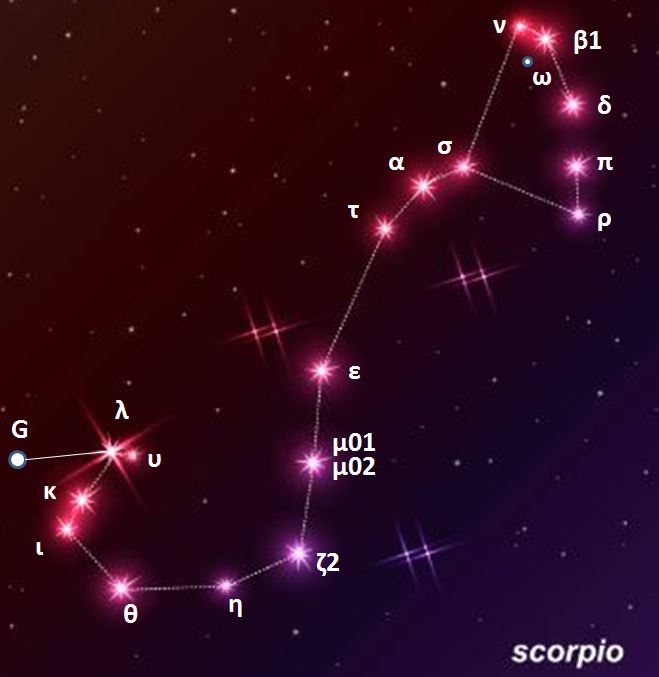
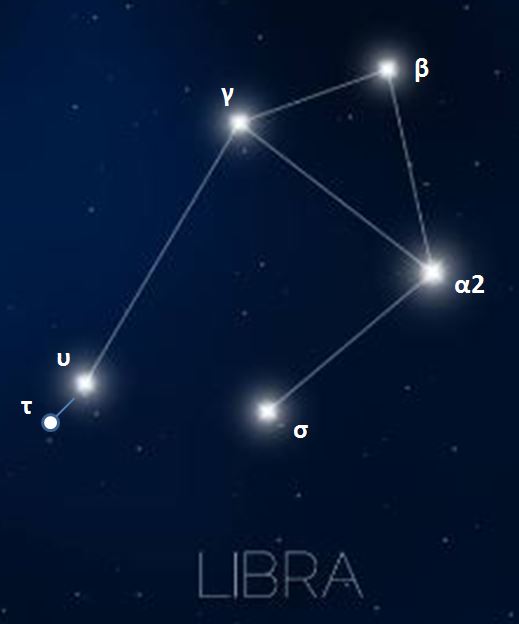
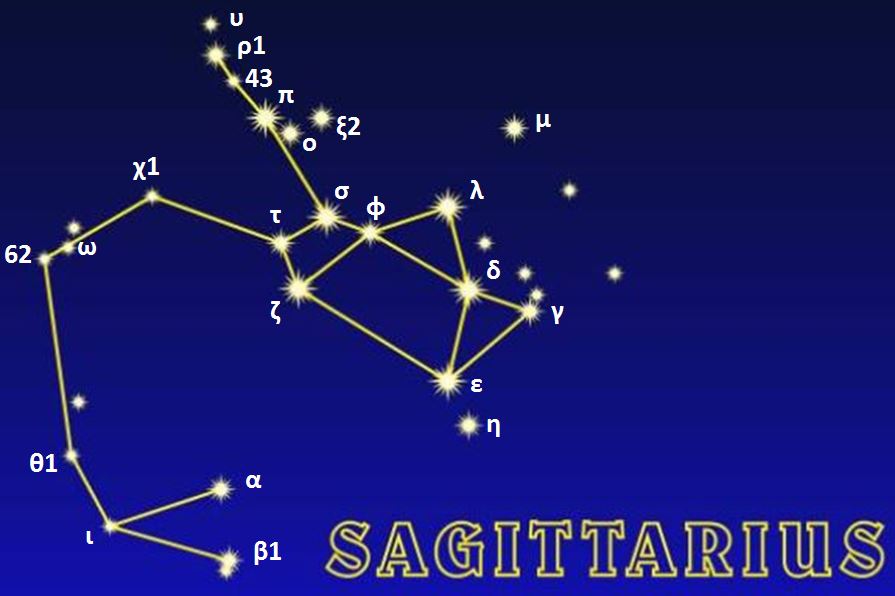
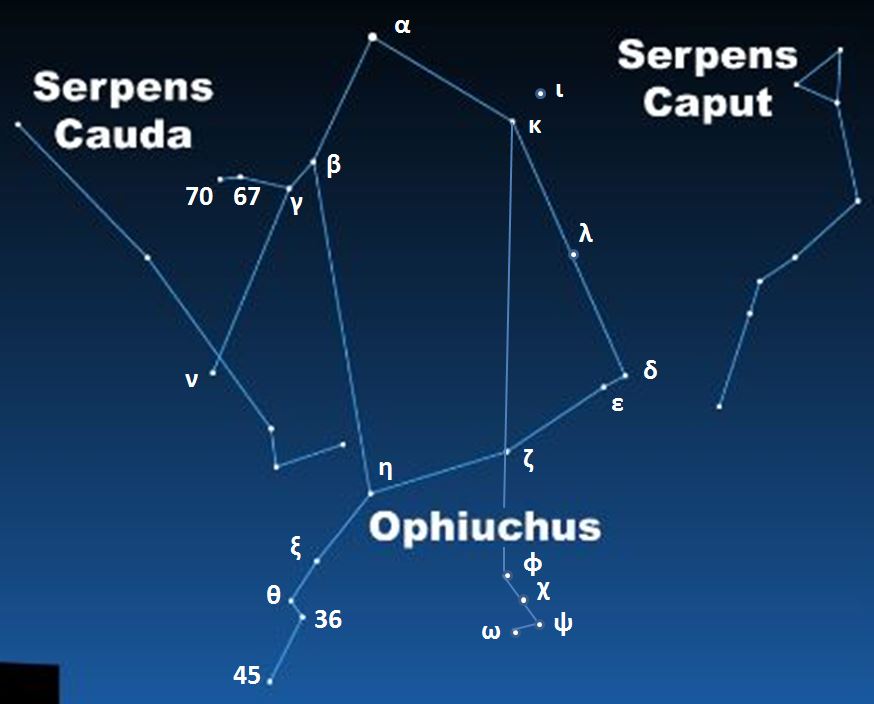
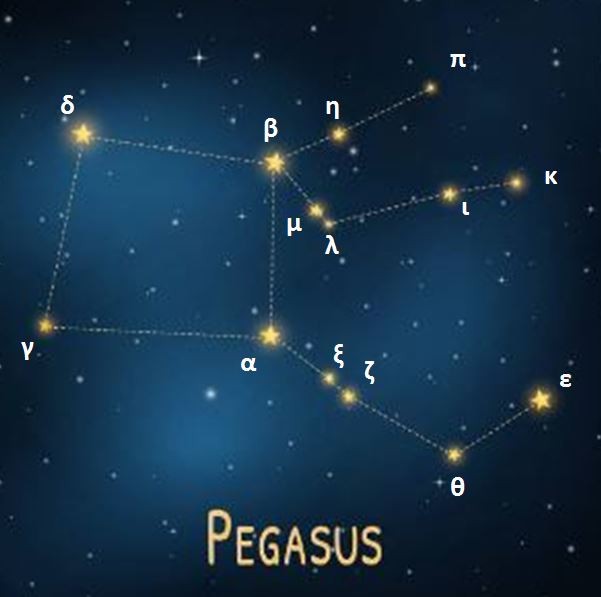
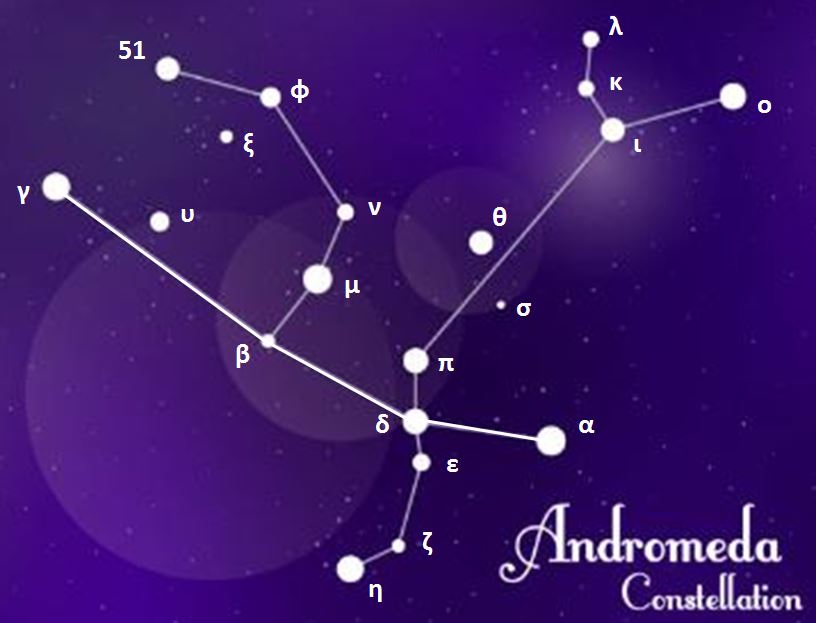
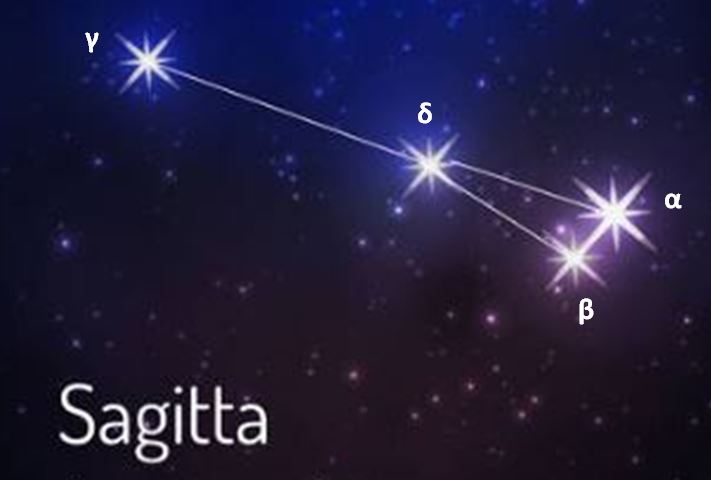
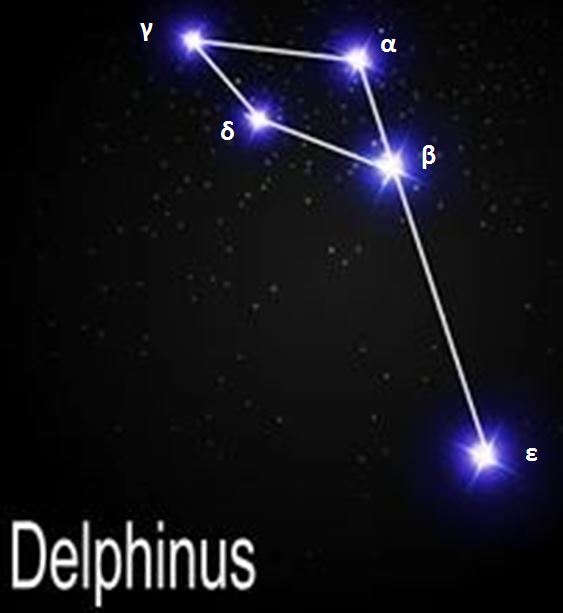
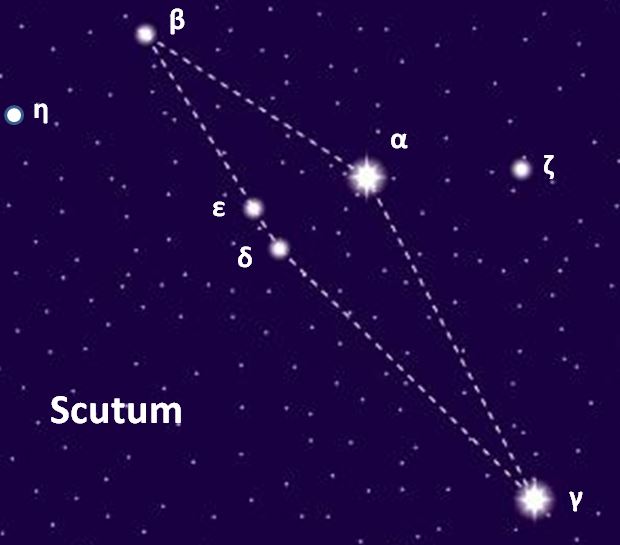
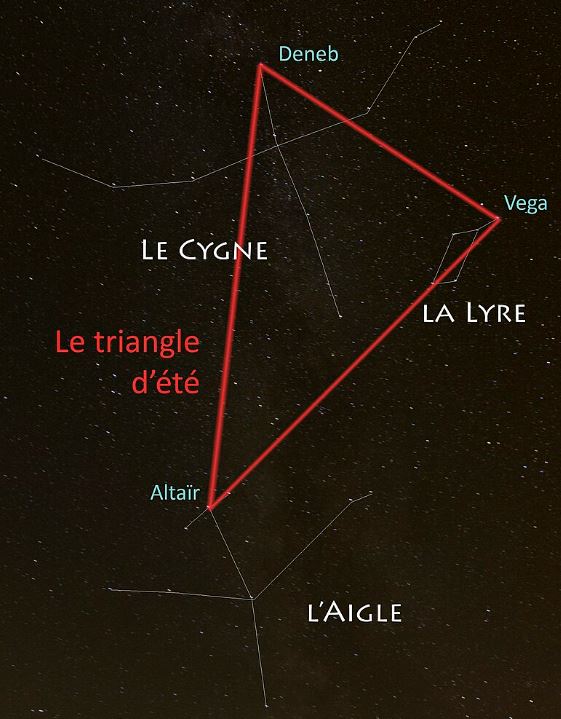
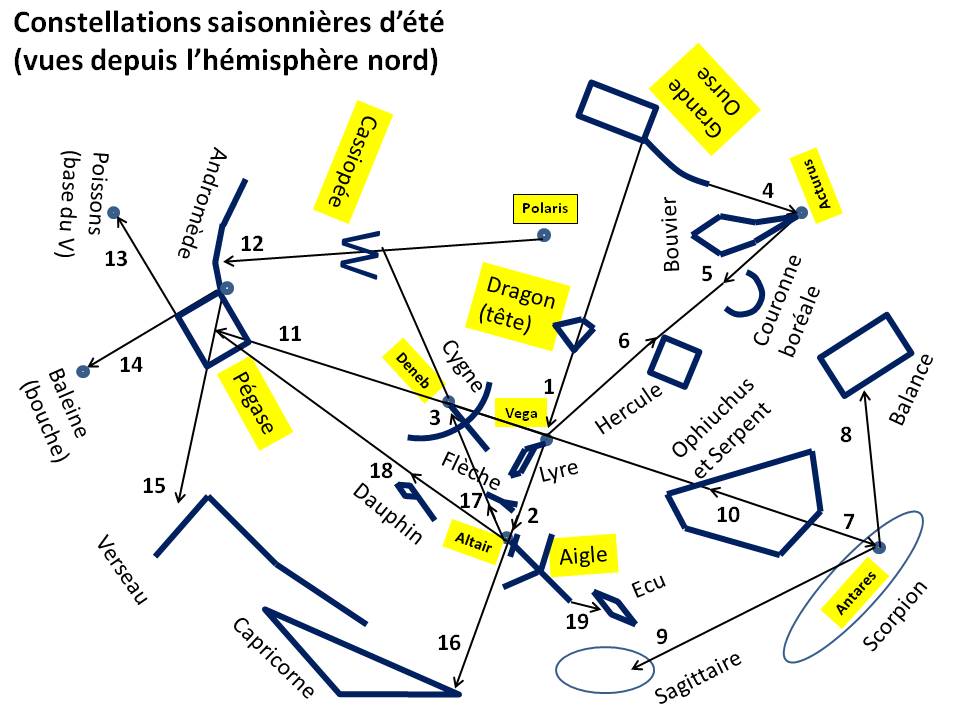
|
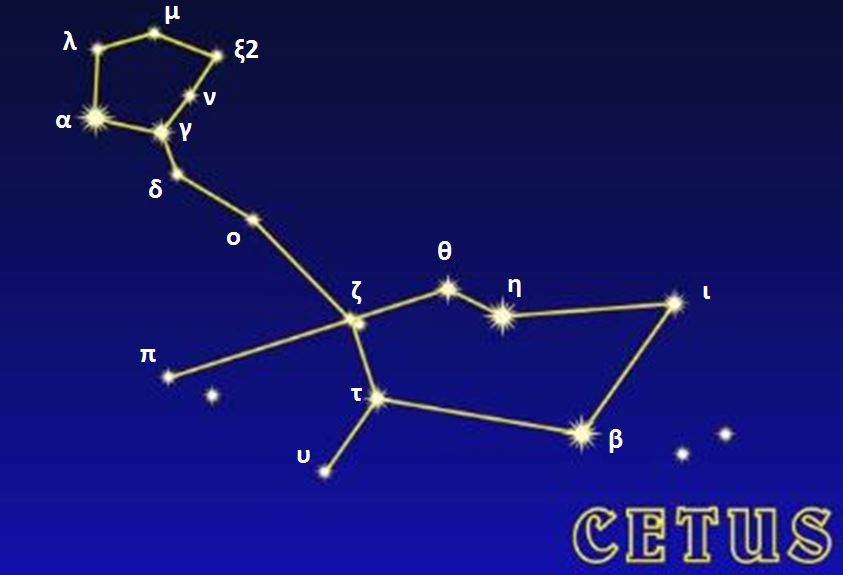
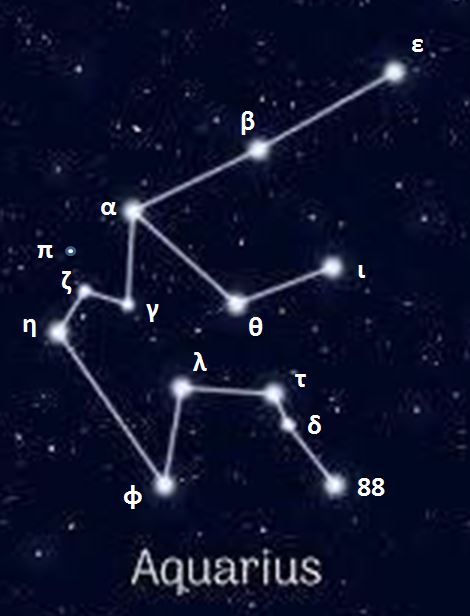
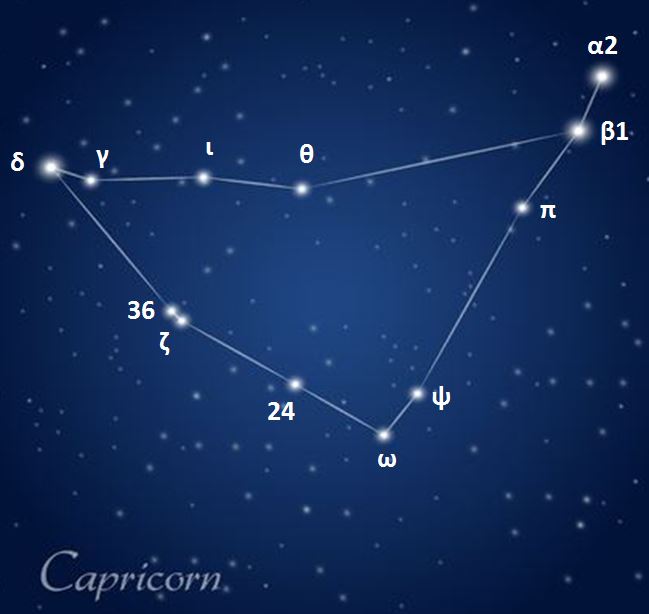
Synthesis : To find these constellations in the summer sky, the simplest method is the following [CHA][PER], by referring to the maps above : - Summer Triangle. - Map of July 25, 2025 at 00:00 for mainland France or latitudes from 40 to 55 N, with zenith at the center of the portion of visible sky [STE]. - Guide to locating summer seasonal constellations (in neutral representation). 0. Find the Summer Triangle located near the zenith around midnight in summer (July to September) : Quasi-equilateral triangle formed by three super-bright stars : Vega (Lyra), Altair (Eagle) and Deneb (Swan). The distance between each star is one width of an open hand. 1. Find the star Vega, a brightest star in the Summer Triangle, blue-white in color. Vega is located near the Dragon's head, on a line coming from the end of Great Bear's handle and passing through the Dragon's head. in line with and opposite the Great Bear. Find The Lyre : Small parallelogram of four stars including two bright ones (β, γ), connected to Vega (α) and extending this line from Vega. 2. Find the star Altair, a star of the Summer Triangle, flanked by two smaller stars (β and γ), located near Vega, one open hand width apart, on a line coming from the end of Great Bear's handle and passing through Vega. Find The Eagle : Large figure located to the left of this line when arriving at Altair (α), composed of a head (γ-α-β) centered on Altair, two straight wings (δ-ζ and δ-θ) turned towards the head, a linear body (α-δ-λ) and a tail (λ). 3. Find the star Deneb, a star of the Summer Triangle, located to the right of the line from Vega to Altair, and also halfway between Altair and Cassiopée. Find The Swan : Large cross composed of a tail (α, Deneb), a body (α-γ), two broken wings (γ-ε-ζ and γ-δ-ι) turned towards the tail, a long neck (γ-η-β) turned towards Altair, and a head (β). 4. Find the star Arcturus, a super-bright, orange star located in line with the handle of the Great Bear, one open hand width apart. Find The Herdsman : Group of seven bright stars in the shape of a kite, located to the right of this line before reaching Acturus (α). 5. Find The Northern Crown : Semicircle of seven stars including three bright ones (α, β, γ), located near Arcturus to the left of the line from Arcturus to Vega. 6. Find Hercules : Group of fourteen bright stars, four of which form a square (ε, ζ, π, η) located near Vega to the left of the line from Arcturus to Vega. 7. Find the star Antares, a super-bright, isolated, red star, located very low on the southern horizon, visible from May to August., on a line coming from Deneb and passing through Vega, three open hand widths apart from Vega. Find The Scorpion : Large S with nineteen bright stars surrounding Antares (α), the heart of the Scorpion, with its two small pincers (β1 - δ and ρ - π) located west of Antares (to the left of the line from Vega to Antares). 8. Find The Scales : Polygon with six bright stars, four of which form a rectangle (α2, β, γ, σ), located west of Antares (to the left of the line from Vega to Antares), one open hand width apart from Antares. 9. Find Sagittarius : Group of fifteen bright stars located east of Antares (to the right of the line from Vega to Antares), two open hand widths apart from Antares. 10a. Find Ophiuchus : Polygon of twelve bright stars, three of which form an irregular pentagon (α, β, η, ζ, δ) located halfway between Antares and Vega. 10b. Find The Serpent : Group of bright stars located on either side of Ophiuchus (six for The Serpent's Head forming a Y and one for The Serpent's Tail). 11. Find Pegasus : Group of eleven bright stars, four of which form a large empty square (α, β, γ, δ) located near Deneb, two open hand widths apart, on a line coming from Vega and passing through Deneb. 12. Find Andromeda : Group of eight bright stars touching Pegasus, four of which form a broken line located opposite Polaris from Cassiopeia. 13. Find The Fishes : Large V with three bright stars. Its base (α Piscium) is located in the extension of one of the sides of the large square of Pegasus as follows: 1. Identify the brightest star (δ) of the square, 2. Identify the corner (α) diagonally opposite, 3. Identify the next corner (γ) clockwise from α, 4. Extend the line α-γ over a distance equivalent to one open hand width. 14. Find The Whale : Polygon of six bright stars extended by a line of three other bright ones. The mouth (β) of the Whale, the brightest star, is located in the extension of one of the sides of the large square of Pegasus as follows : 1. Identify the brightest star (δ) of the square, 2. Identify the next corner (γ) counterclockwise from δ, 4. Extend the line δ-γ over a distance equivalent to one open hand width. 15. Find The Water Bearer : Group of eight bright stars, four of which form a broken line (δ, α, β, ε) located in the extension of a diagonal of the great square of Pegasus as follows : 1. Identify the brightest star (δ) of the square, 2. Identify the diagonally opposite corner (α), 3. Extend the line δ-α over a distance equivalent to one open hand width. 16. Find The Sea Goat : Flattened triangle with eight bright stars, located opposite Vega from Altair. 17. Find The Arrow : Arrow with four stars including two bright ones (γ, δ), located near Altair to the right of the line from Altair to Deneb. 18. Find The Dolphin : Small diamond with five stars including two bright ones (α, β), extended by a tail (ε) and located near Altair to the left of the line from Altair to Pegasus. 19. Find The Shield : Small elongated diamond with four stars including a bright one (α), located near the Eagle's tail (λ). |
C4.5. Winter seasonal constellations :
The seasonal constellations visible from Metropolitan France during the extended winter (November to April) are the following (see Figures below [IST][LES]) :
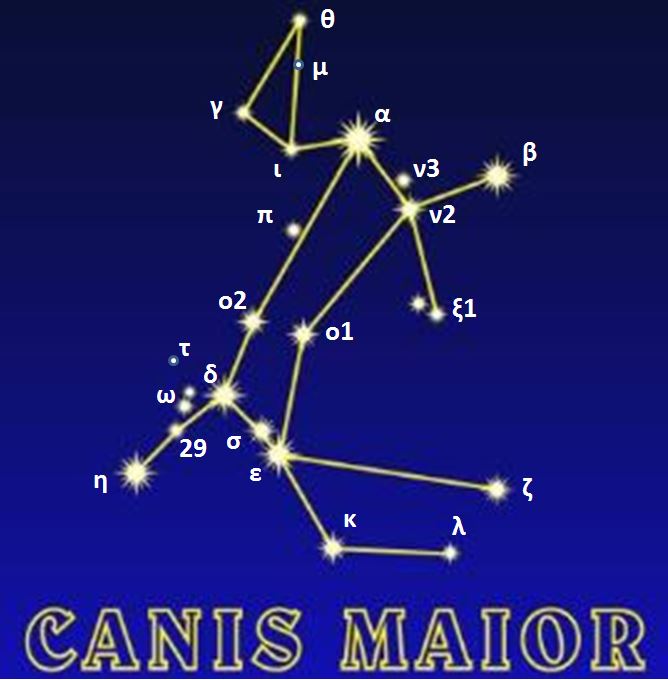
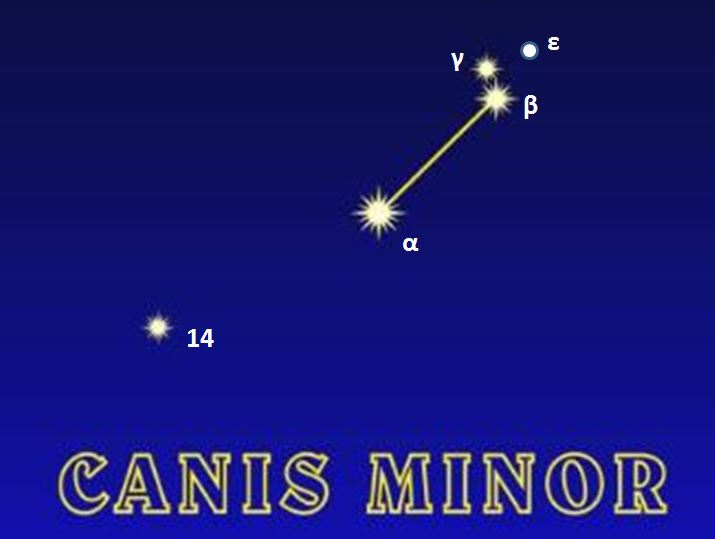
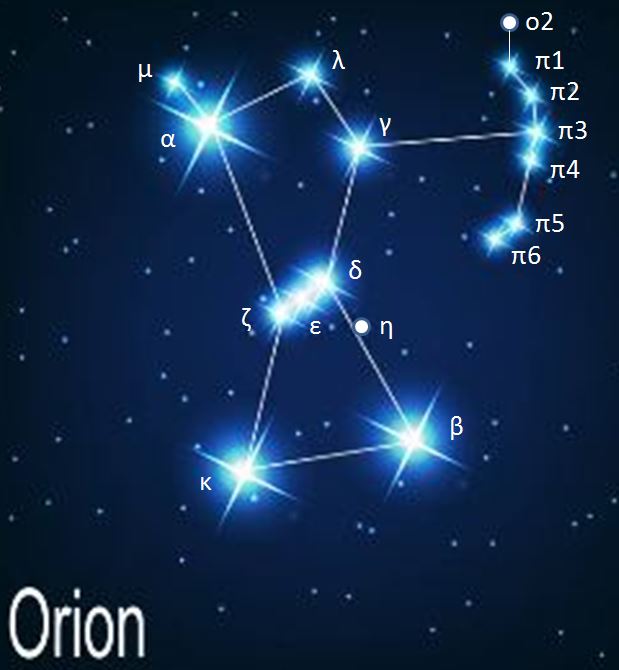
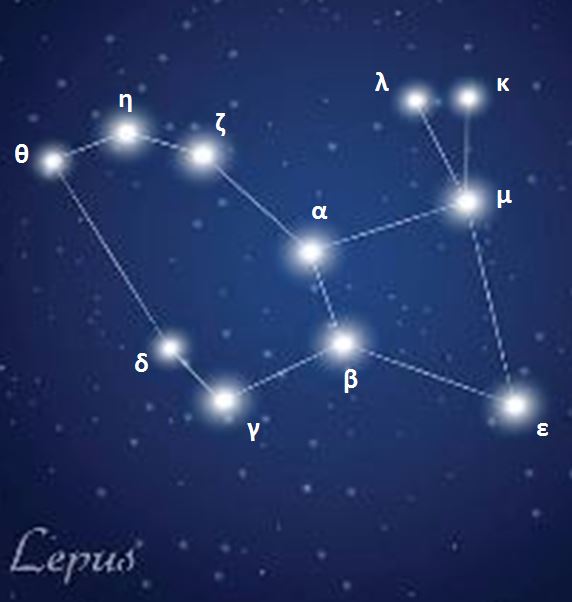

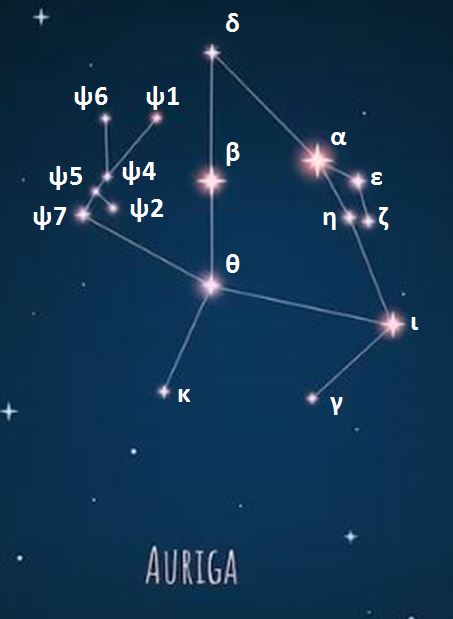
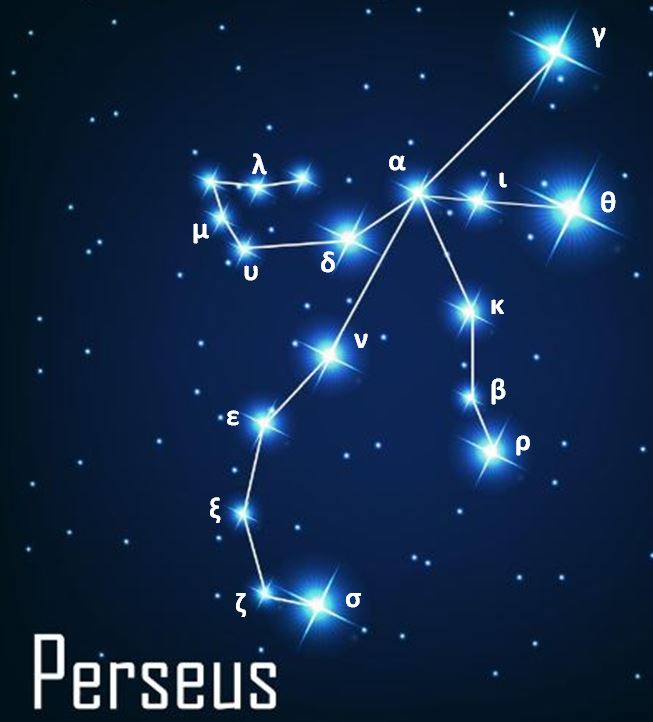
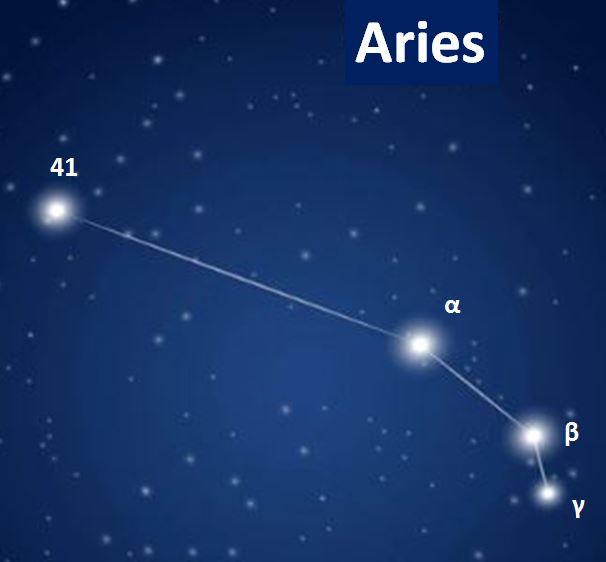
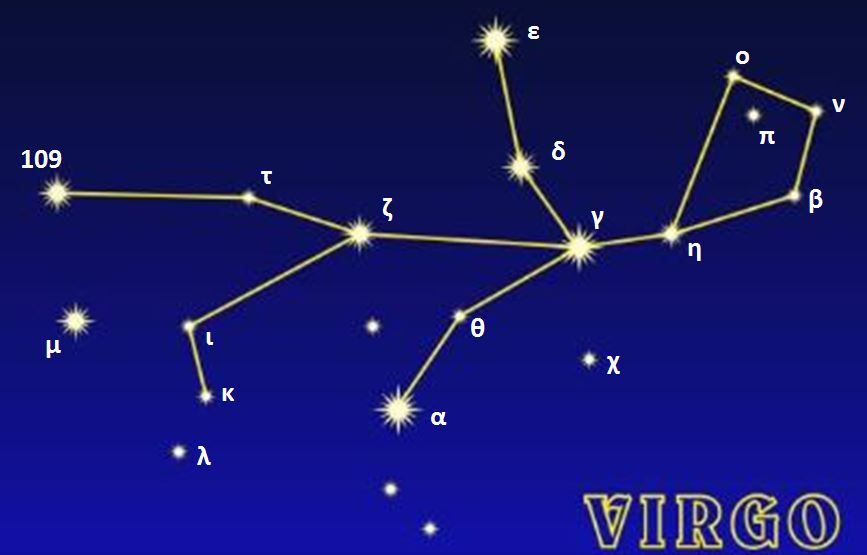
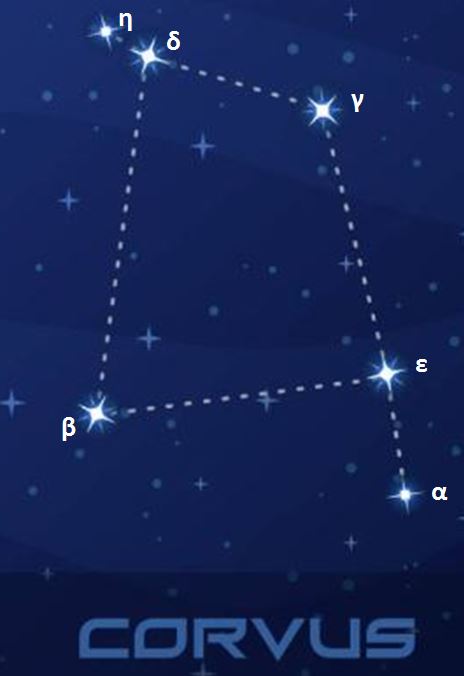
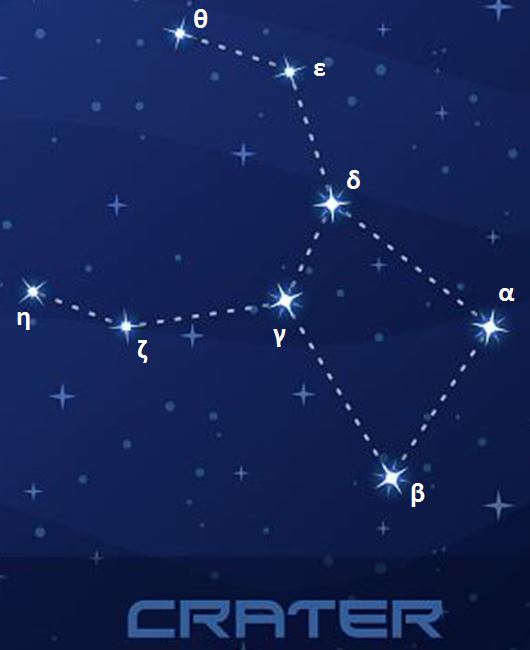
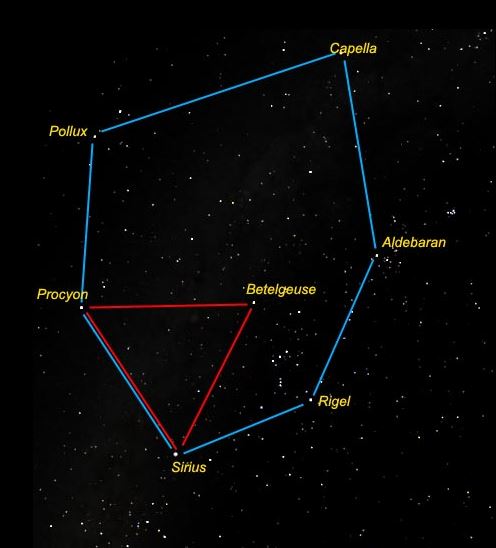
|
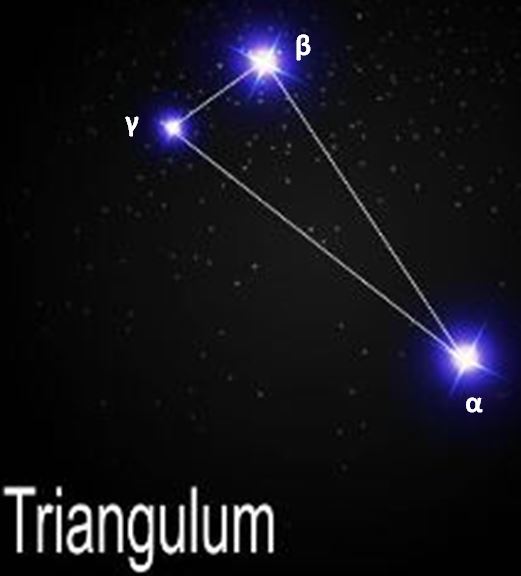
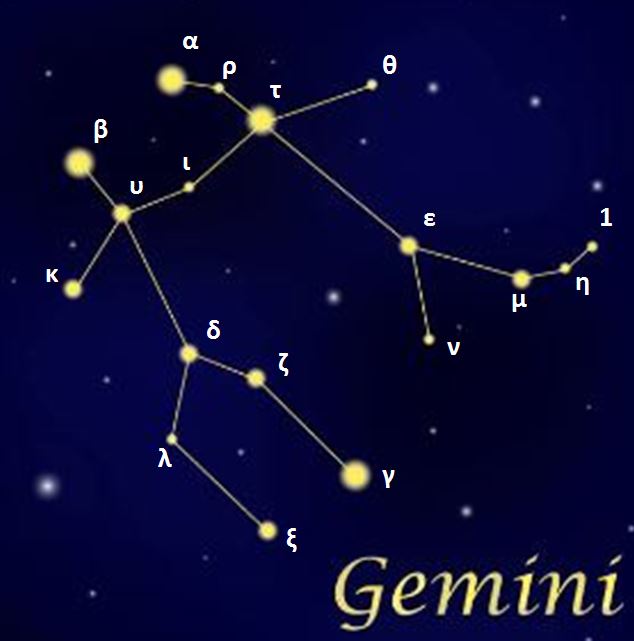
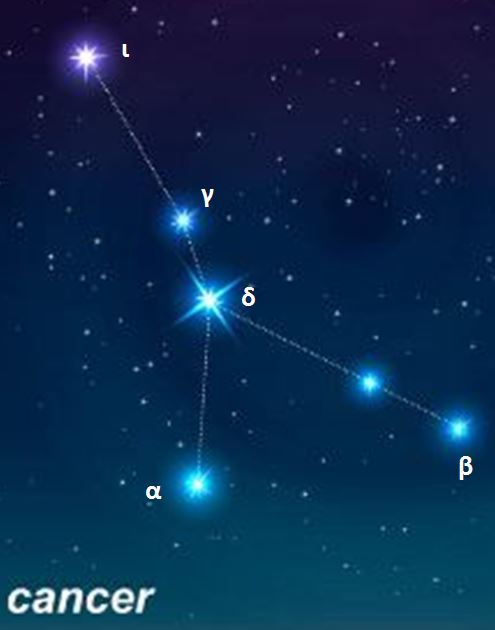
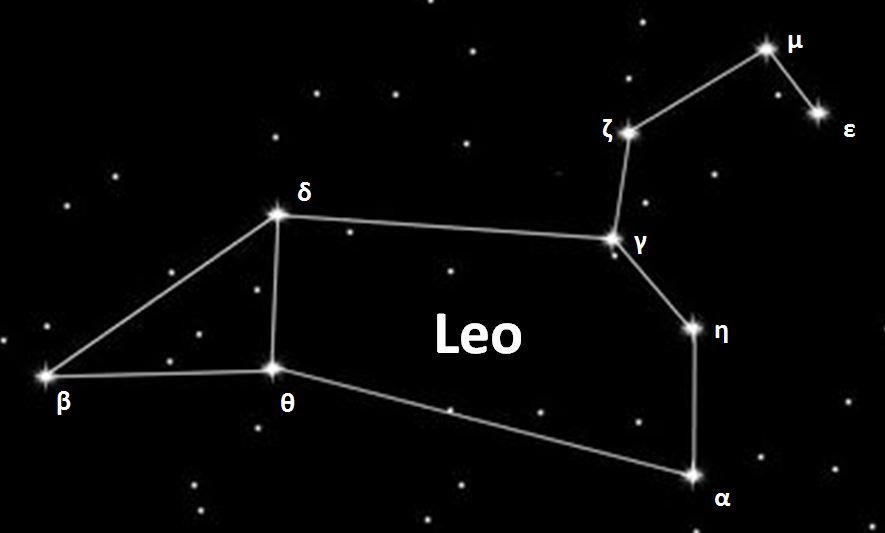
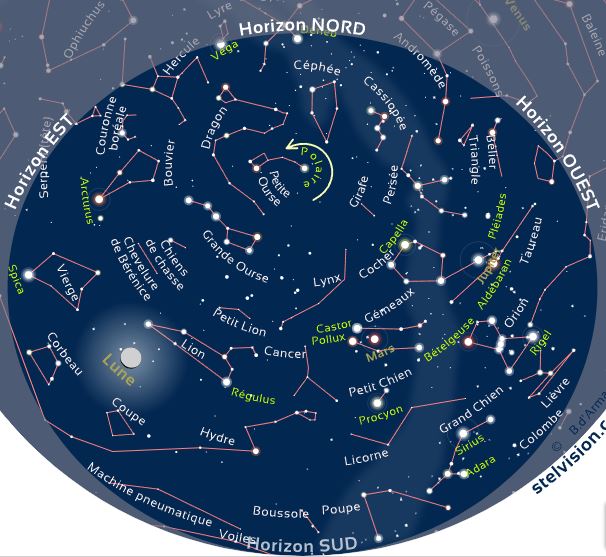
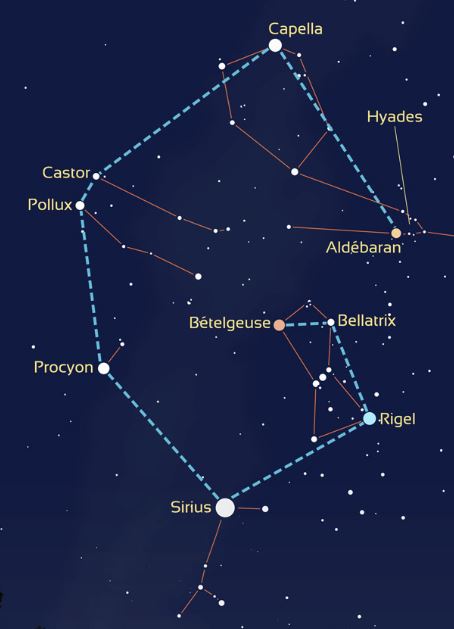
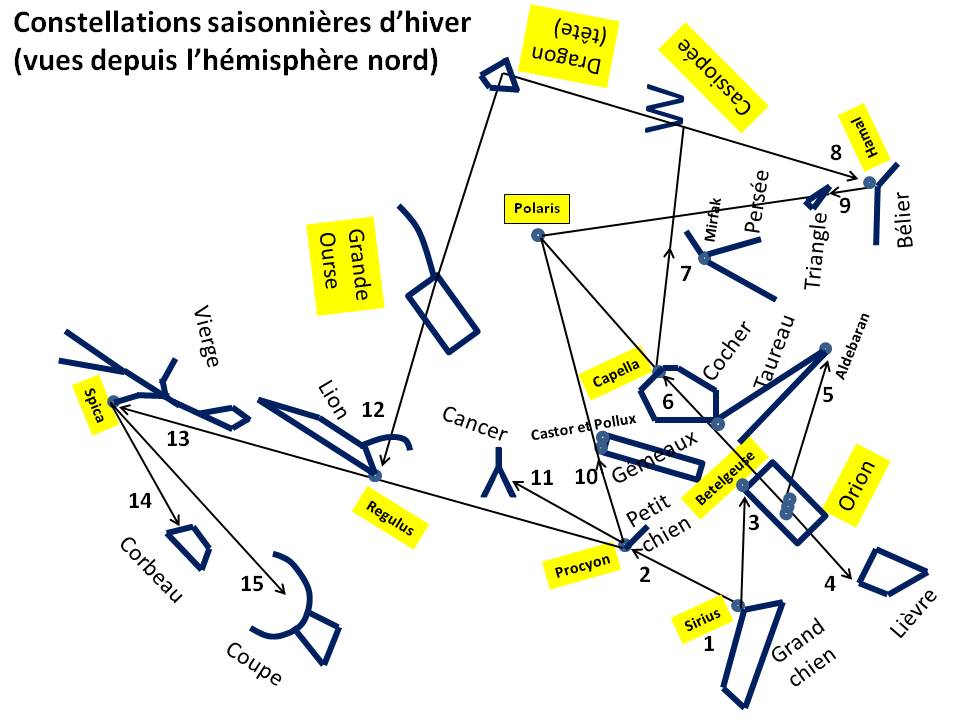
Synthesis : To find these constellations in the winter sky, the simplest method is the following [CHA][PER], by referring to the maps above : - Winter triangle and Winter hexagon. - Map of February 14, 2025 at 00:00 for mainland France or latitudes from 40 to 55 N, with zenith at the center of the portion of visible sky [STE]. - The "Big G". - Guide to locating winter seasonal constellations (in neutral representation). 0. Find the Winter Triangle located low above the southern horizon around midnight in winter (December to February) : Quasi-equilateral triangle, almost empty of stars, formed by three super-bright stars : Sirius (Canis Major), Procyon (Canis Minor) and Betelgeuse (Orion). The distance between each star is one width of an open hand. 1. Find the star Sirius, a brightest and lowest star in the Winter Triangle, blue-white in color. Find The Canis Major : Trapezoid of four bright stars (α, β, ε, δ) including Sirius (α) and extending the Polaris-Sirius line from Sirius (α). 2. Find the star Procyon, an easternmost star of the Winter Triangle (to the right of the line from Polaris to Sirius), white in color. Find The Canis Minor : Group of two bright stars (α, β) including Procyon (α) and turned towards this line. 3. Find the star Betelgeuse, a westernmost star of the Winter Triangle (to the left of the line from Polaris to Sirius), red in color. Find Orion : Large rectangle (α, γ, β, κ) including Betelgeuse (α) and crossed in its center by a belt of three aligned stars (ζ, ε, δ). Important note : This unusual method of spotting (first Sirius, which is unmissable, then Orion) seems more suitable for beginner observers than the classic reverse method (first Orion, then Sirius). 4. Find The Hare : Trapezoid of four bright stars (α, β, ε, μ), located near Orion's belt, on a line coming from Polaris and passing through Orion's belt. 5. Find the star Aldebaran, a super-bright orange star located near Orion, on a line coming from Sirius and passing through Betelgeuse, one open hand width apart from Betelgeuse. Find The Bull : Large V with eleven bright stars, including Aldebaran (α), the eye of the Bull, located very close to the base of the V. 6. Find the star Capella, a super-bright yellow star located halfway between Orion's belt and Polaris. Find The Charioteer : Hexagon of six bright stars (α, β, θ, γ, ι, ε) including Capella (α), touching Taurus and turned towards Orion. 7. Find the star Mirfak, a super-bright white star located halfway between Capella and Cassiopeia. Find Perseus : Large Y with three branches (α-β, α-γ and α-δ-ε-ζ) centered on Mirfak (α). 8. Find the star Hamal, a bright star located opposite Dragon's head from Cassiopeia. Find The Ram : Broken line of three bright stars (β, α, 41), including Hamal (α). 9. Find the Triangle : Elongated triangle of three bright stars, located near Hamal between Hamal and Polaris. 10. Find the stars Castor and Pollux, two super-bright close stars (Castor, white, and Pollux, orange), located near Procyon between Procyon and Polaris. Find The Twins : Group of eleven bright stars including Castor (α) and Pollux (β), forming a large elongated rectangle (α, β, γ, μ) turned towards Orion. 11. Find The Crab : Large Y with four bright stars, located opposite Sirius from Procyon. 12. Find the star Regulus, a super-bright blue star, located to the left of the line coming from Sirius and passing through Procyon, two open hand widths apart from Procyon, and also located opposite the Dragon's head from the center of the Great Bear (attachment point of the dipper handle). Find The lion : Group of nine bright stars forming a flattened trapezoid of four stars (α, β, δ, γ) including Regulus (α) and extended by a head (ε) and a mane (ε, μ, ζ, γ). 13. Find the star Spica, a super-bright blue star located low in the sky, on a line coming from Sirius and passing through Procyon, five open hand widths apart from Procyon. Find The Virgin : Group of nine bright stars, including Spica (α). 14. Find The Crow : Polygon of five stars including four bright ones (β, δ, γ, ε), located low in the sky, west of Spica (to the left of the line from Sirius to Spica), one open hand width apart from Spica. 15. Find The Cup : Polygon of four stars, including one bright star (δ), located low in the sky, west of Spica (to the left of the line from Sirius to Spica), two open hand widths apart from Spica. Notice the Winter Hexagon near the zenith around midnight in winter (December to February) : Symmetrical hexagon with six super-bright stars : Sirius (Canis Major), Procyon (Canis Minor), Pollux (The Twins), Capella (The Charioteer), Aldebaran (The Bull), Rigel (Orion). Notice the "Big G" near the zenith around midnight in winter (December to February) : Big G with nine super-bright stars : Betelgeuse, Bellatrix and Rigel (Orion), Sirius (Canis Major), Procyon (Canis Minor), Pollux and Castor (The Twins), Capella (The Charioteer), Aldebaran (The Bull). |
C4.6. Other constellations :
Other constellations are the following :
12 constellations that are difficult to see with the naked eye :
* Constellations too close to the horizon :
- The Dove (Columba, Col)
- The River (Eridanus, Eri)
- The Southern Fish (Piscis Austrinus, PsA)
- The Water Snake (Hydra, Hya)
* Constellations too faint in brightness (no star with a magnitude less than 4.0) :
- The Berenices's Hair (Coma Berenices, Com)
- The Little Fox (Vulpecula, Vul)
- The Lesser Lion (Leo Minor, LMi)
- The Lizard (Lacerta, Lac)
- The Sextant (Sextans, Sex)
* Constellations drowned in star-dense regions :
- The Hunting Dogs (Canes Venatici, CVn)
- The Little Horse (Equuleus, Equ)
- The Unicorn (Monoceros, Mon)
34 constellations not visible from Metropolitan France :
- The Air Pump (Antlia, Ant)
- The Altar (Ara, Ara)
- The Bird of Paradise (Apus, Aps)
- The Centaur (Centaurus, Cen)
- The Chameleon (Chamaeleon, Cha)
- The Chisel (Caelum, Cae)
- The Clock (Horologium, Hor)
- The Compass (Pyxis, Pyx)
- The Crane (Grus, Gru)
- The Drafting Compass (Circinus, Cir)
- The Fly (Musca, Mus)
- The Flying Fish (Volans, Vol)
- The Furnace (Fornax, For)
- The Goldfish (Dorado, Dor)
- The Indian (Indus, Ind)
- The Keel (Carina, Car)
- The Male Water Snake (Hydrus, Hyi)
- The Microscope (Microscopium, Mic)
- The Octant (Octans, Oct)
- The Painter (Pictor, Pic)
- The Peacock (Pavo, Pav)
- The Phoenix (Phoenix, Phe)
- The Reticle (Reticulum, Ret)
- The Sails (Vela, Vel)
- The Sculptor (Sculptor, Scl)
- The Southern Cross (Crux, Cru)
- The Southern Crown (Corona Australis, CrA)
- The Southern Triangle (Triangulum Australe, TrA)
- The Square (Norma, Nor)
- The Stern (Puppis, Pup)
- The Table Mountain (Mensa, Men)
- The Telescope (Telescopium, Tel)
- The Toucan (Tucana, Tuc)
- The Wolf (Lupus, Lup)
C4.7. Zodiacal constellations :
The astronomical zodiac is a band in the sky that extends about 8 on either side of the ecliptic.
It includes thirteen official constellations, which are the only ones that the Sun obscures during its annual path, as seen from Earth.
The astrological zodiac takes the names and the succession of the constellations of the astronomical zodiac, but is limited to twelve signs excluding Ophiuchus, in order to symbolically divide the ecliptic into twelve equal parts.
The vernal point (spring equinox) once marked the Sun's entry into the constellation of Aries, which justified its status as the first sign of the zodiac. But today, due to the precession of the equinoxes, this point is located in the constellation of Fishes.
The constellations of zodiac are as follows, listed in the order in which the Sun passes through them :
Their visibility from the northern hemisphere is as follows :
* Constellations visible all year round : none.
* Summer seasonal constellations (May to October) : The Scales, The Scorpion, Ophiuchus, Sagittarius, The Sea Goat, The Water Bearer, The Fishes.
* Winter seasonal constellations (November to April) : The Ram, The Bull, The Twins, The Crab, The Lion, The Virgin.
C4.8.
Tips for good observation :
To properly observe the stars, constellations, planets and satellites in the sky, it is advisable to [CHA][PER] :
C4.9. Coordinates, color and magnitude of a celestial body :
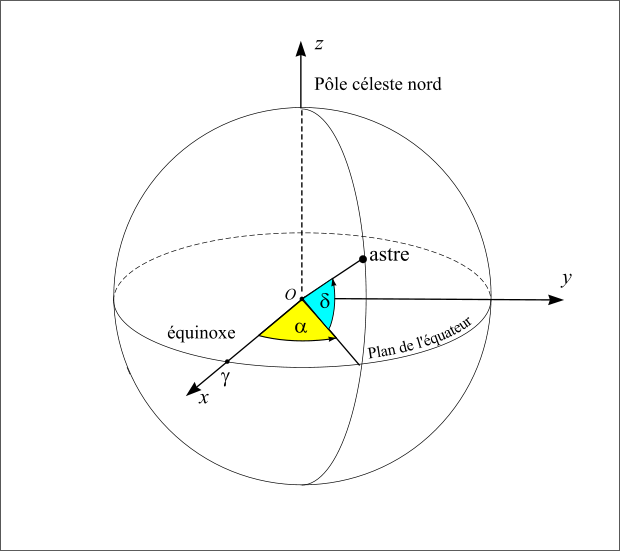
The coordinates of a celestial body are generally the equatorial coordinates (α and δ) defined as follows (see Figure above) :
- Celestial sphere : Imaginary sphere of infinite radius, centered on the Earth, onto which all celestial bodies observed from Earth are projected.
- Celestial equator : Imaginary great circle drawn on the celestial sphere, corresponding to the projection of the Earth's equator onto this sphere.
- Vernal point (γ) : Point of intersection of the celestial equator and the ecliptic at the time of the vernal equinox in the northern hemisphere.
- Right ascension (α) : Hour angle measured along the celestial equator, eastward from the vernal point, between the meridian passing through this point and the meridian passing through the celestial body. It is expressed in hours, from 0 to 24 h, with the following correspondence: 1 h = 15 . Right ascension is the celestial analog of terrestrial longitude.
- Declination (δ) : Angle measuring the distance of a celestial body from the celestial equator. It is expressed in degrees, from -90 (south celestial pole) to +90 (north celestial pole). Declination is the celestial analog of terrestrial latitude.
Example for the star Vega [IAU2] : α = 18 h 36 min 56.345 s (or 279.234735 ), δ = +38 47' 01.28" (or +38.783689 ).
The angular distance (d) separating two celestial bodies in the sky, measured from Earth, is given by the following spherical trigonometry formula :
cos(d) = sin(δ1) sin(δ2) + cos(δ1) cos(δ2) cos(α1 - α2)
where α1 and α2 are the right ascensions of the two celestial bodies, δ1 and δ2 their declinations.
The apparent color of celestial bodies (seen with the naked eye) depends mainly on their surface temperature according to the following simplified classification :
- Blue : Very hot celestial bodies ( > 10 000 K approximately), such as Spica.
- White : Hot celestial bodies (from 6 000 to 10 000 K approximately), such as Sirius.
-
Yellow : celestial bodies of average temperature (from 5 200 to 6 000 K approximately), such as the Sun.
- Orange : Cold celestial bodies (from 3 700 to 5 200 K approximately), such as Aldebaran.
- Red : Very cold celestial bodies ( < 3 700 K approximately), such as Betelgeuse.
However, factors significantly influence the apparent color :
- Brightness (whitish effect for very bright celestial bodies)
-
Earth's atmosphere (reddish effect near the horizon due to the light diffusion in the air)
-
Interstellar dust (accentuation of red by absorption of short wavelengths (blue))
- Interstellar gas clouds (absorption and diffusion of certain wavelengths depending on their composition)
- Sensitivity of the human eye (attenuation of blue and red in the dark)
Warning : Contrary to popular belief (red = hot, and blue = cold), the further you go from red to blue, the higher the star surface temperature.
The apparent magnitude (M) of a celestial body corresponds to its brightness state as perceived from Earth :
M = -2.5 log10[F/F0]
with :
F = luminous flux received from the celestial body (in W/m2)
F0 = reference luminous flux corresponding to M = 0 (historically that of Vega, before the current more precise measurements).
M is a standardized measure that takes into account four factors :
- Intrinsic luminosity of the celestial body. It corresponds to the total power of light (L in Watt) emitted at its surface, then diffused uniformly in all directions across a spherical surface of increasing radius r.
- Distance between the celestial body and the Earth. The apparent luminosity (I in W/m2), perceived at the distance r from the celestial body, decreases in fact according to the inverse square law : I = L/(4 π r2).
- Extinction (absorption and diffusion of light by the Earth's atmosphere, interstellar dust and gas clouds between the celestial body and the Earth)
- Sensitivity of the human eye (which perceives the apparent luminosity according to an inverse logarithmic scale)
Warning : The lower the numerical value (M) of the apparent magnitude, the brighter the celestial body.
C4.10. Sources relative to constellations :
[CHA] ChatGPT, le moteur d'Intelligence Artificielle développé par OpenAI.
[DAR] Découvrir le ciel à l'oeil nu, Bertrand D'Armagnac et Carine Souplet, Stelvision.
[IAU1] IAU, Les constellations.
[IAU2] IAU, Comment sont nommées les étoiles ? or Current List of IAU Star Names.
[IMA] Imago Mundi, Les 88 constellations.
[IST] iStock, Constellations.
[LES] Les Astronautes, Comment reconnaître les constellations dans le ciel ?.
[PER] Perplexity, le moteur d'Intelligence Artificielle développé par Perplexity AI.
[STE] Stelvision, Carte du ciel du jour (pour France métropolitaine ou latitudes de 40 à 55 N, avec zénith au centre de la portion de ciel visible).
The Moon exerts a subtle but real influence on life on Earth. Through its cycles and gravitational pull, it regulates the tides, guides certain animal behaviors, and appears to affect plant growth. In humans, its effects are more difficult to demonstrate with certainty.
C8.1. The Moon's influence on animals :
In animals, the Moon influences their behavior primarily through the increased brightness of a full moon. This nighttime light notably alters hunting and reproductive cycles.
Predators such as cats and owls hunt more effectively thanks to the enhanced light, while prey like rodents and insects reduce their movements to minimize the risk of being detected.
In the marine environment, many species synchronize their reproduction with lunar cycles, influenced by both light intensity and tides.
Domestic animals are sometimes more restless on full moon nights, likely due to this unusual brightness.
C8.2. The Moon's influence on humans :
In humans, the Moon's influence on sleep, mood, births, and behavior is the subject of studies that are often contradictory or inconclusive.
However, the perceived effect of the Moon could stem from a psychological phenomenon : people tend to remember unusual events more readily when they coincide with a full moon, while forgetting periods without any notable events.
C8.3. The Moon's influence on plants :
The Moon's influence on plant growth has always been a subject of lively debate between scientists and biodynamic practitioners.
According to the biodynamic approach, inherited from the work of Rudolf Steiner, solar and lunar cycles, as well as other cosmic rhythms, are the expression of cosmic forces including the Moon, the Sun, and the planets. Sap rises in plants during the waxing moon, which promotes the growth of aerial parts such as leaves and flowers, a favorable period for sowing and harvesting. Conversely, sap descends towards the roots during the waning moon, a favorable period for pruning, dividing, taking cuttings, and harvesting root vegetables.
Biodynamic practitioners also believe that the Moon's position relative to the zodiacal constellations has a specific influence on plant growth. For example, when the Moon is in front of the constellation Virgo (earth element), this period is said to particularly favor root growth, while in Libra (air element), it is thought to favor flower growth.
Conversely, according to the scientific approach, the influence of the lunar phase on plant growth has never been established in a robust, clear, and reproducible manner.
While lunar gravitational forces explain Earth's large ocean tides, they are too weak to have a significant effect on individual plants.
Furthermore, the intensity of moonlight, resulting from the reflection of solar radiation, is insufficient to influence photosynthesis and other essential biological processes.
On the other hand, it is proven that biodynamic practices have beneficial effects on soil quality and biodiversity, but these effects are attributed primarily to agricultural practices and not to the direct influences of lunar or cosmic forces claimed by biodynamics.
Thus, According to modern science, even if a lunar influence exists, it is marginal compared to other agronomic factors that influence crop management.
The key conditions for success, recognized and validated by agronomic research, are primarily linked to the following fundamental factors :
1. Quality of plant propagation material (seeds, seedlings, bulbs, cuttings) :
- Material from reliable sources (healthy and vigorous, free from diseases and pests)
- Variety adapted to the local climate, soil pH, and exposure (sunny or shaded)
2. Soil type :
- Soil drainage to prevent waterlogging around roots
- Soil enrichment with humus (manure, compost) and minerals (lime, sand, clay)
- Crop rotation to prevent disease and soil depletion
- Tilling without disturbing the soil structure to maintain its biological activity
3. Protection against climatic hazards :
- Windbreaks (hedges, nets, tunnels, greenhouses)
- Frost protection (winter fleece, thick mulch, cloches)
- Drought protection (organic mulch, appropriate watering)
4. Agricultural practices :
- Respect for planting depth and Plant spacing
- Watering at the right time and without overwatering
- Regular weeding
- Mulching to retain moisture and limit weeds
- Enriching the plant with fertilizer (nitrogen, phosphate, potassium)
- Monitoring and phytosanitary treatment
5. Planting periods :
- Season suited to each variety
- Taking into account the upcoming weather conditions
- Lunar phase, whose influence, if any, remains very marginal compared to other influences
C8.4. The dictons :
Listed below are the main sayings with a known scientific explanation.
Moon and Tides :
- The Moon rules the tides,
- When the Moon smiles, the water smiles too : The tides are directly caused by the gravitational pull of the Moon (and the Sun). And when the Moon is full or new, the Earth, Moon, and Sun are aligned (spring tides).
Moon and Animals :
- A full moon makes dogs howl and roosters stay awake,
- When the Moon is full, animals are in distress,
- A bright moon makes wolves angry,
- When the Moon is round, dogs howl at its crescent,
- A red moon makes animals and plants suffer : Nocturnal animals (wolves, dogs, birds) react to the light.
Moon and Humans :
- He who sleeps during the full moon dreams of misfortune,
- Full moon keeps everyone awake,
- Children sleep poorly during the full moon,
- Bright moon makes the heart alert : Some people sleep less deeply and for shorter periods during the full moon.
- Bright moon, prosperous love : Moonlight stimulates nighttime activity and social outings.
Moon and Plants :
- Waxing moon, rising sap,
- When the moon is waxing, everything grows,
- Waning moon, growing roots,
- When the moon is waning, everything shrinks : Lunar phases whose influence, if it exists, remains very marginal compared to other influences.
- Red moon, nothing grows,
- Red moon burns young shoots,
- Red moon makes animals and seedlings suffer : The period after Easter during which clear nights lead to heat loss through radiation, making frost possible.
Moon and Weather :
See Weather - The dictons
 Last page update : September 2, 2026.